The United States Demands the Truth Behind the Death of Jimmy Gracey During Spring Break in Spain: The Final CCTV Footage Reveals All, and Police Erred in Declaring It a Mere Tragic Accident
A Tragic End in Barcelona: The Disappearance and Death of Jimmy Gracey
The vibrant neon lights of Barcelona’s Port Olímpic, a hub of world-renowned nightlife, were darkened this week by a tragedy that has resonated from the shores of the Mediterranean to the campus of the University of Alabama. James “Jimmy” Gracey, a 20-year-old honors student from Elmhurst, Illinois, who traveled to Spain to visit friends during spring break, was found dead on Thursday. While local authorities have moved quickly to categorize the incident as a tragic accident, the circumstances surrounding his final hours have left his family, friends, and the public grappling with a haunting series of unanswered questions.
Jimmy Gracey was more than just a tourist; he was a leader in his community. A junior accounting major at the University of Alabama, Gracey served as the chaplain and philanthropy chairman for the Theta Chi fraternity. Described by his aunt, Beth Marren O’Reilly, as a “good Catholic boy from the Midwest” and a role model to his four younger siblings, Gracey was known for his responsibility and deep ties to his faith. His disappearance on March 17 was, in the words of his family, “completely out of character.”
The timeline of the tragedy began in the early hours of Tuesday. After arriving in Barcelona on Monday following a weekend in Amsterdam, Gracey went out with friends to Shoko, a high-end beachfront nightclub. At approximately 3:00 AM, he became separated from his group. When he failed to return to the Airbnb the group had rented on Ronda de Sant Pere, his friends and family immediately raised the alarm.
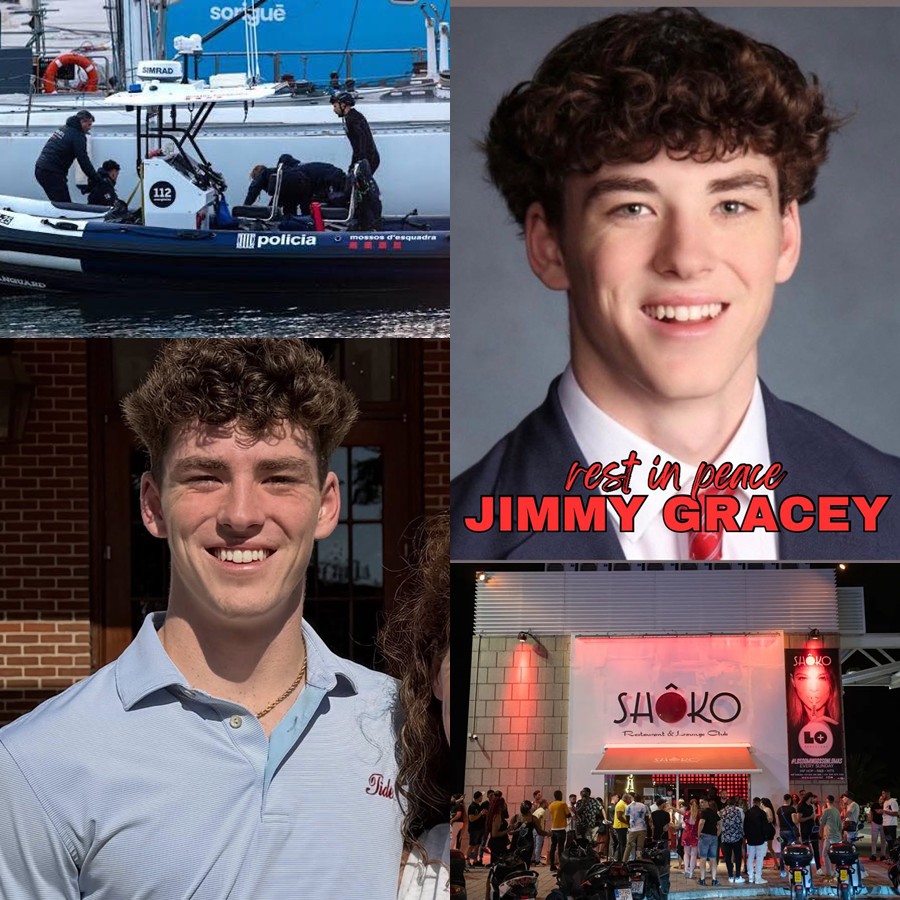
The search ended on Thursday evening when police divers recovered Gracey’s body from the shallow waters off Somorrostro Beach, just meters away from the Shoko nightclub where he was last seen. Almost immediately, a spokesperson for the Mossos d’Esquadra, Catalonia’s regional police, stated that “everything points to it being an accident, not a criminal act.” However, for those following the case closely, that conclusion feels premature given the complex evidence that surfaced during the 48-hour search.
One of the most significant points of contention involves Gracey’s cell phone. While his wallet was found discarded on the beach, his phone was recovered by police under much more suspicious circumstances. Reports indicate that the device was found in the possession of an individual who was subsequently arrested. This raises a pivotal question: how did this person obtain the phone? If it was stolen, was it a simple case of pickpocketing, or was there a confrontation? In a city like Barcelona, where petty theft is common, the loss of a phone is not unusual, but the timing—occurring exactly when a young man went missing and later drowned—suggests a potential link that many feel warrants deeper investigation.
Furthermore, early reports during the search suggested that police were investigating the possibility of foul play. These suspicions were bolstered by rumors of surveillance footage from the nightclub area. Some sources claimed the footage showed Gracey leaving the club or interacting with an “unknown person,” possibly an American female with brown hair. If Gracey was seen on CCTV with another individual, investigators must determine if he was being led away or if he was simply walking toward the shoreline of his own volition. If he left with someone, why was that person not seen with him later near the rocks where his body was eventually found?
The physical geography of the scene also presents a puzzle. Somorrostro Beach is a popular, well-lit stretch of sand, even in the early hours. If Gracey was sober—as those close to him suggest, noting he was not a heavy drinker—the idea of him accidentally falling into shallow water and drowning seems statistically unlikely for a fit, 6-foot-1 young man. Comparisons have been drawn to the recent case of Riley Strain in Nashville; however, in Strain’s case, there was clear evidence of extreme intoxication. In Gracey’s case, the toxicology results from the pending autopsy will be the only way to confirm his state of mind that night.
The shift in the police narrative from “foul play suspected” to “tragic accident” in such a short window of time has left a void of information. Was the person arrested with the phone questioned about Gracey’s whereabouts? Was there any signs of a struggle on the body? The Gracey family has expressed their intention to continue working with the U.S. Consulate and local authorities to “better understand this tragedy.” For now, the area remains cordoned off by forensic teams, and the University of Alabama community remains in mourning for a student who, by all accounts, had a brilliant future ahead of him. As the investigation continues, the hope remains that the “all signs point to an accident” conclusion is based on exhaustive evidence, rather than a desire to quickly close a high-profile case in a tourist-heavy city.