BEHIND 30,000 TEXT MESSAGES OF LOVE AND HATE: WAS MACKENZIE SHIRILLA MANIPULATED, OR WAS SHE “PLAYING THE VICTIM” BEFORE THE FATAL 100-MPH CRASH?
INTRODUCTION: THE DARK PRELUDE TO A 100-MPH TRAGEDY
On July 31, 2022, a horrific car crash in Strongsville, Ohio, claimed the lives of two young men, Dominic Russo and Davion Flanagan. The 2014 Toyota Camry, driven by 17-year-old Mackenzie Shirilla, slammed straight into a brick building at a blistering speed of over 100 mph with absolutely no evidence of braking. The case concluded with a life sentence for Mackenzie, branding her a “hell on wheels” killer in the eyes of the public.
However, the debate surrounding the motive and the true nature of this tragedy has never completely stopped. Recently, the release of recovered text messages from July 17, 2022—exactly two weeks before the crash—has triggered a new wave of shockwaves. Extracted from a pool of over 30,000 texts exchanged between the pair, these logs do not just expose a suffocatingly toxic relationship; they raise a troubling question regarding criminal psychology: Was Mackenzie Shirilla truly a terrified victim of abuse, or was she a master manipulator deliberately drafting a victim narrative to lay the groundwork for an ultimate act of violence?
1. THE JULY 17 TEXT EXCHANGES: A PSYCHOLOGICAL WAR AND DEADLY ACCUSATIONS
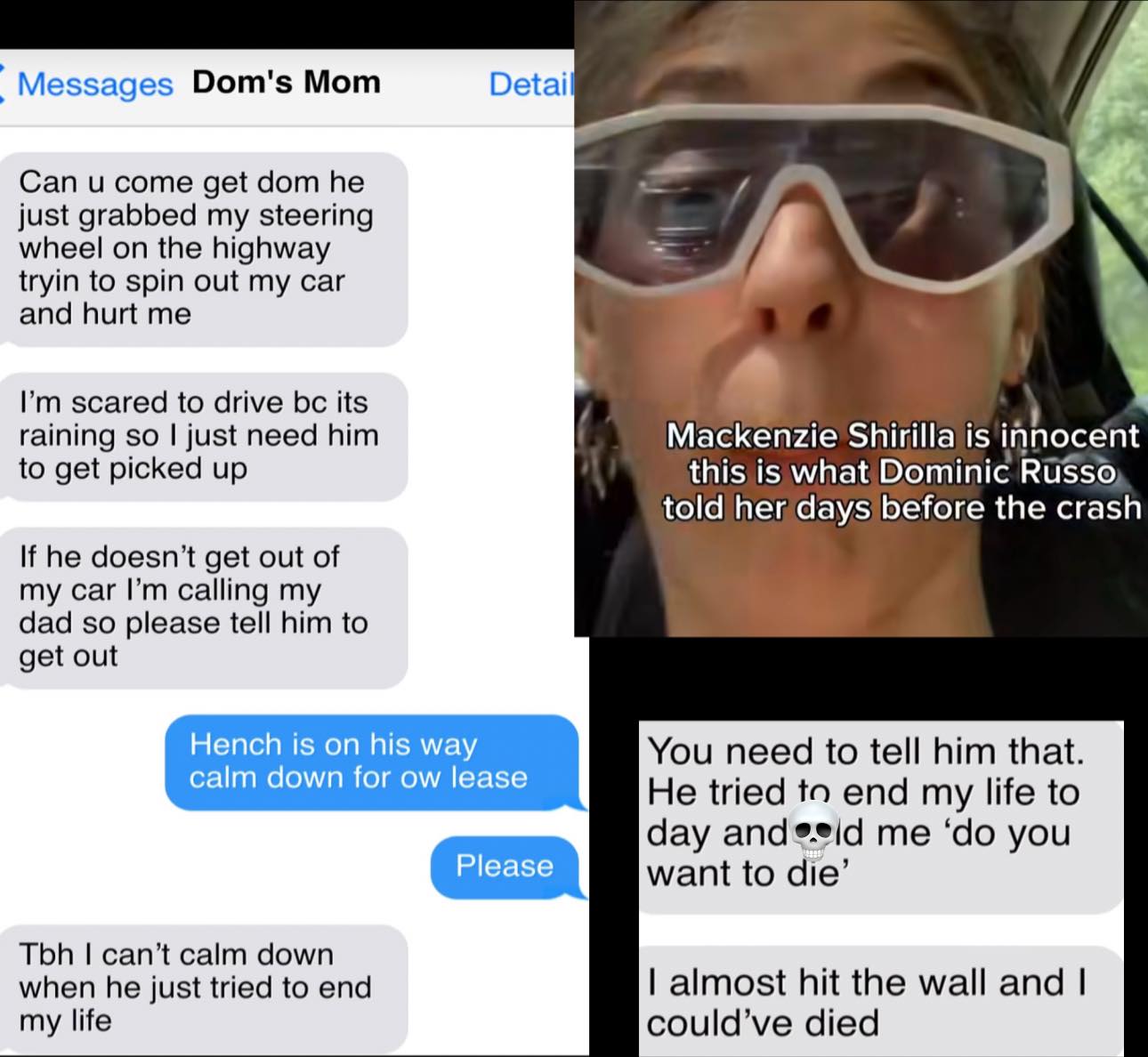
In the conversation threads leaked from July 17, readers cannot help but shudder at the extreme escalation of tension between Mackenzie and Dominic. Through every line of text, Mackenzie Shirilla continuously plays the role of the vulnerable, terrified girl whose life is actively being threatened.
She directly messaged Dominic’s mother in a state of sheer panic, claiming she no longer felt safe around Dom. In one exchange, Mackenzie accused Dominic of a violent outburst inside the vehicle: “He grabbed the steering wheel and tried to end my life.” Not stopping there, she also accused her boyfriend of attempting to blackmail her and ruin her reputation.
Yet, Dominic Russo’s response to these heavy accusations sheds light on a completely different perspective. Instead of reacting with rage or admission, Dominic fired back with a bitter truth well-understood between the two of them: “U threaten to end my life all the time.”
This dialogue was far from a simple teenage argument. It was a psychological battlefield where accusations of death and survival were thrown around recklessly, foreshadowing an irreversible end just two weeks later.
+--------------------------------------------------------------------------+
|                 THE CONTRAST IN THE COUPLE'S TEXTING STYLES              |
+--------------------------------------------------------------------------+
| ATTRIBUTE                   | MACKENZIE SHIRILLA     | DOMINIC RUSSO     |
+-----------------------------+------------------------+-------------------+
| Length and Frequency        | Much longer, constant, | Noticeably short, |
|                             | emotional, and clingy  | brief, abrupt     |
+-----------------------------+------------------------+-------------------+
| Emotional State             | Highly dramatic,       | Attempting to     |
|                             | escalating, victimhood | de-escalate       |
+-----------------------------+------------------------+-------------------+
| Behavioral Tendency         | Mental manipulation,   | Enduring, weak    |
|                             | suicide threats        | counter-responses |
+-----------------------------+------------------------+-------------------+
2. ANALYZING 30,000 TEXTS: THE PORTRAIT OF A MANIC CONTROLLER
As investigators and behavioral psychologists dissected over 30,000 texts spanning the timeline of their relationship, a profoundly deviant behavioral pattern emerged. Contrary to the image of a helpless, abused girl that Mackenzie attempted to project on July 17, the digital data proves she was the one exhibiting a morbidly controlling and possessive grip.
Observers have noted that the vast majority of Mackenzie’s messages were incredibly lengthy, flooded with extreme emotion, and noticeably clingy. She would fire off dozens of consecutive texts simply to cross-examine Dominic on his location, his activities, and his company. Conversely, Dominic’s replies were overwhelmingly brief, defensive, and consistently aimed at de-escalating his girlfriend’s volatile fury.
This massive communication asymmetry reveals that Dominic was permanently on the defensive, exhausted and constantly “walking on eggshells” to avoid triggering Mackenzie’s unstable mental state. Mackenzie’s repeated moves to text Dominic’s mother to complain and defame him was, in reality, an isolation tactic, framing Dominic as the guilty party and trapping him further within her grasp.
3. THE WEB OF MANIPULATION: DID MACKENZIE EXAGGERATE AND MISREPRESENT THE TRUTH?
Based on this new evidence, a massive question takes center stage: Were Mackenzie’s desperate pleas on July 17—claiming Dominic grabbed the wheel to kill her—grounded in reality, or were they a calculated psychological strike to paint Dominic as an abusive partner in the eyes of his family and society?
Many criminal analysts lean toward the hypothesis that Mackenzie actively exaggerated and misrepresented the facts. In behavioral psychology, highly manipulative individuals often employ “projection”—imposing their own dark thoughts and plots onto their victims. When Dominic stated, “U threaten to end my life all the time,” he unmasked Mackenzie’s established habit of weaponizing death threats to enforce compliance.
Realizing that Dominic was attempting to pull away from the toxic bond, Mackenzie may have fabricated an assault scenario as a preemptive defense mechanism. Tragically, the exact action she accused Dominic of performing on July 17—grabbing the wheel to end a life—was the very action she carried out thoroughly and ruthlessly on July 31. She transformed her manufactured fear into an actual weapon, using the vehicle to execute the boyfriend she could no longer control.
4. MUTUAL TOXICITY AND THE COUNTDOWN TO CATASTROPHE
Whether or not Mackenzie was distorting the truth, no one can deny that her bond with Dominic was a destructive loop of mutual toxicity from both sides. Dominic was no saint; he was dragged into a quicksand of wild partying, reckless substance use, and chaotic lifestyle choices alongside Mackenzie. The emotional instability harbored by both individuals created the perfect breeding ground for escalating systematic abuse.
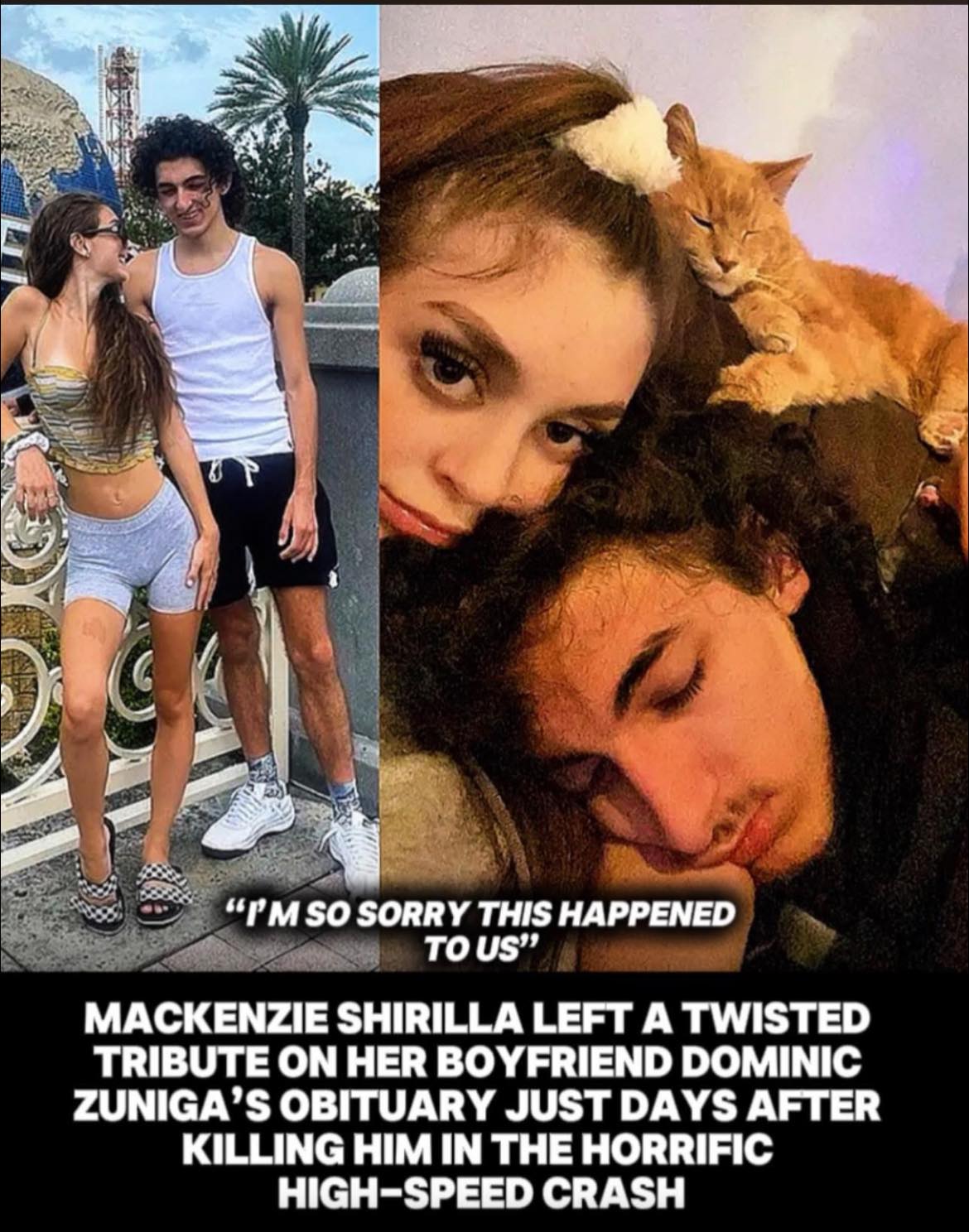
They imprisoned one another in an inescapable cycle: fighting, threatening mutual destruction, breaking up, and clinging back together in a blur of intoxication. The presence of these text messages, when placed side-by-side with the hypocritical, tear-stained obituary post Mackenzie published after Dominic’s death, or her chillingly detached jailhouse calls, completes a dark picture of personality deviance.
On the night of July 31, 2022, when Mackenzie pinned the accelerator to 100 mph directly toward a dead-end brick wall, it was not a sudden, split-second impulse. It was the absolute destination of a prolonged countdown, where the written threats to “end my life” materialized into absolute physical reality. Davion Flanagan, an innocent friend who stepped into the vehicle that night, became the ultimate tragic casualty of a warped romantic game where the perpetrator was willing to destroy everything to satisfy her possessive impulses.
CONCLUSION: THE COST OF IGNORED RED FLAGS
The July 17, 2022 text logs between Mackenzie Shirilla and Dominic Russo stand as a vivid, heartbreaking testament to the ignored red flags within a toxic relationship. Death threats, frantic text bombing, and extreme psychological instability are never expressions of love—they are the warning sirens of an impending catastrophe.
This case delivers a costly lesson for youth and parents alike: When a relationship reaches the threshold of death threats and psychological terrorism, escaping and seeking legal protection is the only viable path to survival. Dominic Russo’s delayed realization, combined with the general inaction of those around them to the frantic texts, was paid for with two innocent lives and a life sentence stretching across the remaining days of the killer.