OFFICIAL INVESTIGATION FILE FROM BRAZILIAN POLICE: UNMASKING SYSTEMIC FAILURE AND GROSS NEGLIGENCE BEHIND THE DEATH OF THE 21-YEAR-OLD GIRL
Introduction: The Case Breakthrough Report and Initial Justice for the Victim
As the dust begins to settle on the horrific accident at the Ponte do Esqueleto (Skeleton Bridge) in Limeira, State of São Paulo, the Civil Police of Brazil have officially pulled back the dark curtain obscuring this shocking homicide case. The death of Maria Eduarda Rodrigues de Freitas, a 21-year-old physical education graduate, is no longer considered a mere “unfortunate sports risk.” Following a rapid and intensive investigation—utilizing aerial manhunts and taking six suspects (five men and one woman) into custody—law enforcement has delivered a damning final investigation report.
Under the direct supervision of Police Chief Andrea Dantas Levy, the case file has been finalized with details that have left the public in absolute shock. The report does not merely pinpoint the exact individual who “forgot” the vital lifeline; it exposes a rogue, underground network operating extreme sports excursions in flagrant violation of national safety standards. This is a comprehensive look into the official investigation file from the Brazilian police—where every minute technical detail has been forged into ironclad evidence for the prosecution.
Part I: A Breathless Manhunt and the Profiles of the Six Detained Suspects
Immediately after Maria Eduarda plummeted 40 meters into the rocky ravine before the helpless eyes of her loved ones, the scene at the Ponte do Esqueleto erupted into absolute chaos. Instead of fulfilling their rescue and first-aid responsibilities, the event staff engaged in covering up physical evidence and fleeing the scene.
The Civil Police of São Paulo immediately activated a red alert, mobilizing ground units in tandem with a specialized helicopter from the Urban Air Force to launch a tight dragnet. Through high-altitude tracking systems, authorities spotted two men from the organizing team attempting to escape into a dense, wooded area surrounding the canyon. The helicopter closed in, pinning down their location for tactical ground forces to surround and apprehend them.
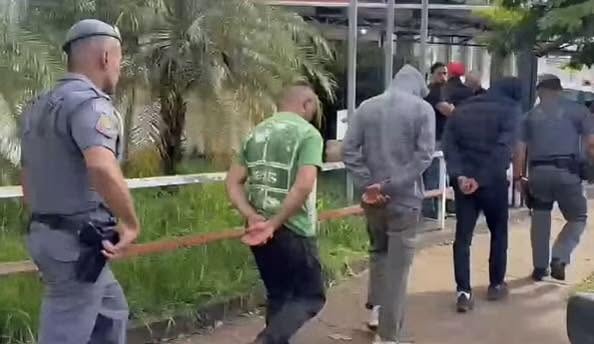
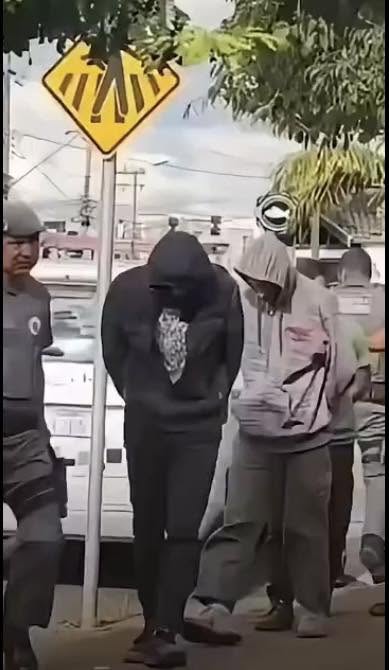
In total, six suspects were placed under emergency arrest, including:
- Three workers operating directly on the jump platform: Those responsible for the technical harness rigging and giving the launch command.
- Two logistics and ground management personnel: The team responsible for customer coordination and collecting payments.
- One woman in charge of marketing and customer outreach: The individual who directly published advertisements for “cheap, thrilling” jump tours on various social media platforms to lure in young people.
Following 48 hours of independent interrogations and cross-examinations, Chief Andrea Dantas Levy announced the classification of the criminal charges. Three of the five men—the ones who directly operated the launch platform at the exact millisecond Maria fell—were formally indicted on severe charges of “Homicide with implied malice” (Dolo eventual). The remaining three suspects were detained under investigation for “Conducting an illegal business operation resulting in severe fatal consequences” and “Failure to render assistance to a person in imminent danger.”
Part II: Crime Scene Reconstruction Results – A Primitive Mistake Destroys a Life
The most pivotal and infuriating detail within the police investigation file is the determination of the direct cause of Maria Eduarda’s death. Contrasting sharply with the initial defense lines put forward by attorneys for the “Entre Cordas” outfit—who claimed that “the equipment suffered an act of God malfunction” or “the carabiner lock slipped due to a manufacturer defect”—the police conclusions completely dismantled all excuses.
The victim was never connected to the jump system.
According to the results of the crime scene reconstruction and eyewitness testimonies (those who can be heard shouting, “The rope, people, the rope!” in the footage), the operating procedure utilized by these workers had been stripped down to an insane degree:
- Negligence in the Rigging Phase: The technical staff buckled the safety harness tightly around Maria’s hips and thighs, giving her a false, tragic sense of security. But at the absolute critical step—clamping the heavy-duty carabiner from the participant’s harness onto the loop of the main lifeline—they completely forgot.
- The Rope Left Behind: At the moment Maria was launched from the bridge deck, the specialized safety rope weighing dozens of kilograms sat entirely untouched, coiled neatly on the concrete floor of the bridge. The two workers standing on the platform coordinated in unison, lifted the young woman up, and forcefully propelled her into the air in the “Superman style” posture she requested, without ever glancing down to check where the line was.
When interrogated by police as to how such a primitive mistake could occur among individuals claiming to possess “years of experience,” the suspects fell completely silent. They were unable to provide a single rational explanation for omitting the safety cross-check (Double-check)—the most fundamental, life-saving rule of the extreme sports industry.

Part III: Unmasking a Rogue Underground Network and Regulatory Loopholes
Beyond the direct technical failure, the Brazilian police investigation expanded into the legal framework of the operating company, “Entre Cordas.” Verification checks across regulatory agencies in the State of São Paulo exposed an alarming truth: The company possessed absolutely no authorization or permits to operate.
The Ponte do Esqueleto (Skeleton Bridge) is an abandoned, old transit structure under the municipal jurisdiction of Limeira. The local government had long issued strict orders banning public gatherings and spontaneous extreme activities there due to structural concrete degradation over time. However, exploiting the remote terrain and a lack of routine patrols by local security forces, the suspects illegally established a bootleg “jump site” on the structure.
Chief Andrea Dantas Levy emphasized in the indictment:
“They did not possess a single safety certification from the Regional Council of Engineering and Architecture (CREA), carried no civil liability insurance for clients, and were completely unauthorized by the local fire and rescue department. This was a tax-evading business model, operating covertly through social media, gambling with the lives of customers in exchange for massive profit margins.”
The lone woman among the detained suspects acted as the “link” to reel in victims. She utilized polished, eye-catching edited videos and photos on Instagram and TikTok to market Rope Jump excursions at nearly half the price of legitimate, licensed centers. It was precisely the cheap price and the enticing marketing of an “explosive youth experience” that caused active, dynamic young individuals like Maria Eduarda to lower their guard.
Part IV: The Legal Leverage of the “Dolo Eventual” Charge
The decision by Brazilian police to apply the severe legal framework of “Homicide with implied malice” (Dolo eventual) against the three direct platform workers marks a historic milestone in the prosecution of extreme sports tragedies within the country.
Brazilian criminal law states explicitly: When you engage in an inherently high-risk action (such as launching a human being from a 40-meter-high bridge into a ravine), your total failure to inspect the safety lines dictates that you have consciously accepted the risk that the victim will die. You did not premeditate or plot to murder them, but your utter indifference and disregard for human life regarding the fatal outcome constitutes “indirect intent.”

The final investigation report completely shattered the efforts of the defense attorneys, who sought to downgrade the case to “Involuntary manslaughter due to professional negligence” (Homicídio culposo)—a charge that typically carries light sentences of a few years of probation or community service. Under the “Dolo eventual” indictment, the three suspects face primary criminal homicide charges, carrying severe prison terms ranging from 12 to 30 years inside federal penitentiaries.
Furthermore, police firmly rejected the suspects’ claims that they “attempted immediate CPR and that Maria still possessed a faint pulse when they reached the bottom of the gorge.” Cross-checking with the report from the Institute of Legal Medicine (IML), the massive impact of a 130-foot fall at a velocity exceeding 100 km/h onto jagged rocks instantly obliterated the victim’s central nervous system, ruptured her heart, and tore her aorta. Death occurred instantaneously at the exact millisecond of impact. The suspects’ claims regarding first-aid attempts were exposed as psychological tactics designed to evade accountability and mitigate their criminal culpability before investigators.
Conclusion: A Stern Verdict and a Lesson Written in Blood for Society
The Civil Police of Brazil have officially closed the evidentiary phase of the investigation into the death of Maria Eduarda Rodrigues de Freitas, transferring the entire case file to the Public Prosecutor’s Office of São Paulo in preparation for a public trial. Justice is moving swiftly and strictly to restore fairness for the young woman and to soothe the immense grief of her family and fiancé.
Looking back at the entire investigation report, this is not merely an indictment of six specific individuals; it stands as a fierce warning to society at large. For regulatory bodies, this case is a harsh lesson regarding lax territory management, which allowed a rogue outfit to openly operate on abandoned infrastructure. For the community, especially thrill-seekers and adventure enthusiasts, the police conclusions point out one undeniable truth: your personal safety must never be blindly entrusted to someone else without your own validation.
Let the heartbreaking story of Maria Eduarda and the strict indictment handed down to the irresponsible operators at Skeleton Bridge remain the ultimate reminder written in blood: behind the glittering, viral videos of extreme stunts on social media lies a fatal trap if we lack the alertness and awareness to protect our own lives.