TRAGIC BLUNDER OR WORSE? WHO IS RESPONSIBLE FOR THE DEATH OF THE 21-YEAR-OLD GIRL WHILE INSTRUCTORS SUFFER FROM “TEMPORARY AMNESIA”?
Introduction: Evasive Testimonies in the Face of an Unjust Passing
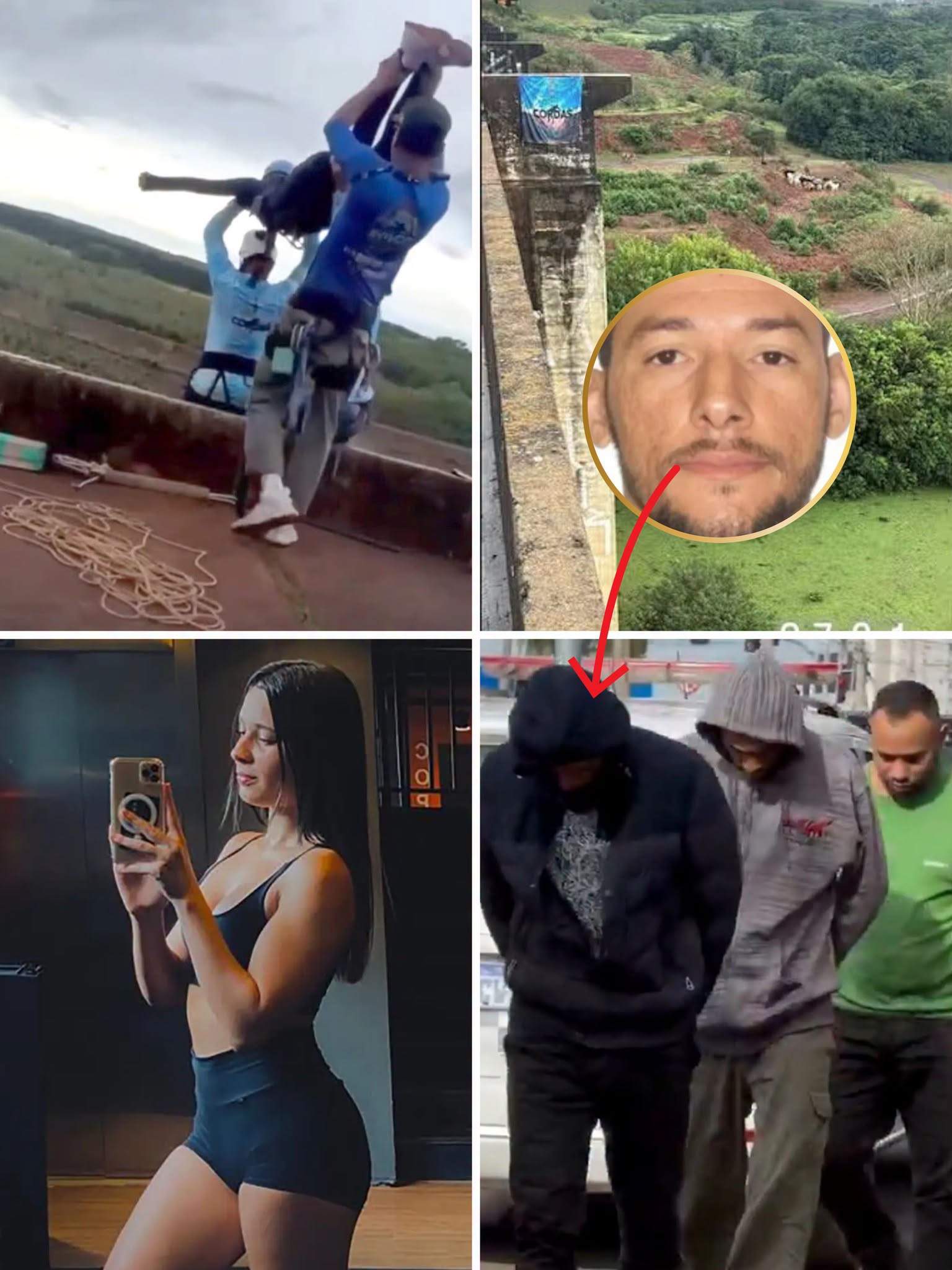
The tragedy that unfolded on June 13 at the abandoned railway structure known as the “Skeleton Bridge” (Ponte do Esqueleto) in the Brazilian state of São Paulo has claimed the life of Maria Eduarda Rodrigues de Freitas—a 21-year-old girl bursting with life who had just graduated with a degree in Physical Education. The viral video capturing the horrifying moment two staff members lifted her body in an “airplane style” position and launched her into a 40-meter (approximately 131-foot) abyss, while the lifeline remained completely disconnected, has sent shockwaves through millions worldwide.
However, the public outrage did not stop at that bone-chilling footage; it completely boiled over when investigators released the latest documents and testimonies of the suspects. The three instructors directly responsible for the victim’s life offered an unacceptable defense at police headquarters: they “don’t remember” who forgot to attach the safety cord, nor can they recall who was in charge of the final safety check.
A human life was stolen in an instant by an act of insanely reckless negligence, yet the only response is a calculated, hazy blank space in their memory. The ultimate question echoing right now is: Was this truly an inadvertent technical mistake, or a brutal crime masked by callous indifference? Who will bear the ultimate responsibility before the law and the memory of Maria Eduarda?
Part I: “We Don’t Remember” – The Shield of Irresponsibility From the Instructors
According to official data from the São Paulo Secretariat of Public Security, the three primary suspects—Maicon Fernandes Cintra (42), Luis Felipe Feliciano Egoroff (32), and Vitor de Freitas Gonçalves (27)—have been detained and face severe charges. Yet, their unified resistance strategy of feigning “collective amnesia” has deeply infuriated both investigators and the public.
Police investigator Andrea Dantas Levy, who is directly handling the case, stated to the Associated Press (AP):
“They do not remember whether they forgot to attach (the ropes), or who was supposed to do it, or who failed to check. But the fact is the ropes were not attached to her.”
In any extreme sport, especially rope jumping (free-falling from structures using specialized dynamic ropes), safety protocols strictly dictate rigorous cross-checking principles (double-checking and triple-checking). The fact that all three individuals, despite their extensive years in the profession, simultaneously claimed they “cannot recall” who performed the final step points to a calculated collusion aimed at diluting legal accountability. They are attempting to morph a specific individual blunder into a hazy “shared group responsibility,” hoping to mitigate penalties or shift the blame onto circumstances.
Part II: The Legal Substance – Why Is It Charged as “Homicide with Implied Malice”?
Brazilian prosecutors did not indict the suspects under ordinary involuntary manslaughter. Instead, all three instructors remain in preventative detention under the stringent charges of “Homicide with dolus eventualis” (Homicide with implied malice / Reckless indifference).
This legal distinction is absolutely critical:
- Manslaughter (Vô ý làm chết người): An act resulting from an unintended oversight, where the actor fails to foresee the consequences or genuinely believes the outcome will not materialize.
- Implied Malice / Dolus Eventualis (Cố ý gián tiếp): The actor fully recognizes that their action carries a high probability of causing someone else’s death, yet they push forward regardless, demonstrating a callous indifference and total disregard for human life.
Hurling a human being off a height equivalent to a 13-story building into a rocky ravine without verifying the carabiner connection is not a minor oversight akin to forgetting a seatbelt in a car. It is a deadly gamble with someone else’s life. The suspects knew perfectly well that without the cord, the victim would face certain death, yet they rushed through the launch execution to keep up with the schedule or out of pure carelessness. This callous indifference satisfies the criteria for homicide with implied malice under the Brazilian Penal Code.
Part III: The Chaos of a Rogue Operation and Multi-Layered Liability
To address the question of “Who is responsible for Maria’s death?”, we must dismantle the multi-layered system of failures stretching from the operating unit to regulatory bodies.
1. Direct Liability: The “Entre Cordas” Operating Team
Investigator Andrea Dantas Levy revealed a staggering truth to the local news outlet G1: this group of instructors operated completely outside the law. They lacked a legitimate business license, held no safety certifications from accredited extreme sports associations, and possessed zero authorization to host activities at the abandoned Skeleton Bridge. A nameless, unregulated outfit collecting money from customers and treating human life as a gambling chip is the core catalyst of this tragedy.
2. The Illusion of Professionalism
In addition to the three primary suspects on the jumping deck, three other employees handling ticket sales, logistics, and parking directions were brought in for questioning. Although they were released because they did not physically participate in the technical launch protocol, their presence constructed a “veneer of false professionalism,” leading young clients like Maria to fully trust the validity of the service.
3. Administrative Accountability
The tragedy has ignited a fierce legal battle between administrative tiers. The municipal government of Limeira (where the Skeleton Bridge is located) announced its intention to sue the Brazilian federal government. Mayor Murilo Felix explicitly blasted federal authorities for abandoning this defunct railway infrastructure for years without installing barriers, surveillance, or basic safety controls, despite the site having a history of severe accidents.
Part IV: A Broken Dream in the Abyss and the Agony of Those Left Behind
The passing of Maria Eduarda Rodrigues de Freitas leaves a catastrophic wound on her family and friends. As a vibrant woman passionate about sports and nature, Maria arrived at the Skeleton Bridge on the morning of June 13 with immense excitement. She chose an “airplane style” jump—a pose demanding complete freedom by spreading her arms wide against the wind, demonstrating absolute trust in the individuals she regarded as “instructors.”
Just minutes before being thrown over the edge, she uploaded lighthearted stories on Instagram to joke with her friends: “Who was the crazy person who let me come jump off a bridge???” The photo she snapped of the warning sign bearing a skeleton icon alongside the words “Danger. Risk of death” has transformed into a bitter reality. The victim acknowledged that the sport carried inherent risks, but she believed she had paid for safety. She could not have foreseen that the true “crazy persons” were the very individuals strapping her into the harness.
Following her tearful funeral on June 15, Maria’s mother spoke out in total helplessness and shattering pain:
“That damn rope took you away from me forever. My beloved daughter is gone, leaving behind only pain and longing. I will love you forever.”
That torment is multiplied tenfold when the family must endure the deceitful “I don’t remember” testimonies from the men who physically launched their daughter to her death. The truth is, the rope did not kill Maria; human irresponsibility transformed that rope into an execution tool suspended in the void.
Conclusion: Justice Rejects Amnesia
“Tragic Blunder or Worse?” The answer is entirely clear. Carelessness that shatters all boundaries of professional ethics, followed by claims of “amnesia” in the investigation room, cannot be categorized as an accidental mishap. It is a crime nurtured by indifference and greed within black-market operations.
As the case progresses through the São Paulo justice system, the public demands the absolute maximum penalty for Maicon, Luis Felipe, and Vitor. Prosecuting them under the framework of “Implied Malice” will serve as the firmest statement from Brazilian law: you cannot kill a human being through gross negligence and wash your hands of it by saying “I don’t remember.” True justice must be served for the dignity and soul of Maria Eduarda Rodrigues de Freitas, ensuring her death does not fade into a meaningless statistic, but stands as the final alarm putting an end to rogue thrill ventures that gamble with human lives.
:max_bytes(150000):strip_icc():focal(740x180:742x182):format(webp)/Maria-Eduarda-Rodrigues-de-Freitas-061526-d2f385296cb541c59e8e63d493438ada.jpg)
The rope jump instructors charged after a 21-year-old woman died in a devastating fall say they don’t remember who was supposed to attach the safety cord — or even if they forgot it entirely.
According to investigators, the three men told authorities they cannot recall whether they forgot to attach the ropes, who was responsible for doing so, or who failed to perform the crucial safety check before the jump.
“They do not remember whether they forgot to attach (the ropes), or who was supposed to do it, or who failed to check. But the fact is the ropes were not attached to her,” police investigator Andrea Dantas Levy stated, as reported by the Associated Press.
Maria Eduarda Rodrigues de Freitas, 21, tragically lost her life on June 13 while participating in a rope jump from the infamous Ponte do Esqueleto, or Skeleton Bridge, in the Brazilian state of São Paulo. The young woman plunged approximately 131 feet (40 metres) to the ground after being launched without any safety equipment connected.
The São Paulo Secretariat of Public Security confirmed that the three instructors — aged 27, 32, and 42 — were arrested and charged with homicide with dolus eventualis. This legal term indicates that authorities believe the men were aware of the potential risk of death but proceeded with the activity anyway, showing reckless indifference.
:max_bytes(150000):strip_icc():focal(791x568:793x570):format(webp)/Ponte-do-Esqueleto-Sao-Paulo-061526-a6bdd56c2968416f85169179c44dde97.jpg)
Heartbreaking video of the incident, which quickly went viral, showed two men lifting Maria Eduarda in an “airplane style” position — her arms spread wide as she had requested — before tossing her from the bridge. Onlookers immediately realized the horrifying mistake and could be heard shouting desperately, “Guys, the rope!”
Maria had dreams of becoming a physical education teacher and was known for her adventurous spirit and love of outdoor activities. Just moments before the fatal jump, she shared an excited photo from the site on Instagram, writing with playful anticipation: “Who was the crazy person who let me come jump off a bridge???”
Six people were questioned in connection with the tragedy, but only the three instructors remain in custody. Investigator Levy also revealed that the group operating the jumps was not properly authorized or regulated. “It was a team there that wasn’t regulated; they didn’t even have authorization to be there,” she told local outlet G1.
The incident has cast a dark shadow over adventure tourism at the Skeleton Bridge, a location already linked to past tragedies. Maria Eduarda was laid to rest on June 15, leaving her family and friends devastated by the sudden and preventable loss of a bright young woman full of life and passion for sports and nature.
The case continues to spark outrage and intense scrutiny over safety protocols, with many questioning how such a basic and life-saving step could have been overlooked in front of dozens of witnesses.