Oak Creek, Pennsylvania, was the sort of town that used to hold deep meaning for the generations who built it from the ground up.
Oak Creek, Pennsylvania, was the sort of town that used to hold deep meaning for the generations who built it from the ground up.
Nestled roughly two hours southwest of Pittsburgh, it thrived as a proud, roaring foundry town during the energetic decades of the late sixties and seventies. It was a close-knit community forged by grit and hard labor, where the loud blast of the morning factory whistle set the pace for every household. On warm, humid summer nights, families crowded their front porches, sipping sweet tea and watching their kids chase fireflies into the darkness. In those days, you could raise a family in Oak Creek and feel a quiet, profound pride in the stable life you were building.
But then, the town’s massive iron gates slammed shut for the very last time at the primary steel works.
Not long after, the secondary manufacturing plant further down the river bank followed suit, its towering smokestacks going permanently cold. Slowly and painfully, year after year, the lifeblood of Oak Creek drained away. The younger generation packed up their trunks and abandoned the town for booming cities that still possessed a economic heartbeat. By the time the clouds turned ominously dark on the afternoon of February the fourteenth, Oak Creek had lost well over half of its peak population.
Main Street had become a hollow echo of its former glory. It was now defined by boarded-up storefronts, weathered brick buildings, and a couple of surviving discount shops. It had transformed into a ghost town—the kind of place highway travelers speed right through without ever tapping their brakes.
Right in the center of this forgotten landscape, at the end of a quiet, dead-end road named Willow Lane, lived Clara Vance.
Clara was seventy-three years old, a retired public school cafeteria cook, and a widow. Her husband, Arthur, had passed away twelve long years ago from severe health complications following a devastating factory accident that had shattered his lower back. The sprawling foundry had already abandoned the town by the time he died, leaving the couple with nothing but a meager, shrinking pension. His monthly disability checks could barely keep up with the overwhelming cost of his prescription medications. At the very end, Clara had sat by his side in that sterile hospital room, clutching his calloused, weakened hand. She had looked into his fading eyes and promised him, with a steady, unwavering voice, that she would manage just fine.
She had kept that sacred promise—for the most part.
Clara lived entirely alone in the exact same modest, two-bedroom ranch house that Arthur had proudly bought for them in nineteen-seventy-eight. He had constructed the covered back deck himself, using his own scarred hands, his own lumber, and his own exhausting weekends. She had never permitted anyone to alter a single detail of that house since the afternoon he took his final breath.
Every single morning, regardless of the bitter weather or the season, Clara was out of bed by 5:15 AM. It wasn’t because she had an appointment to keep, but simply because that early routine was etched into the unyielding architecture of who she was. She would shuffle into the kitchen and brew black coffee in the exact same vintage metal percolator she had used since nineteen-eighty-eight.
Then, she would unlock the back door to feed the two stray, battle-scarred outdoor cats who had wandered onto her property years ago. She had named them Rusty and Smokey, making sure they were fed before she ever considered making breakfast for herself. Afterward, she would sit quietly at her worn laminate kitchen table, open her leather-bound daily devotional, and read her morning scripture. When she finished, she would look up and talk directly to the framed photograph of Arthur that sat prominently on the living room mantelpiece.
“A storm is brewing, sweetheart,” she whispered to the photograph that particular week, watching the dark gray clouds roll over the hills. “Looks like it’s going to be a rough one this time.”
To truly comprehend the events of that fateful night, one must first understand the stark reality of Clara’s financial world.
She survived exclusively on a single monthly Social Security check that totaled exactly one thousand, one hundred and thirty-eight dollars. That small sum represented the entirety of her livelihood. To make matters worse, her asphalt shingle roof had been failing and leaking ever since the heavy rainstorms of the previous spring. She kept three plastic utility buckets positioned with absolute precision in the dark attic to catch the steady, relentless drips. Every time a storm rolled through, she would pull down the attic stairs, haul the heavy buckets down to empty them into the bathtub, and carefully reset them on their marks.
On top of that, she owed twenty-one hundred dollars to the community hospital—a daunting medical bill left over from a terrifying fall she took the previous November. She had slipped on a treacherous patch of black ice on her own front steps, bruising her hip so severely that she couldn’t pull herself up from the frozen concrete for over an hour.
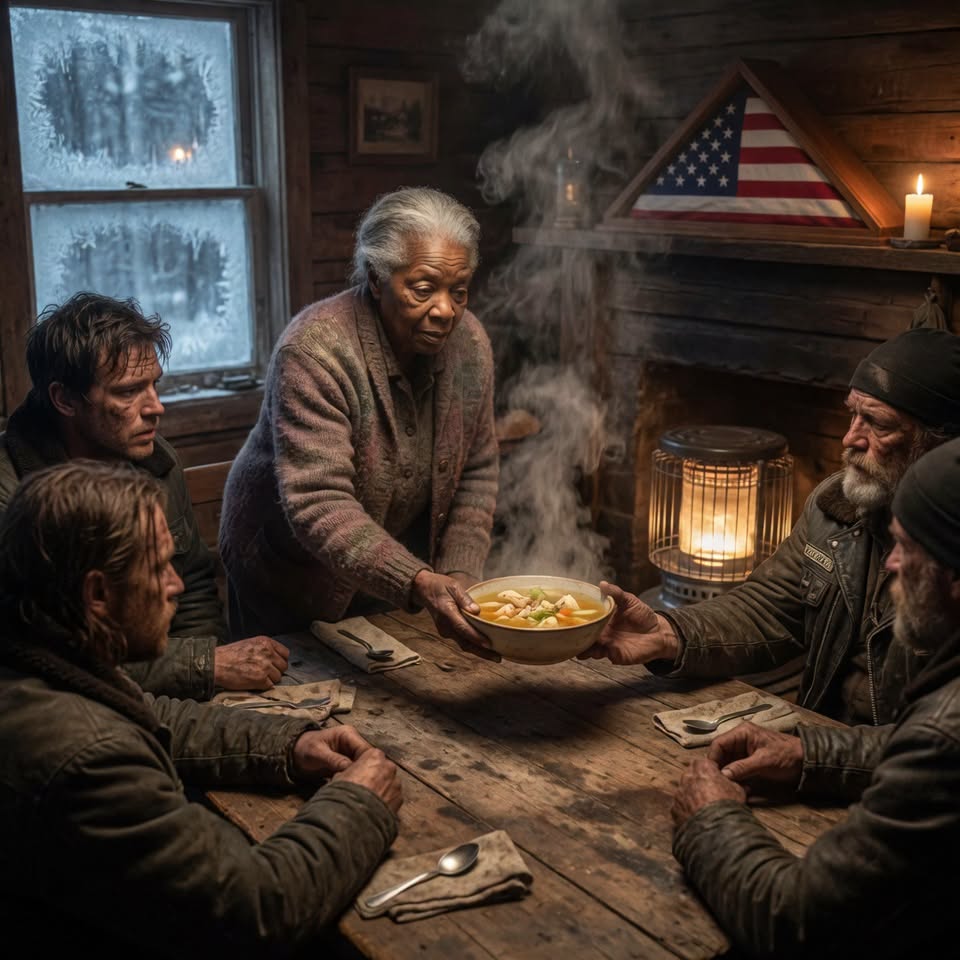
The Gathering Shadows
The wind began its true assault just after seven o’clock that evening. It didn’t arrive with a sudden theatrical clap of thunder, but rather as a low, ominous vibration that rattled the loose storm windows of the Willow Lane ranch house. Clara Vance sat in her worn armchair, a faded wool blanket draped over her lap, watching the thermostat on the wall slowly drop. The ancient furnace in the basement groaned, its heating coils expanding with a metal-on-metal screech that had long since become the ambient soundtrack of her winters.
Outside, the snow was falling in dense, heavy sheets, driven sideways by gusts that swept down from the ridges surrounding Oak Creek. The streetlamps on the corner flickered, casting long, erratic shadows across the frozen expanse of her front yard.
Clara adjusted her glasses and looked down at her hands. They were stiff tonight, the arthritis flaring up in response to the plunging barometric pressure. She could feel the damp cold creeping through the floorboards, defying the weather stripping she had meticulously pressed into the door frames back in October.
“Arthur’s deck is going to take a beating tonight,” she murmured to the empty living room.
On the mantelpiece, Arthur’s framed photograph caught the dim reflection of the single floor lamp she kept lit. He was smiling his trademark quiet, confident smile, wearing his pristine blue union shirt, his shoulders broad and untamed by the physical agony that would define his final decade. Clara looked at him for a long moment, drawing a deep, steadying breath. She had promised him she would be fine, and she intended to keep that promise, even if the world outside was freezing over.
A sudden, distinctive thunk echoed from directly above her head.
Clara froze. It was followed by a rhythmic, metallic ping… ping… ping…
The roof. The heavy snow accumulation was already pressing down on the compromised asphalt shingles, forcing the melting under-layer through the structural fractures. The leaks had begun earlier than she anticipated.
With a soft groan, Clara pushed herself out of the armchair. Her left hip, still deeply tender from her terrifying ordeal on the black ice three months prior, throbbed in protest. She ignored the sharp ache, gripping the wooden armrest for leverage until she stood stable.
She walked slowly into the hallway, reached up with a wooden pole she kept tucked in the linen closet, and hooked the metal ring of the pull-down attic stairs. With a heavy tug, the wooden steps extended downward, releasing a puff of stagnant, freezing air into the hallway.
Clara climbed slowly, her good leg leading each step, her hands gripping the unvarnished wooden rails with fierce determination. The attic was dark, illuminated only by the narrow beam of the plastic flashlight she carried in her cardigan pocket. She swept the light across the dusty rafters until the beam landed on her target: the three heavy, plastic utility buckets she had positioned with military precision during the last rainstorm.
The middle bucket was already a quarter full of dark, icy water, the drips falling from a stained roof beam at an accelerating pace.
“Good boys,” she whispered to the buckets, as if praising loyal hounds. “Hold the line.”
She knew she would have to empty them before midnight if the storm continued at this rate. The thought of hauling thirty pounds of sloshing water down those steep, narrow steps made her breath catch in her throat, but she pushed the anxiety aside. One problem at a time. That was how she and Arthur had survived the strike of eighty-two, and that was how she would survive tonight.
The Cold Reality
By nine o’clock, the storm had escalated into a full-blown historic blizzard. The local radio station, broadcasting from a small tower miles away, crackled through her vintage tabletop radio with an urgent weather bulletin: the county had declared a Level 3 snow emergency. All travel was strictly prohibited. The wind chill factor had plummeted well below zero, and emergency services were already stretched to their absolute limits dealing with downed power lines across the region.
Then, with a faint, pathetic pop, the lights went out.
The sudden silence in the house was deafening. The gentle hum of the refrigerator ceased, the amber glow of the space heater died, and the furnace downstairs spun down to a quiet, lifeless halt. The only light remaining was the pale, ghostly luminescence of the snow outside reflecting through the frost-rimed windows.
Clara sat perfectly still in the darkness, her heart hammering against her ribs. She had lived through power outages before, but never during a freeze this severe, and never with her bank account completely depleted. The twenty-one hundred dollar debt hanging over her from the community hospital had prevented her from filling the propane backup tank that winter; she simply hadn’t been able to afford the minimum delivery fee.
“Alright, Clara,” she said aloud, her voice sounding small in the dark. “Layer up. Just like the old days.”
Using her flashlight, she navigated to the bedroom, pulling thick woolen blankets, Arthur’s old flannel work shirts, and three layers of heavy socks from the drawers. She wrapped herself tightly, returning to the living room couch where she could keep an eye on the mantelpiece. She lit a single emergency candle, placing it safely inside a glass jar on the coffee table. The tiny flame danced, casting a warm, fragile circle of light that barely pushed back the encroaching shadows.
From the back porch, a faint, desperate mewing cut through the howling wind.
Rusty and Smokey.
The two feral tomcats were tough, built from the same hardened material as the old Oak Creek steelworkers, but this storm was a different animal entirely. Clara knew that if she left them out on the covered deck tonight, the sub-zero wind chills would claim them before dawn.
Ignoring the cold slicing through her joints, she limped to the kitchen, unlocked the heavy back door, and cracked it open. A swirl of fine, icy snow blasted inward, coating her slippers.
“Come on, boys! Inside, right now!” she called out into the white vortex.
Two dark, shivering shapes darted through the gap, their fur encrusted with ice. They didn’t stop to complain or beg for food; they immediately bolted toward the living room, seeking the faint warmth of the candle. Clara slammed the door shut, locking it tight, and threw a heavy towel over the drafty threshold.
When she returned to the living room, the two cats had curled into tight, interlocking circles directly at the base of the sofa, their shivering gradually subsiding as they absorbed the residual heat of the carpet. Clara lay down on the sofa, pulling the mountain of blankets over herself and the cats, watching her own breath turn into faint, white plumes of mist in the air.
The house was freezing fast. Within two hours, the indoor temperature had dropped into the low forties. Clara could feel the numbness creeping into her toes, a dull, heavy sensation that reminded her dangerously of the hour she spent stranded on the frozen concrete steps back in November.
She closed her eyes, praying for the morning light, praying for the wind to die down, praying that the pipes wouldn’t burst beneath the floorboards.
The Midnight Echo
At precisely one in the morning, a sound shattered the icy silence of Willow Lane.
It wasn’t the wind, and it wasn’t the shifting of the roof. It was the distinct, heavy crunch of a vehicle struggling through the deep, unplowed snowdrifts outside. The engine roared, tires spinning violently against the buried asphalt, before settling into a low, idling rumble directly in front of her house.
Rusty’s ears twitched, his head snapping up as a low growl vibrated in his throat. Smokey shifted uneasily against Clara’s ankles.
Clara pulled the blankets from her face, her eyes wide with apprehension. Nobody drove down Willow Lane in weather like this. It was a dead-end street, forgotten by the city’s plow drivers until days after a storm had passed.
Through the frost on the living room window, she saw the sweeping beams of powerful headlights slicing through the blizzard. A large, heavy-duty utility truck had parked at her curb, its yellow strobe lights rotating silently, painting the snow-covered trees in rhythmic flashes of amber.
A figure emerged from the driver’s side—tall, heavily bundled in a dark canvas winter jacket and a high-visibility vest. The stranger carried a heavy plastic case in one hand and a long iron tool in the other. He began trudging through the knee-deep snow toward her front porch, his heavy boots sinking deep into the drifts.
Clara’s hand instinctively went to her throat, her fingers wrapping around the small silver cross she always wore. Fear, sharp and cold, flared in her chest. She was an old woman, completely isolated, with no power, no telephone connection, and no neighbors within shouting distance.
The heavy thud of boots echoed onto her front porch. Then, a firm, measured knock rattled the front door.
“Mrs. Vance?” a deep, muffled voice called out over the roar of the wind. “Mrs. Clara Vance? It’s the county emergency utility crew. Are you inside, ma’am?”
Clara picked up her plastic flashlight, her hands shaking so violently the beam danced wildly across the ceiling. She limped toward the entryway, keeping the security chain firmly engaged as she unlocked the deadbolt and cracked the door open an inch.
The freezing wind tore at the opening, but the massive frame of the man blocked the worst of it. He lowered his insulated face mask, revealing a rugged, bearded face and eyes that looked incredibly tired but deeply resolute.
“I’m Clara,” she said, her voice trembling from both the cold and the adrenaline. “What’s wrong? What are you doing out here?”
The man offered a brief, reassuring smile that instantly eased the tension in her chest. “My name’s Marcus, Mrs. Vance. I’m a field supervisor with Oak Creek Public Works, partnered with the county medical emergency task force. We received an automated structural vulnerability alert for Willow Lane, cross-referenced with your critical medical registry from last November.”
Clara stared at him, confused. “An alert? From who? I didn’t call anyone. My phone is completely dead.”
Marcus held up a heavy, weather-proof tablet, its screen glowing bright blue in the darkness. “The county hospital’s community outreach program monitors vulnerable seniors during historic weather events, ma’am. When the power grid went offline in this sector, your address flagged automatically because of your severe hip injury and the lack of a secondary heating source on file.”
He gestured to the heavy plastic case he had set down on the porch. “We’re not here to take you away, unless you want to go to the high school shelter. But if you want to stay in your home, my orders are to secure your utilities, hook up an emergency generator line, and make sure you don’t freeze tonight. May I come in?”
Clara looked past him at the roaring blizzard, then back at his honest, exhausted face. She unhooked the security chain and swung the door open.
“Come inside, young man,” she whispered. “Before the weather takes us both.”
The Weight Lifted
For the next two hours, the modest house on Willow Lane became a hive of quiet, efficient salvation.
Marcus worked with a rhythmic precision that reminded Clara intensely of Arthur. He didn’t waste words; he simply identified a problem and fixed it. He carried a portable, commercial-grade inverter generator to her back deck, carefully positioning it away from the windows to prevent exhaust fumes from entering. Within twenty minutes, he had run a heavy, insulated line through a specialized utility port in her kitchen, restoring power to her refrigerator, her space heaters, and a select few electrical outlets.
The sudden return of warmth was miraculous. The electric space heaters began to hum, casting a deep, golden heat that slowly pushed the bitter frost away from the interior walls.
But Marcus wasn’t finished.
“I noticed the structural sagging from the street, Mrs. Vance,” he said, wiping sweat from his forehead despite the freezing air in the hallway. “Mind if I take a look at your attic?”
Clara, wrapped in a single blanket now that the kitchen was warming up, pointed toward the pull-down stairs. “There are three buckets up there. They’re catching the leaks.”
Marcus climbed the steps without hesitation. When he returned fifteen minutes later, his face was deadly serious, but his tone remained gentle. “The structural beams are holding, but the central valley of your roof is heavily compromised. Those buckets were about to overflow. I emptied them into your drainage stack and reinforced the catchment area with a heavy-duty vinyl tarp I keep in the truck. It’ll hold until the spring thaw, but you’re going to need a full crew up there come April.”
Clara looked down at the kitchen table, a familiar, heavy shame weighing down her shoulders. “I know,” she said softly. “But a full crew costs money, Marcus. Money I don’t have. I survive on eleven hundred dollars a month, and the hospital is already threatening to send me to collections for my fall last year.”
Marcus walked over to the kitchen counter, where he had placed his tablet. He looked at the screen, typed a few lines with his thick, gloved fingers, and then looked back at Clara with a strange, quiet expression.
“Mrs. Vance, did your husband work the hot strip mill at the primary foundry back in the late seventies?”
Clara’s head snapped up, her eyes wide. “Yes. Arthur Vance. Thirty-two years with Oak Creek Steel. Why do you ask?”
Marcus let out a long, slow breath, a faint smile breaking through his thick beard. “My dad worked the blast furnaces right alongside him. He used to talk about Arthur all the time—said he was the finest structural welder in the entire valley.”
He turned the tablet around, sliding it across the worn formica table so Clara could see the display.
“What’s this?” she asked, adjusting her glasses.
“When Oak Creek Steel went bankrupt in the late nineties, the legacy pension fund was locked up in federal litigation for nearly twenty-five years,” Marcus explained, pointing to a series of official documents stamped with the seal of the Pennsylvania Department of Labor. “Last summer, a class-action settlement finally cleared the state supreme court. Because Arthur was classified as a permanently disabled worker prior to the plant’s final closure, his estate was listed under the primary beneficiary tier.”
Marcus tapped the screen, highlighting a line of bold, black text.
“The county hospital’s critical care registry isn’t just a monitoring system, Mrs. Vance. It’s linked directly to the state’s uncollected labor benefits database. Your medical debt from November didn’t go to collections. It was flagged for automatic matching against Arthur’s outstanding legacy settlement.”
Clara stared at the numbers on the screen, her breath catching in her throat. The words blurred behind her tears, but the final balance was unmistakably clear.
“The hospital bill has been cleared out entirely by the state indemnity fund,” Marcus said softly. “And as the surviving spouse, the remaining undistributed legacy pension balance is being transferred directly to your account via the state treasury. It’s an automatic monthly adjustment of seven hundred and fifty dollars, retroactive to the date of the court’s final ruling last July.”
Clara sank into her kitchen chair, her hands flying to her mouth to stifle a sob. For twelve years, she had carried the crushing weight of survival alone, counting every single dollar, measuring the price of her medications against the price of her groceries, watching her roof fall apart around her while she prayed for a miracle that never seemed to come.
And all this time, the union, the town, and the very labor Arthur had poured his lifeblood into had been fighting their way through the bureaucratic dark to find her.
“Seven hundred and fifty?” she whispered, her voice cracking with emotion. “Every month?”
“Every month, ma’am,” Marcus confirmed, his own voice thick with emotion. “Starting this Friday. It’s plenty enough to get that roof completely replaced the second the snow melts. My dad always said the steelworks never forgot its own. I guess he was right.”
A New Dawn over Oak Creek
By five o’clock the next morning, the wind had finally died down to a gentle, whisper-thin breeze. The historic storm had passed, leaving behind a pristine, untouched blanket of white that muffled every sound in the valley.
Marcus had finally departed, his heavy utility truck roaring back into the pre-dawn darkness to help other stranded souls across the county. But before he left, he had ensured the generator was fully fueled, the space heaters were stable, and a hot, fresh pot of black coffee was brewing in Clara’s vintage aluminum percolator.
The house on Willow Lane was warmer than it had been in years.
Clara stood by the living room window, her faded wool blanket draped casually over her shoulders. Rusty and Smokey stood on either side of her ankles, their tails brushing against her shins as they watched the first pale pink and amber rays of the morning sun slice through the breaking clouds.
The snow-covered valley stretched out before her, beautiful and vast. Oak Creek was still a quiet, struggling town, its towering smokestacks cold and silent against the Pennsylvania sky. But looking out at the white landscape, Clara no longer felt the biting, suffocating terror of isolation. The town wasn’t dead; its heart was simply beating in a different way, carried forward by the children of the men who had built it, by people like Marcus who still looked out for the forgotten corners of the valley.
She turned away from the window and walked slowly over to the living room mantelpiece.
The morning sunlight caught the frame of Arthur’s photograph, illuminating his handsome, smiling face. Clara reached up with a steady, warm hand, her fingers gently tracing the edge of the silver frame. The arthritis in her joints felt lighter this morning, the constant, low-grade anxiety that had defined her widowhood completely evaporated.
She looked deep into his painted eyes, a brilliant, beautiful smile breaking across her face for the first time in twelve long years.
“I kept my promise, Arthur,” she whispered into the quiet warmth of the room. “We’re going to be just fine.”
Outside, the morning whistle of a distant snowplow echoed through the valley, clearing the roads, opening the gates, and welcoming a brand new day to Oak Creek.