THE DEFENDANT’S BROTHER BREAKS SILENCE ON “LOW IQ,” GENERATIONAL TRAUMA, AND BLAMING THE WELFARE CHECKS
The horrific case involving the rescue of 16 children from a cramped 12-foot (around 13 $m^2$) room in Hamden, Ohio, continues to unravel with deeply complicated developments. Following the arrest of the four adult members of the Siders household—mother Elizabeth Siders, father Gary Siders Jr., alongside grandparents Gary Siders Sr. and Christina Siders—on severe child endangerment charges, all four have entered pleas of not guilty. In a startling turn of events, the grandfather, Gary Siders Sr., has since been released from custody due to medical reasons that officials admitted would have “bankrupted” the county if his detention had continued.
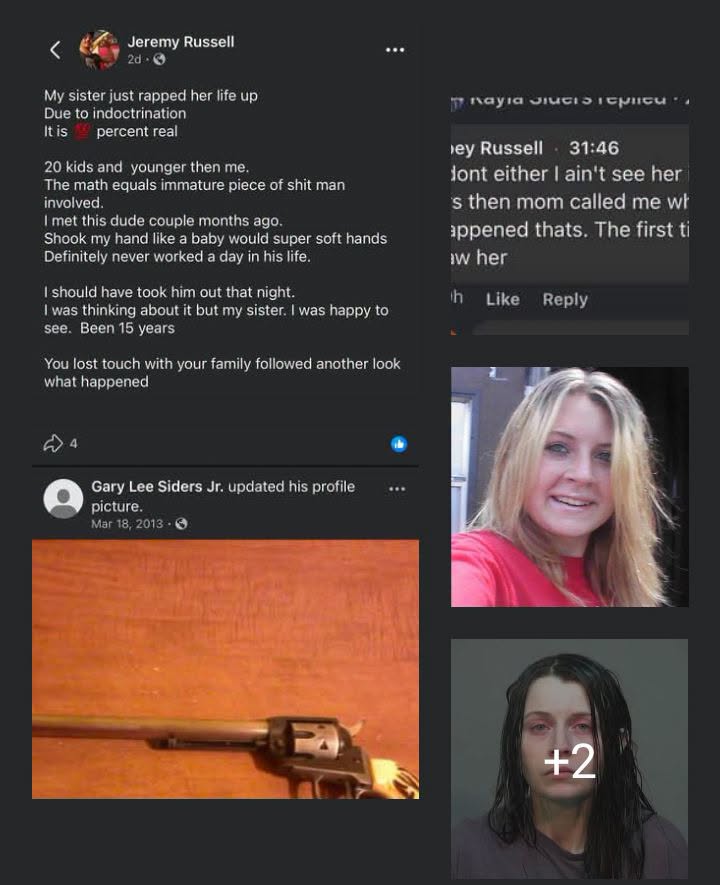
As public outrage reaches a boiling point, a significant insider voice has emerged. Jeremy Russell, identifying himself as the biological brother of Elizabeth Siders, unexpectedly took to Facebook to post a series of lengthy statements. These posts do not just reflect an internal family perspective; they strip back the dark layers of cognitive capacity, intellect, and money operating behind the facade of this “house of horrors.” While investigators have yet to comment officially on these claims, Russell’s perspective introduces a completely new analytical lens: Was this a case of deliberate cruelty, or was it the byproduct of intellectual deficiency coupled with the allure of welfare cash?
1. Generational Trauma and the Fight for the Russell Family Name
In his initial posts, Jeremy Russell expressed intense frustration over how members of his family were acting, which he believed was tarnishing their family name. “My family been actin super immature. Giving the Russell’s a bad name. We really do seek respect,” he wrote.
In an effort to defend his father and separate him from the crimes committed by Elizabeth in her marital home, Russell shared a painful yet resilient backstory about his father’s upbringing. According to the account, the father of Elizabeth and Jeremy built his life from the absolute bottom as a helpless orphan:
- His biological mother passed away when he was just two years old.
- His biological father was entirely incapable of caring for him.
- By the age of eight, his grandparents had passed away, landing him in a homeless children’s home until he turned 18.
- Tragically, while he was still a teenager, his sister was murdered.
Despite this staggering chain of multi-layered tragedies, Elizabeth’s father stood strong. Russell wrote of him with absolute reverence: “My father is a warrior. Smiles every day.” Through this detail, Russell sought to establish that the Russell line has a foundation of overcoming adversity, and that Elizabeth’s misconduct under the Siders roof does not reflect their father’s character.
2. “You Cannot Be Charged for Ignorance” — A Controversial Argument on IQ and the Welfare Trap
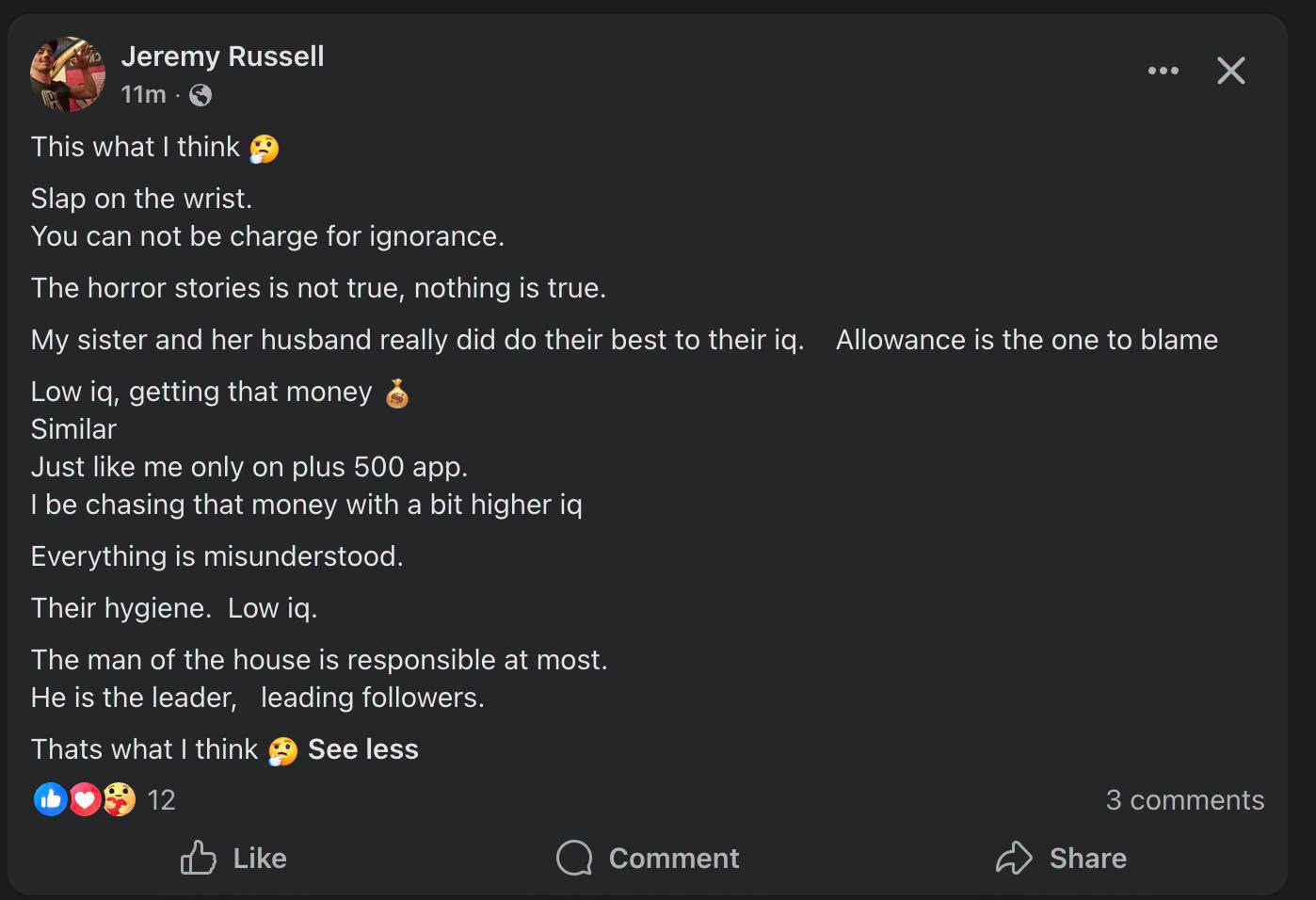
Striking directly at the core of the case, Jeremy Russell offered a shocking assessment, asserting that the true nature of the story had been heavily sensationalized by the media. He claimed: “This what I think. Slap on the wrist. You can not be charge for ignorance.”

Notably, Russell explicitly used the term “low IQ” to rationalize the deplorable, unsanitary conditions the 16 children endured for four years. According to him, his sister Elizabeth and brother-in-law Gary Jr. never harbored malicious intent to abuse their children; they simply acted within the narrow boundaries of their cognitive limitations:
“My sister and her husband really did do their best to their iq. Allowance is the one to blame. Low IQ, getting that money.”
This statement indirectly points to a dark financial reality: the steady stream of monthly welfare allowances distributed to an exceptionally large family inadvertently became an income trap for individuals with limited cognitive capacity. Lacking the necessary life skills and awareness to manage a massive household, they suffered a total breakdown in basic hygiene, resulting in the trash-filled environment documented by authorities.
Concurrently, Russell emphasized the traditional family structure within the Siders home, directing the brunt of the accountability toward his brother-in-law: “Everything is misunderstood. Their hygiene. Low IQ. The man of the house is responsible at most. He is the leader, leading followers. That’s what I think.”
3. Bitter Regrets and a Grim Prophecy of Post-Prison Homelessness
Though he attempted to contextualize his sister’s actions through the lens of a “low IQ,” Russell could not hide his profound sorrow and regret regarding the consequences forced upon the 16 children. “I feel so sorry for you. I wish I could have been there to prevent this. My father’s name will go down as a disgrace,” he wrote bitterly.
In a separate, fury-laden warning—seemingly directed squarely at Elizabeth and Gary Jr. once they eventually exit the correctional system—Russell painted a bleak future of poverty and homelessness driven by the fallout of the case:
“This is how you end up homeless. It’s gonna be cold man. Are you not thinking. Your employment record is shot no IQ. Like that equals homeless. Your anger will put you there within two years. After you get back out of prison. That’s exactly what it is.”
Russell stated clearly that once a severe criminal record for child endangerment is attached to an already weak intellectual capacity, the Siders couple will find it virtually impossible to secure stable employment to reintegrate into society. He further declared that he would turn his back on them completely if they ever sought his charity in the future: “If I allow it, I will not.”4. The Current Status of the 16 Children: Emergency Intervention by the State of Ohio
While the adult members of the Siders family and the Russells debate semantics and navigate the legal system, the lives of the 16 children—the true victims of this tragedy—have entered a much safer chapter.
A spokesperson with the Ohio Department of Children and Youth issued an official statement to television station WSAZ to reassure the public: “The safety and well-being of each of these children are top priorities for the Ohio Department of Children and Youth. The children are now in safe environments and in the custody of the Vinton County Public Children Services Agency (PCSA).”
| Responsible Agency | Population Received | Ongoing Support Services |
| Vinton County PCSA | All 16 children (aged 18 months to 18 years) | Segregated from parents; provided immediate safe shelter. |
| South Central Ohio Job and Family Services | Partnering with the PCSA team | Ensuring the consistent delivery of all necessary wrap-around support. |
| Specialized Medical Units | Victims displaying developmental delays | Executing targeted, high-level medical and behavioral health treatments. |
The comprehensive intervention by Ohio welfare agencies demonstrates that the state is actively working to counteract the four years these children spent isolated from proper care. The path of behavioral and medical rehabilitation will be exceptionally long, particularly for the older children whose communication skills were heavily impacted by the isolated lifestyle and lack of education imposed by their parents.
5. Conclusion: The Scales of Justice and the Question of Accountability
The revelations from brother Jeremy Russell expose a painful reality frequently seen in child neglect cases within impoverished rural pockets of America: the volatile intersections of low educational attainment, systemic dependence on social welfare systems, and the detachment of extended family.
While Russell’s argument that “you cannot be charged for ignorance” or that “they did their best to their IQ” may hold psychological truth regarding behavioral limitations, it absolutely cannot serve as a viable legal shield to dissolve criminal accountability in an Ohio court of law. The law is explicitly designed to protect the most vulnerable entities—in this case, 16 innocent children. The upcoming trials for Elizabeth Siders and her co-defendants will not only dictate the punitive consequences for the accused but will stand as a firm reminder to social welfare systems to audit the proper allocation of family allowances.