The Fatal Void and the Forensic Battle: Silent Pieces from Nolan Xavier Wells’ Autopsy Reports
The mystery surrounding the death of 18-year-old football star Nolan Xavier Wells on Horn Island, Mississippi, is entering its most critical phase as the autopsy reports begin to surface. Caught between a preliminary conclusion of “accidental drowning” by local authorities and a parallel independent examination funded by the family, the young athlete’s body has become the ultimate legal battleground. Did the waters of the Gulf Coast claim the life of a rising talent, or was a sinister crime covered up beneath the ocean’s surface?
A Pending Case and the Emergence of Two Forensic Lenses
Nolan Xavier Wells—an ambitious young man, a recent graduate of Ocean Springs High School, and an incoming freshman football player at Southwest Mississippi Community College—vanished on July 4, 2026, during a boat trip with three white companions. Two days later, his body was recovered on the northwest side of Horn Island, a barrier island located about seven miles off the mainland coast.
From the very beginning, the Jackson County Sheriff’s Department, led by Sheriff John Ledbetter, offered a preliminary assessment: Nolan likely died of accidental drowning, and investigators stated there was “no evidence of a homicide at this point.”
To the Wells family, accepting this conclusion was an affront to their son’s memory. Nolan was an exceptional swimmer, physically elite, and highly cautious by nature. Someone with his background would not easily succumb to shallow coastal waters unless incapacitated by an external force or a neglected medical emergency.
For this reason, with financial backing from former NFL quarterback Colin Kaepernick and legal representation from civil rights attorney Ben Crump, the family made a decisive move: commissioning a second, independent autopsy to cross-reference directly with the state’s official forensic report.
The Official State Report: Framing an “Accidental Incident”
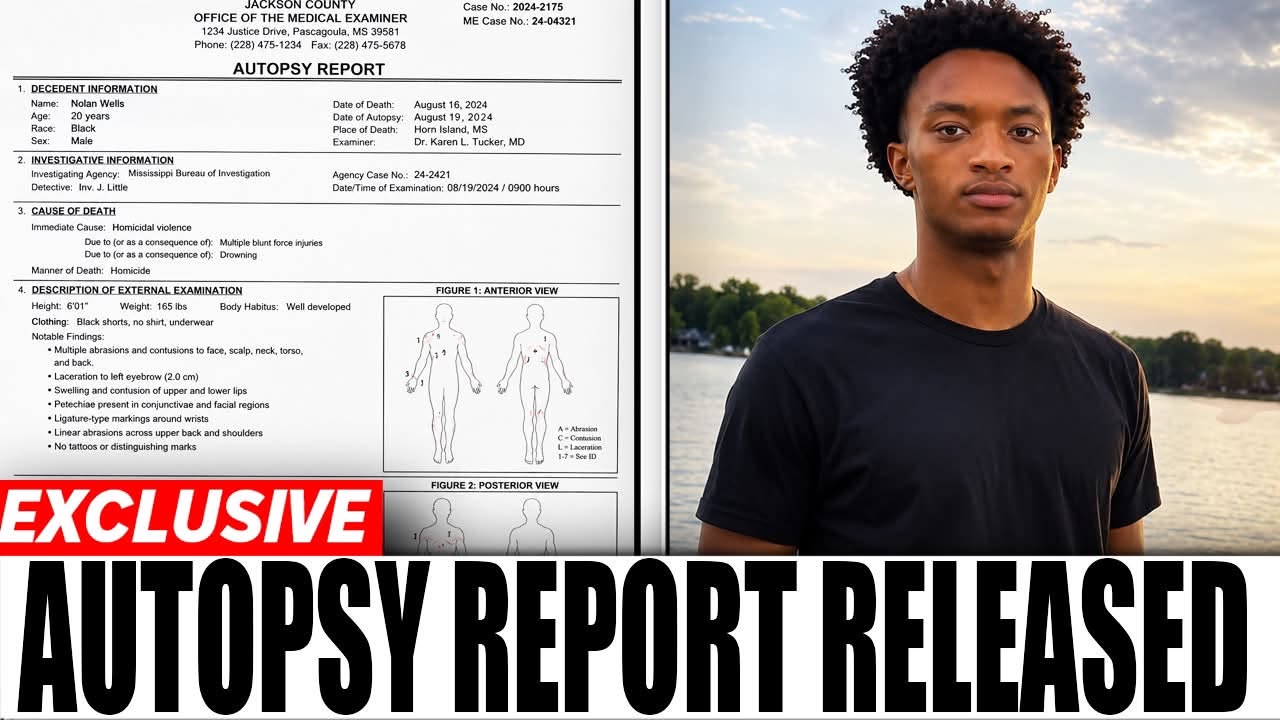
The official forensic report from the Mississippi State Medical Examiner’s Office focuses on establishing the mechanical markers of drowning. According to details made available through investigative channels, the recorded biological indicators include:
- Fluid in the Airway: The victim’s lungs were congested, hyper-inflated, and contained a significant volume of fluid mixed with marine particulate matter (such as fine sand and silt). This is a classic indicator that the victim was still breathing when submerged, gasping in vain before losing consciousness.
- Absence of Severe Bone Trauma: Initial X-rays and CT scans recorded no major bone fractures, no skull trauma consistent with blunt-force impacts from weapons, and completely intact joints.
- Estimated Time of Death: Based on the progression of rigor mortis and biological tissue decomposition in the warm summer saltwater of the Gulf of Mexico, the time of death was estimated to fall between the late evening of July 4th and the early morning of July 5th.
Based on these foundational points, Jackson County investigators have leaned toward closing the case as an accident: that Nolan remained on the island alone, potentially attempted to swim after a departing vessel or encountered a severe cramp while wading in the darkness, and was swept away by currents.
The Independent Report: Disquieting Details on the Decedent’s Body
In stark contrast to the uncomplicated narrative outlined by local authorities, the independent autopsy report commissioned by the Wells family centers tightly on “silent bruising” found on Nolan’s body.
In high-profile American cases involving racial dynamics or perceived institutional bias, independent examiners scrutinize soft-tissue trauma with extreme care—details that might otherwise be overlooked or attributed to post-mortem aquatic impacts. Preliminary findings from the family’s independent forensic team are shifting the context of the case:

1. Blunt-Force Contusions and Ecchymosis
Independent experts discovered localized areas of subcutaneous bruising on Nolan’s wrists, forearms, and the back of his neck. Crucially, the bruising on his wrists exhibits a symmetrical, circular pattern, strongly suggesting manual restraint, gripping, or forceful pulling by another individual prior to death. If this were a standard drowning, why would a physically powerful young adult bear defensive or restraint-type injuries?
2. Questioning the Drowning Mechanism at Dog Key Pass
Following rescue dispatch audio disclosures that Nolan was last seen near Dog Key Pass—a treacherous strait notorious for unpredictable undertows and violent rip currents—the independent pathologists have closely analyzed sediment density and fluid pressure within the lung parenchyma.
Had Nolan been pushed or forced into the volatile waters of this transition zone, his body would display trauma consistent with impact against submerged sandbars or sharp drop-offs. The independent report seeks to evaluate whether the trauma to the back of his neck correlates with a forced submersion mechanism from behind.
3. The Toxicology Frontier
An indispensable component of both reports is the pending toxicology panels evaluating blood and vitreous humor chemistry. The Wells family has raised a critical hypothesis: Was Nolan drugged, given an unwanted substance, or pressured into a state of severe intoxication that incapacitated his self-preservation instincts before he was left behind?
The toxicology findings will provide an unyielding answer. If chemical markers register within expected baseline thresholds, the narrative that Nolan acted erratically due to voluntary, excessive substance use will face heavy legal scrutiny.
A Scientific Comparison of the Forensic Perspectives
To better map out the fundamental differences between the two medical viewpoints, consider the following scientific cross-reference:
| Examination Metric | Preliminary State Forensic Stance | Independent Forensic Perspective |
| Cause of Death | Drowning due to submersion in a liquid medium. | Drowning, but with markers of pre-submersion trauma or physical restraint contributing to the event. |
| Manner of Death | Accidental. | Undetermined / Suspicious, with indicators warranting a criminal homicide investigation. |
| Soft-Tissue Trauma | Deemed post-mortem artifacts caused by marine life or natural contact with underwater hazards. | Identified as ante-mortem (occurring prior to death), pointing to a physical altercation or forced restraint. |
| Investigative Direction | Closes the file as a tragic holiday weekend drowning accident. | Keeps the investigation open to pursue potential charges of homicide or criminal negligence via abandonment. |
Heavy Pressure on the Grand Jury
The profound divergence between these two medical assessments explains why Jackson County District Attorney Angel Myers McIlrath has committed to presenting the completed investigation to a Grand Jury. Before an independent panel of citizens, forensic experts from both sides will be required to present tissue sections, toxicology charts, and gross anatomy photographs under oath.
Confronted with the cold, scientific observations from the laboratory, Christine Wonsley—Nolan’s mother—spoke out through her grief. Addressing the media, she expressed her unyielding determination:
“They want to tell me that my son just walked into that water on his own and disappeared. But Nolan’s body is talking. The bruises on his wrists, the marks on his skin—they show he fought until his very last breath. We are not going to let a rushed, superficial report bury the truth.”
With a cell phone wiped clean of Snapchat activity, glaring inconsistencies in the statements of the three white companions, and now critical counter-findings from an independent autopsy, the momentum behind the case is shifting. Nolan Xavier Wells’ voice may be silenced, but the biological evidence left behind is systematically forcing the hidden details of July 4th into the open, ensuring that his memory is met with absolute legal transparency.