Speaking out publicly for the first time since her husband’s tragic death at the hands of a U.S. Immigration and Customs Enforcement (ICE) agent, young widow Karolina Rojas Alvarez exposed a completely different side of Johan Sebastian Duran Guerrero—not as a cold “illegal immigrant” on paperwork, but as an exemplary father, a devoted husband, and the sole provider of a shattered young family.
Echoes of Grief from The Lincoln Hotel
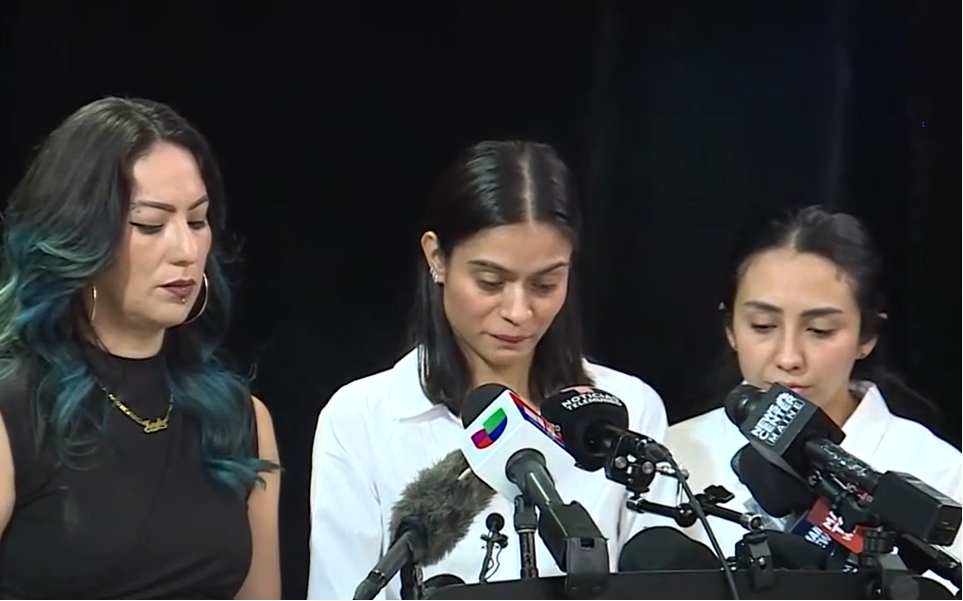
Last Thursday afternoon, a somber atmosphere enveloped a press conference held at The Lincoln Hotel in Biddeford, a city just outside Portland, Maine. Karolina Rojas Alvarez stepped up to the microphone, her face haggard from sleeplessness and profound grief. This was her first public appearance since that dark Monday—the day her husband, Johan Sebastian Duran Guerrero, a 25-year-old Colombian national, was shot and killed by an ICE agent at a Biddeford intersection.
Alvarez shared that she gathered the courage to stand before the media’s lenses because she wants the world to remember her husband for who he was when he lived, rather than the horrific manner in which his life was stolen.
“All I have left are the photos and a blanket with the three of us on it that he gave [our daughter] a few weeks before. My soul is broken. He was everything to me,” Alvarez said through tears. “He never let me worry about anything. I feel so unprotected. I wish I could run into his arms and hear him say: ‘It’s OK, mi flaca (an affectionate Spanish term meaning “my skinny girl”), I’m right here.'”
According to Alvarez, Guerrero was a hardworking man driven by immense love. He worked multiple jobs tirelessly to ensure his wife and 3-year-old daughter had everything they needed. He hated staying still and was always active and full of positive energy.
Ironically, that fateful Monday was supposed to be a joyful day. Guerrero had planned to spend most of it playing with his daughter. But he never returned. Alvarez bitterly admitted that, up until now, she still cannot find the strength to explain to their innocent child that her father will never be coming home.
Two Conflicting Portraits: A Dedicated Family Man or an “Illegal Immigrant”?
The shooting in Biddeford immediately reignited the fierce and perennially sensitive debate surrounding immigration in the United States. Behind the dry, bureaucratic reports of federal authorities lies a complex and deeply tragic real-life story.
An Exemplary Worker in the Eyes of the Community
The Maine Immigrant Rights Coalition (MIRC) stated that Guerrero was on his way to work when the shooting occurred. The coalition’s executive director emphasized a critical detail: Guerrero was fully authorized to work in the United States and had been issued a Social Security number (SSN).
From their hometown in Colombia, the victim’s sister, Angie Carolina Duran, also spoke out in anger and pain:
“We demand help to clarify what happened and justice, as it’s a huge pain that is affecting our family,” Duran said. “He was a wise guy, he never got into trouble, not here nor there (in the U.S.), so he only commuted from work back to his home, that’s it, he was devoted to his family.”
The Perspective of the Department of Homeland Security (DHS)
In stark contrast to the picture of a model community member, a spokesperson for the U.S. Department of Homeland Security presented rigid legal timelines. According to DHS, Guerrero “illegally entered the United States on Sept. 1, 2023, via the southern border.” Although the agency acknowledged he was granted a work permit in May 2025, they maintained that this did not alter his original unlawful status in the country.
Currently, it remains unclear whether Guerrero had a pending asylum case. Under U.S. immigration law, work permits can be granted to individuals with pending asylum claims while they are in the country. However, DHS stressed that even if an asylum claim was pending, it would not erase Guerrero’s status of being in the United States illegally.
It is precisely this discrepancy between a “legal work permit” and “entry status” that pushed Guerrero into a legal gray area, ultimately leading to a fatal end at a Maine intersection.
Unanswered Questions and the Upcoming Legal Battle
The death of Johan Sebastian Duran Guerrero is not only a family tragedy but also raises a massive question mark regarding the use-of-force protocols by ICE agents. Why was a man with no criminal record, simply commuting to work, shot dead in the middle of the street? Was there a systemic abuse of power or a critical misjudgment?
Benjamin Gideon, a prominent attorney representing Guerrero’s family, stated that they are currently gathering evidence and preparing the necessary legal steps. A civil lawsuit against the federal law enforcement agency is expected to be filed in the near future.
The Family & Coalition’s Perspective
Law Enforcement’s Perspective (ICE/DHS)
• Granted a legal work permit (May 2025). • Held a valid Social Security Number (SSN). • No criminal record; a diligent man who only commuted between home and work. • Shot while on his way to his workplace.
• Illegally entered the U.S. via the southern border (Sept. 1, 2023). • Work permit did not alter his underlying unlawful presence. • The shooting occurred within the context of an official immigration enforcement operation.
The upcoming legal battle will undoubtedly be arduous. Lawsuits against federal agencies like ICE always face the steep hurdle of “qualified immunity” granted to federal agents. However, attorney Gideon asserted that the family will pursue the case to the very end to uncover the truth.
Conclusion: Behind the Statistics are Human Lives
While political debates over immigration waves and ICE’s authority continue to echo through legislative halls, a young mother in a quiet corner of Maine faces an bleak and uncertain future, and a 3-year-old child still waits innocently for her father to bring home gifts after his shift.
The death of Johan Guerrero serves as a stark reminder to the world: behind bureaucratic terms like “refugee,” “undocumented immigrant,” or “deportation target” are real human beings of flesh and blood, with dreams, aspirations, and loved ones waiting for them to return home. Karolina Rojas Alvarez’s plea at The Lincoln Hotel was not just a cry for justice for her husband—it was a call for society to view immigrants through a lens of humanity and empathy, before a cold gunshot permanently robs them of their chance to explain.