I Arrived at the Family Party and Found My Children Serving Tables in Aprons
I Arrived at the Family Party and Found My Children Serving Tables in Aprons; When I Asked Why They Were Being Humiliated, My Parents Said, “That’s How They Learn Their Place,” in Front of Everyone. I Felt Something Inside Me Finally Break.
The very first thing that hit me was the sound of laughter.
It wasn’t the lighthearted kind that usually accompanies birthday cake, cousins talking over background music, and kids playing tag across the lawn. This laughter possessed a sharp, cruel edge. It drifted across the outdoor event venue alongside the aroma of smoked barbecue and warm frosting under the warm Denver sun.
My keys were still clutched in my hand when my father’s voice boomed above the chatter of the tables.
“If Arthur couldn’t raise a proper family the way God intended,” he declared, raising his glass high, “then the least his kids can do is learn how to serve others early on.”
For a brief second, my mind refused to process the scene right in front of me.
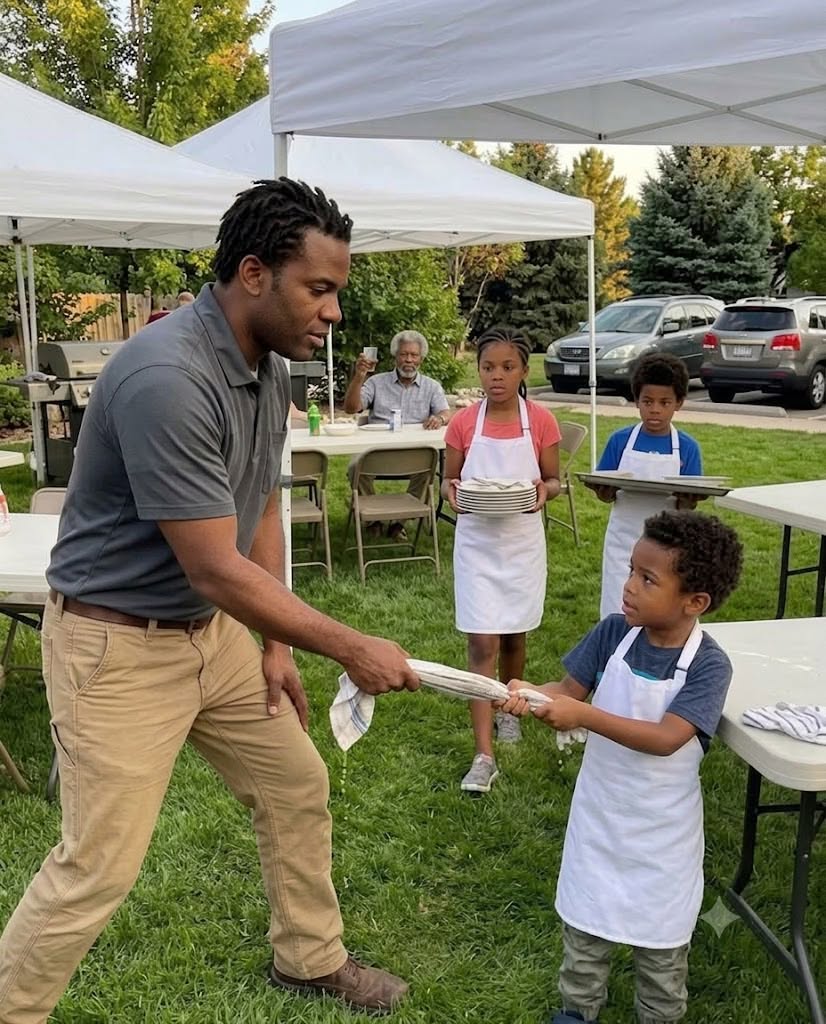
Maya, my ten-year-old daughter, was weaving between tables wearing a white apron, carrying a stack of dirty dishes nearly up to her chin. Her eyes were puffy and bloodshot—that distinct look a child gets when she’s desperately fighting back tears under the gaze of adults.
Lucas, eight, was trembling beneath a heavy serving platter far too wide for his small arms while two of my uncles chuckled and warned him not to drop a thing.
And Leo, my six-year-old, was scrubbing down a sticky table with a wet rag while two teenage cousins held up their smartphones, filming him as if he were part of the afternoon’s entertainment.
Something inside me went completely numb.
I am a single father. My children have different mothers, a fact that certain relatives have always used as an excuse to look down on the family I built. But inside our home, those three kids aren’t “half” anything. They share cereal boxes before school, argue over the TV remote, leave their sneakers everywhere, and pass out together on the sectional when movie night runs late.
They are my whole world.
My parents, Richard and Evelyn, had never accepted my life.
For years, I swallowed their jab after jab simply because they were my parents. “Three kids, three different mothers, no wife.” “A respectable man doesn’t build a fractured household.” “One day you’ll understand what shame really feels like.”
What made their judgment even harder to stomach was that while they looked down on my life, they relied heavily on it.
I covered the utility bills for the suburban house I let them stay in. I bought their groceries whenever my mother’s debit card was declined. I paid for my father’s prescriptions, their auto insurance, the hot water heater replacement, and more unexpected expenses than I could keep track of.
I had built two successful local diners and a small catering company from the ground up after starting with nothing at nineteen. My name was on the business licenses, payroll documents, supplier contracts—and the rental agreement for the venue where this very event was taking place.
It was my mother’s 70th birthday celebration.
At 2:18 p.m., I had sent her a quick message: “Please bring the kids over by 3. I’ll meet you there right after my catering delivery. Just keep an eye on them for a couple of hours.”
She texted back: “Of course, sweetheart. Don’t worry about a thing.”
So I didn’t.
I pulled up a little after 4:30 p.m. expecting music, cake, and my children running over to greet me. Instead, my entire extended family sat relaxed beneath white canopy tents while my kids catered to them like hired hands.
My father spotted me and held his glass up once more.
“Look at that,” he announced to the crowd. “That’s how you correct poor parenting. Nobody in this family gets special treatment just because they’re Arthur’s kids.”
A few relatives chuckled. Others stared down at their plates. One cousin suddenly became intensely focused on his phone screen. My aunt kept slicing her cake into tiny bits just to avoid eye contact with me.
Plastic forks froze mid-air. A red cup tilted precariously in someone’s hand. Birthday candles flickered out while a stray napkin drifted across the grass near Lucas’s shoe. Nobody told the teenagers to stop recording.
Then Leo caught sight of me.
“Daddy…”
That single word nearly brought me to my knees.
I walked across the lawn without raising my voice. Every furious instinct inside me wanted to flip the tables upside down and force every laughing person there to realize what they had done. But my children were watching me.
So I gently took the damp rag from Leo’s small hand and scooped him up into my arms. His fingers clung tightly to the collar of my shirt as if he’d been waiting for permission to just be six years old again.
I unknotted Lucas’s apron. The string had been pulled so tight that a red mark encircled his waist.
Then I placed a hand on Maya’s shoulder. Her chin began to tremble the moment I touched her.
“Who made you wear these?” I asked.
My voice was dead quiet. That calm tone seemed to unnerve the room far more than shouting ever could have.
My mother offered a dismissive smile from the head table.
“Don’t make a big deal out of it,” Evelyn said smoothly. “We were only teaching them a little humility.”
Maya let out a shaky breath. Lucas kept his eyes fixed on the grass. Leo buried his face in my shoulder.
Then my father leaned back in his chair, glass still gripped in his hand, wearing the exact same arrogant expression he had worn every time he assumed I would eventually bite my tongue and comply.
“That’s how they learn their place,” he sneered.
And for the very first time in my life, I stopped seeing my parents as people I was obligated to forgive. I saw with absolute clarity what they had done with every second chance I had ever handed them.
I shifted Leo higher on my hip, took Maya and Lucas by their hands, and turned toward the head table where my mother’s smile was finally starting to fade.
Then I said—
“Pack up your things,” I said.
My voice wasn’t a roar; it was a blade sliding out of a sheath. “All three of you, go straight to my truck. Lock the doors. Daddy will be there in two minutes.”
Maya didn’t hesitate. She grabbed Lucas’s hand, took the keys from my pocket, and marched toward my F-150 parked at the far end of the lawn. Not a single person at those white-linen tables dared to say a word to stop them.
My mother, Evelyn, stood up from her chair, her pearl necklace catching the afternoon light. “Arthur, don’t be dramatic. It was just a little chore! Kids these days are far too soft, and you indulge them because of your own guilt over their mothers—”
“Quiet, Evelyn,” I said.
The entire venue went so still you could hear the wind rustling through the canopy tents. I had never called my mother by her first name in my thirty-four years on this earth. The color instantly drained from her face.
My father, Richard, slammed his whiskey glass onto the table, splashing amber liquid over his napkin. “How dare you speak to your mother like that! You show some respect in front of this family!”
“Respect?” I let out a short, cold laugh that made two of my cousins flinch. “You want to talk about respect, Richard? Let’s talk about it.”
I took three slow, deliberate steps toward the head table. Every eye in the family—uncles, aunts, cousins, in-laws—was fixed on me. The teenagers had stopped filming. The cruelty that had felt so comfortable moments ago had suddenly turned into sharp, suffocating panic.
“You sat here and humiliated my children because you think my life is a failure,” I said, pointing a finger directly at my father. “You called them servants. You told everyone here that they needed to ‘learn their place.’ Well, let’s talk about places.”
I pulled my phone out of my pocket, tapped the screen, and placed it face-up on the head table right beside my mother’s birthday cake.
“Every single vendor at this venue—the caterers, the sound system, the tent rental, the open bar—is booked under Sterling Hospitality Group. That’s my company,” I said, my voice echoing across the silent lawn. “The deposit on this park shelter? Paid from my personal checking account. The ribs you’re eating? Smoked in my diner’s kitchen this morning by staff I pay.”
My mother’s hand fluttered to her throat. “Arthur, please…”
“No, Evelyn. You don’t get to ‘sweetheart’ your way out of this,” I cut her off smoothly. “You think I’m the failure of this family? Let’s look at the financial reality of the man standing before you.”
I turned my gaze to my uncles, who suddenly looked very interested in the grass beneath their shoes.
“Who paid for Uncle Mark’s bail when he got his second DUI three years ago? I did. Who covered Aunt Sarah’s mortgage installment when her shop went under? I did. And who buys the blood pressure medication Richard takes every single month because his pension doesn’t cover it?” I stared directly into my father’s eyes. “I do.”
Richard’s jaw worked silently, his face flushing a deep, angry crimson, but for the first time in his life, he couldn’t find a single insult to throw back.
“And then there’s the house,” I continued, leaning down until I was eye-level with my mother. “The three-bedroom brick house in Arvada that you two live in. You tell the neighbors you ‘downsized’ into it. The truth is, my name is on the deed. I bought it. I pay the property taxes. I pay the water bill, the electric bill, and the home insurance.”
My mother gasped, looking around frantically at her sisters and friends, terrified of the truth exposed in front of everyone she had spent a lifetime trying to impress.
“You wanted my kids to learn their place?” I asked, my voice dropping to a whisper that felt heavier than thunder. “Their place is in my heart, in my home, and as the sole heirs to every single dollar I build. Your place was being my parents. But you traded that away today for a few cheap laughs.”
I reached out, tapped my phone screen, and opened my banking app. In three quick taps, I canceled the corporate card attached to the catering order for the party, revoking the venue clearance for the remainder of the evening.
“The venue manager will be out here in about five minutes to shut down the power and pack up the tents,” I announced to the entire gathering. “Anyone who wants to stay and finish the party can figure out how to settle the five-thousand-dollar remaining balance with the manager themselves.”
Screams of shock erupted from a few of my aunts. Uncle Mark sat up straight. “Arthur! You can’t just cancel your mother’s 70th birthday!”
“Watch me,” I replied without looking back at him.
I picked up my phone and turned toward my father, who was leaning heavily against his chair, suddenly looking very old, fragile, and utterly defeated.
“You have until 5:00 p.m. this Friday to pack your things and leave my house in Arvada,” I told him, every word laced with unbreakable finality. “I’m putting it on the market on Monday. Since you think I’m such a terrible father, you can find a proper landlord to take care of you.”
“Arthur! You’re evicting your own parents?!” my mother shrieked, tears finally bursting past her mascara as she grabbed my forearm. “Where are we supposed to go?! We don’t have the money for rent!”
I looked down at her hand on my arm, then looked up into her eyes. The anger inside me had completely burned away, leaving behind nothing but cold, crystal-clear indifference.
“I don’t care,” I said quietly, shaking her hand off my sleeve. “That’s how you learn your place.”
I turned my back on the head table, walking away from the gasps, the panicked arguments breaking out among my relatives, and my mother’s desperate cries. I didn’t look back once.
When I opened the door to my F-150, the cab was quiet. Maya, Lucas, and Leo were sitting in the back seat, their eyes wide, watching me get into the driver’s seat. The aprons were crumpled on the floorboards.
I turned around, looked at all three of them, and felt the tightness in my chest finally ease.
“Who wants ice cream?” I asked, offering them a soft, genuine smile.
Lucas wiped a stray tear from his cheek and gave a small nod. Leo reached forward from his car seat and patted my shoulder.
Maya looked at me, her young eyes holding a newfound depth of understanding. “Are we ever going back there, Dad?”
I started the engine, pulled out of the parking lot, and set our course toward home—toward the place where we were safe, where we were loved, and where no one would ever make my children feel small again.
“No, baby,” I said, catching her eye in the rearview mirror. “We’re going forward.”
Six months later.
The autumn leaves were turning golden across the Denver foothills. I sat on the back patio of our new home in Littleton—a beautiful, sprawling four-bedroom house with a huge backyard where the kids could run until sunset.
The house in Arvada had sold within three weeks of being listed. My parents had been forced to move into a modest, two-bedroom apartment funded entirely by Richard’s modest pension and my mother’s small savings. Without my financial cushion, their days of grandstanding, throwing catered dinners, and looking down on others were permanently over.
When my uncles and aunts had tried to call me in the weeks following the party to lecture me about “family loyalty,” I had blocked their numbers one by one. I severed every financial link, closed every shared account, and cut off the toxicity that had quietly drained my spirit for decades.
My diners were thriving. We had just expanded our catering service to a second location, and for the first time in my adult life, every dollar I made went directly into building a secure, peaceful future for my children.
A laughter echoed from the lawn.
I looked up to see Maya helping Lucas build a wooden fort near the oak tree, while Leo raced around them with our new rescue retriever puppy, his high-pitched giggles filling the crisp autumn air. They were happy, confident, and completely free from the shadows of a family that had never deserved them.
My phone chimed on the patio table. It was a text from an unknown number—a short message from my mother, sent through a friend’s phone: Arthur, please. It’s almost Thanksgiving. Can we just talk? We miss the grandkids.
I looked at the screen for a long moment, feeling no bitterness, no anger, and no regret.
I didn’t reply. I simply deleted the message, locked my phone, and walked down the patio steps into the yard to join my children in the sunshine.