My 14-Year-Old Daughter Baked 40 Apple Pies for a Nursing Home—The Following Morning, Two Police Officers Arrived at Our Door With an Unexpected Question
My 14-Year-Old Daughter Baked 40 Apple Pies for a Nursing Home—The Following Morning, Two Police Officers Arrived at Our Door With an Unexpected Question
Chapter 1: The Midnight Bakery
The sweet, buttery aroma of roasted Gala apples, dark brown sugar, and cinnamon had saturated every corner of our two-story home in suburban Columbus, Ohio.
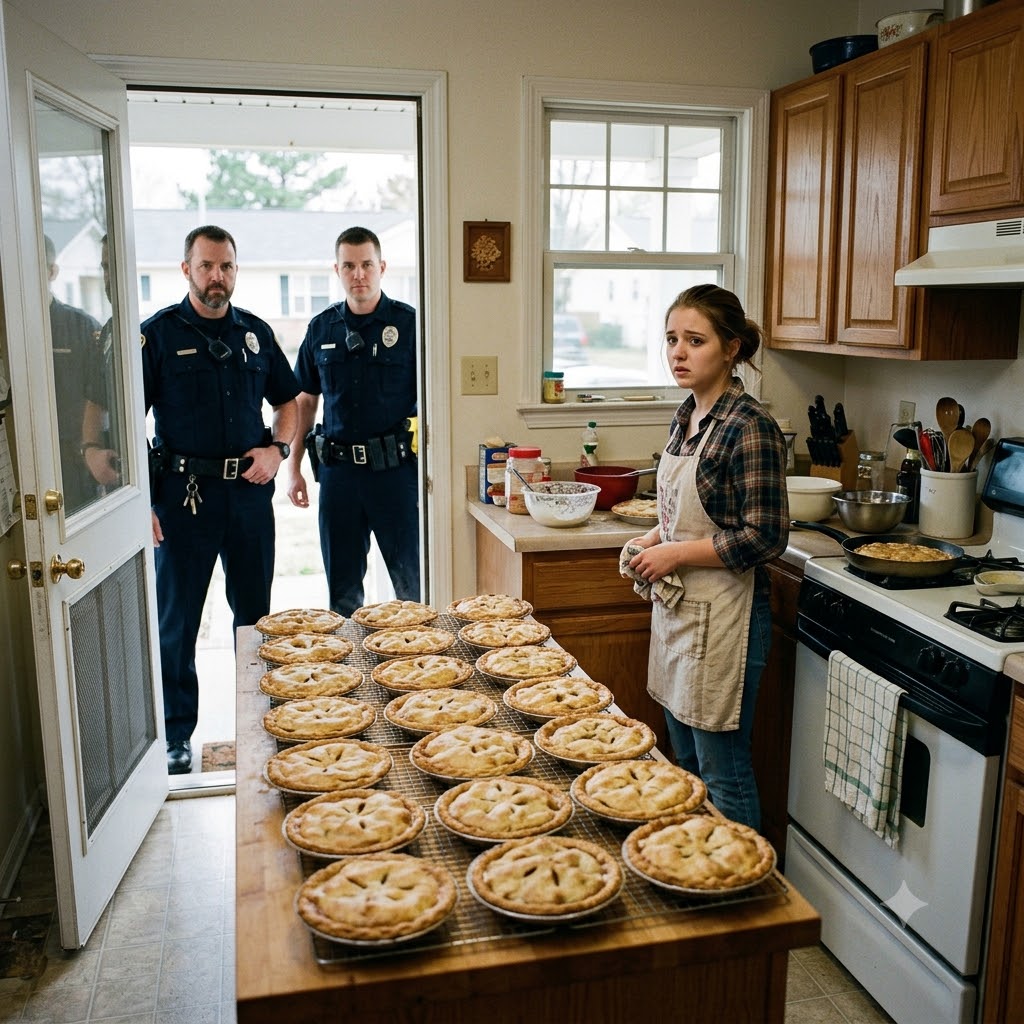
By 2:00 AM on a crisp Saturday morning, our spacious kitchen looked like a commercial bakery after a holiday rush. Flour dusted the granite countertops like a fresh snowfall, wooden rolling pins lay resting beside stacks of empty aluminum pie pans, and every single inch of stovetop and table space was occupied by golden-brown pastry crusts.
My fourteen-year-old daughter, Chloe, sat on a high kitchen stool, wiping a smudge of flour off her cheek with the back of her forearm. Her apron was covered in sugar stains, her dark hair was tied back in a messy bun, and her eyes were tired—but glowing with absolute pride.
“That’s forty, Mom,” Chloe whispered, her voice raspy with exhaustion as she closed the oven door on the final batch. “Exactly forty.”
I leaned against the refrigerator, holding two mugs of warm chamomile tea, looking at my daughter in sheer awe.
Chloe had spent three weeks saving her pocket money, odd-job earnings from walking the neighbors’ dogs, and allowance to buy fifty pounds of fresh apples, fifty pounds of flour, and gallons of heavy cream. Her goal was simple: she wanted to bring a hot, homemade dessert to every resident at Maplewood Senior Living, a local non-profit care facility down the road where her beloved grandmother had spent her final years.
“Your grandmother would be beaming right now, Chloe,” I said gently, handing her a mug. “You worked fourteen hours straight.”
“They deserve something made with love, Mom,” Chloe smiled, taking a slow sip of tea. “Not store-bought sheet cakes. A real pie tastes like home.”
By 8:00 AM, we had loaded all forty warm, foil-wrapped pies into the back of my Honda CR-V. We drove five miles down the road to Maplewood, where the weekend staff welcomed us with tears and open arms. We helped set up the dining hall, arranged the pies on serving carts, and watched the residents’ faces light up as the warm cinnamon fragrance filled the hallways.
Chloe spent two hours chatting with the elderly residents, listening to their stories, cutting slices, and handing out paper napkins. It was a picture-perfect morning of pure, selfless community kindness.
We arrived back home around noon. Exhausted and fulfilled, Chloe took a long shower and went straight to bed for a well-deserved nap. I cleaned the flour off the kitchen counters, poured myself a cup of fresh coffee, and looked forward to a quiet, peaceful weekend.
That peace lasted precisely forty-five minutes.
Chapter 2: Heavy Boots on the Porch
At 1:15 PM, a heavy, rhythmic knocking echoed through our front hallway—a sound too loud, too deliberate, to be a delivery driver or a neighbor dropping off mail.
I set my coffee mug down on the kitchen island, pulled open the inner wooden door, and froze.
Standing on our front porch, framed by the bright midday sun, were two uniformed officers from the Columbus Division of Police. Parked along the curb behind them was a marked black-and-white cruiser with its side lights flashing quietly….
Chapter 1: The Midnight Bakery
The sweet, buttery aroma of roasted Gala apples, dark brown sugar, and cinnamon had saturated every corner of our two-story home in suburban Columbus, Ohio.
By 2:00 AM on a crisp Saturday morning, our spacious kitchen looked like a commercial bakery after a holiday rush. Flour dusted the granite countertops like a fresh snowfall, wooden rolling pins lay resting beside stacks of empty aluminum pie pans, and every single inch of stovetop and table space was occupied by golden-brown pastry crusts.
My fourteen-year-old daughter, Chloe, sat on a high kitchen stool, wiping a smudge of flour off her cheek with the back of her forearm. Her apron was covered in sugar stains, her dark hair was tied back in a messy bun, and her eyes were tired—but glowing with absolute pride.
“That’s forty, Mom,” Chloe whispered, her voice raspy with exhaustion as she closed the oven door on the final batch. “Exactly forty.”
I leaned against the refrigerator, holding two mugs of warm chamomile tea, looking at my daughter in sheer awe.
Chloe had spent three weeks saving her pocket money, odd-job earnings from walking the neighbors’ dogs, and allowance to buy fifty pounds of fresh apples, fifty pounds of flour, and gallons of heavy cream. Her goal was simple: she wanted to bring a hot, homemade dessert to every resident at Maplewood Senior Living, a local non-profit care facility down the road where her beloved grandmother had spent her final years.
“Your grandmother would be beaming right now, Chloe,” I said gently, handing her a mug. “You worked fourteen hours straight.”
“They deserve something made with love, Mom,” Chloe smiled, taking a slow sip of tea. “Not store-bought sheet cakes. A real pie tastes like home.”
By 8:00 AM, we had loaded all forty warm, foil-wrapped pies into the back of my Honda CR-V. We drove five miles down the road to Maplewood, where the weekend staff welcomed us with tears and open arms. We helped set up the dining hall, arranged the pies on serving carts, and watched the residents’ faces light up as the warm cinnamon fragrance filled the hallways.
Chloe spent two hours chatting with the elderly residents, listening to their stories, cutting slices, and handing out paper napkins. It was a picture-perfect morning of pure, selfless community kindness.
We arrived back home around noon. Exhausted and fulfilled, Chloe took a long shower and went straight to bed for a well-deserved nap. I cleaned the flour off the kitchen counters, poured myself a cup of fresh coffee, and looked forward to a quiet, peaceful weekend.
That peace lasted precisely forty-five minutes.
Chapter 2: Heavy Boots on the Porch
At 1:15 PM, a heavy, rhythmic knocking echoed through our front hallway—a sound too loud, too deliberate, to be a delivery driver or a neighbor dropping off mail.
I set my coffee mug down on the kitchen island, pulled open the inner wooden door, and froze.
Standing on our front porch, framed by the bright midday sun, were two uniformed officers from the Columbus Division of Police. Parked along the curb behind them was a marked black-and-white cruiser with its side lights flashing quietly.
The lead officer was a broad-shouldered man in his late forties with graying temples, a stern, unreadable expression, and a heavy tactical belt holding a radio and firearm. Beside him stood a younger female officer, holding a black leather notebook and a pen.
My heart instantly slammed into my throat. Every mother’s worst nightmare flashed through my mind in a split second—a car accident, a family tragedy, a sudden disaster.
“Mrs. Miller?” the senior officer asked, his voice low, firm, and authoritative.
“Yes… yes, I’m Sarah Miller,” I stammered, my hand clutching the doorframe so hard my knuckles turned white. “Is… is everything okay, Officer? Did something happen?”
The officer didn’t smile. He looked past me into the entry hallway, taking a slow, deliberate step onto the porch floorboard.
“I’m Officer Hendricks, and this is Officer Ramirez,” he said. “We’re here regarding an incident that occurred at the Maplewood Senior Living facility on Oakmont Boulevard earlier today.”
My stomach dropped into a icy pit of confusion. “Maplewood? I… we were just there two hours ago. My daughter dropped off—”
“We know, ma’am,” Officer Hendricks interrupted, his voice dropping into a solemn, heavy register. “We were dispatched to the facility forty-five minutes ago following an urgent call from the facility administrator.”
He paused, adjusting his duty belt, looking me directly in the eyes.
“Mrs. Miller… does your daughter, Chloe Miller, own a blue smartphone with a cracked screen protector?”
I blinked, completely thrown off guard by the strange, specific question. “Yes… she does. She lost her phone somewhere in her room last night while she was baking. Why? What does her phone have to do with anything?”
Officer Hendricks exchanged a brief, serious glance with his partner. Officer Ramirez opened her notebook, tapping her pen against the page.
Then Officer Hendricks looked back at me and asked an unexpected question that made my entire world halt.
“Mrs. Miller… who provided your daughter with the sixty-thousand-dollar bearer bond that was baked inside the crust of Pie Number Seventeen?”
Chapter 3: The Secret in the Crust
I stared at the two officers, convinced my ears were playing a sick, surreal joke on me.
“A… a what?” I gasped, my jaw practically dropping. “A sixty-thousand-dollar… bearer bond? Inside an apple pie? Officer, that’s impossible. We bought the apples at Kroger! We mixed the flour in our own bowl!”
“May we come inside, Mrs. Miller?” Officer Hendricks asked calmly, stepping through the threshold as I instinctively backed away.
We walked into the living room. Officer Ramirez pulled a thick, clear plastic evidence bag from her tactical pouch and laid it gently onto our coffee table.
Inside the transparent plastic bag was a folded, heavy-grade paper certificate with ornate green borders, gold foil stamps, and visible grease stains along the edge. Half of the document was scorched brown, but the bold, black engraving at the top was crystal clear: UNITED STATES TREASURY BEARER OBLIGATION — VALUE: $60,000.
“An eighty-two-year-old resident named Arthur Higgins was given the slice from the seventeenth pie,” Officer Ramirez explained softly, her tone far gentler than her partner’s. “When he pressed his fork into the bottom crust, he hit something stiff. When the kitchen staff washed off the baked sugar, they found this document embedded between the dough layers.”
“That’s crazy!” I cried out, holding my hands to my head. “We didn’t put that in there! I helped Chloe peel fifty pounds of apples! We didn’t have sixty thousand dollars lying around our kitchen!”
“Mom… what’s going on?”
I turned around. Chloe was standing at the top of the staircase in her oversized pajamas, rubbing her sleepy eyes, looking down at the two armed police officers in our living room with sudden, wide-eyed terror.
“Chloe, stay right there, honey—” I started, but Officer Hendricks raised a hand gently.
“It’s okay, Mrs. Miller,” Hendricks said softly, looking up at my daughter. “Chloe, we’re not here to arrest anyone. But we need your help solving a very serious mystery. Do you recognize this document?”
Chloe walked down the stairs slowly, her eyes fixed on the plastic evidence bag on the table. She leaned over, read the green lettering, and her face went completely pale.
“Oh my gosh…” Chloe whispered, her voice trembling. “The old recipe binder…”
“What recipe binder, Chloe?” I demanded, rushing over to grip her shoulders.
“Grandma’s old wooden box!” Chloe stammered, tears suddenly filling her eyes. “The dark oak box Grandma left me when she passed away at Maplewood two years ago! I couldn’t find her apple pie recipe on my phone last night because my battery died… so I pulled out Grandma’s handwritten index cards from the hidden bottom folder of that wooden box!”
Chloe wiped a tear from her cheek, looking up at the officers with absolute innocence.
“There was an old, thick piece of stiff paper tucked inside the back lining of the recipe envelope,” Chloe wept. “It felt like heavy baking parchment… I thought Grandma had used it fifty years ago to keep the index cards flat so they wouldn’t bend! I used it last night on the counter as a scraping card to lift sticky dough off the marble island… I must have dropped it right onto the crust sheet and rolled it flat into the dough without realizing what it was!”
Chapter 4: The Mystery Unraveled
Officer Hendricks let out a long, slow breath, his stern face finally softening into a warm, human smile. He looked at his partner and shook his head in quiet disbelief.
“Your grandmother was Eleanor Miller?” Officer Hendricks asked.
“Yes,” I answered, my voice shaking as the pieces of a twenty-year family puzzle began falling into place before my eyes. “Eleanor lived at Maplewood for four years before she passed in 2024. Her husband—my father-in-law, Charles Miller—was an old-fashioned machinist who never trusted commercial banks after the financial crashes of the late 1970s.”
“Charles Miller…” Officer Ramirez murmured, flipping through her case notes. “We ran the serial number on the obligation bond through the Treasury registry thirty minutes ago. It was purchased in cash in 1984 by a Charles E. Miller of Columbus, Ohio.”
The room went dead quiet.
My father-in-law had passed away suddenly in 1998. For nearly thirty years, our family had heard rumors that Grandpa Charles had hidden his life savings somewhere inside their old farmhouse before it was sold, but no one had ever found a single penny.
He hadn’t hidden it in the attic floorboards or behind the basement bricks. He had tucked a bearer bond into the lining of his wife’s prized pie recipe box for safe keeping—where it sat undisturbed, untouched, and forgotten for four decades.
Until a fourteen-year-old girl decided to bake forty apple pies for a nursing home.
Officer Hendricks picked up the plastic evidence bag from the coffee table and handed it directly to me.
“Because this is an unregistered bearer instrument belonging to the late Charles Miller,” Hendricks said, a proud smile breaking across his weathered face, “it legally passes to his direct living heirs. Mrs. Miller, your daughter didn’t just bake pies today. She uncovered her family’s lost inheritance.”
Tears streamed down my face as I pulled Chloe into a fierce, tight hug. My daughter buried her face in my shoulder, laughing and crying all at once.
“Wait…” Chloe looked up suddenly, wiping her nose with her sleeve, her eyes widening. “What about Mr. Higgins? The resident who found it in his slice?”
Officer Hendricks chuckled, resting his hands on his duty belt. “Well, Mr. Higgins told the facility director that it was the best slice of pie he’d eaten in eighty-two years—even if it was a little chewy in the middle.”
Two weeks later, after the Treasury bond was legally redeemed and processed through our family attorney, my husband and I established a dedicated college trust fund for Chloe that completely covered her future university tuition.
And with the remaining funds, Chloe bought brand-new industrial baking equipment, fifty fresh crates of Gala apples, and organized the first annual Miller Family Charity Bake-Off—delivering over three hundred warm, homemade pies to every senior center across central Ohio.
This time, however, we checked every single crust twice before putting it in the oven.
Chapter 5: The Ripple Effect
The local news anchor from WBNS-10TV in Columbus sat on the floral armchair in our living room, adjusting her lapel microphone while a camera operator framed the shot.
“Three, two, one…” the floor manager signaled.
“Tonight,” the anchor beamed into the camera lens, “we bring you a story that proves warm cinnamon, buttery crusts, and pure kindness can unlock small miracles. What began as a fourteen-year-old girl’s tribute to her late grandmother at Maplewood Senior Living turned into the discovery of a lost family treasure—and a community movement that is sweeping across Central Ohio.”
In the weeks following the discovery of Grandpa Charles’s 1984 Treasury bond, our suburban home had transformed from a quiet residence into the unofficial headquarters of a blossoming non-profit initiative.
The story had spread like wildfire. What started as a brief paragraph in the Columbus Dispatch was picked up by national news syndicates. Within days, our kitchen table was piled high with letters, emails, and phone calls from people across the country—some sharing their own memories of Eleanor and Charles Miller, others asking how they could volunteer, and dozens of local business owners offering to sponsor Chloe’s expanding charitable vision.
“Chloe,” the news anchor turned to my daughter, holding out her microphone. “When you rolled out that dough on a dark Friday night, did you ever imagine that one pie would change your life?”
Chloe smiled modestly, looking down at her hands. “I just wanted the grandmas and grandpas at Maplewood to feel remembered. My grandmother used to say that baking for someone is the quietest way of saying ‘I love you.’ I didn’t care about money. I just wanted them to taste home.”
What Chloe didn’t mention on air, however, was that the story was far from over. Grandpa Charles’s legacy held one more surprise for us—one that was sitting inside a heavy steel safety deposit box at the Huntington National Bank on High Street, waiting for us to turn the key.
Chapter 6: The Hidden Compartment
Three days after the television interview aired, my husband, David, and I accompanied Chloe to the downtown branch of Huntington National Bank.
After verifying our legal documentation and probate certificates, the bank’s trust officer led us down into the cool, fluorescent-lit vault below ground level. He unlocked a long, rectangular metal safety deposit box—Box 412—which had remained untouched since my father-in-law had rented it in the spring of 1996, two years before his sudden heart attack.
“Your father paid thirty years of rental fees up front in cash, Mr. Miller,” the trust officer explained softly as he pushed the heavy box across the polished mahogany table. “The lease agreement officially expires this month. You arrived just in time.”
David’s hands trembled slightly as he lifted the heavy brass lid.
Inside the box lay three items: a faded leather-bound journal, a brass key attached to a wooden key tag stamped with the letters M.M. – WORKSHOP, and a sealed Manila envelope addressed to My Grandchildren.
David picked up the Manila envelope and carefully broke the yellowed tape. Inside was a handwritten letter penned in the thick, blocky print characteristic of a lifelong machinist.
To Whomever Finds This,
If you are reading this note, it means my Eleanor has passed, and someone in the family was smart enough to look inside her recipe collection. Eleanor always scolded me for hiding things where rust and dust couldn’t find them, but I knew her pie recipes would outlast any iron vault I ever built.
The bearer bond you found was meant to keep the roof over Eleanor’s head if the world ever fell apart. But if you have opened this bank box, you have also found the key to my old machine shop behind the old farmhouse on County Road 14.
Before the county bought the acreage for the new bypass, I poured a double-walled steel gun safe into the concrete slab under the heavy lathe in the back corner. Inside, you’ll find the blueprints, the land patents, and the original brass prototypes for the self-lubricating ball-bearing assembly I patented in 1982.
Don’t let the corporate lawyers tell you the patent expired without royalties. Check the secondary license with the General Motors supplier in Akron. They’ve been paying into an escrow account since 1994.
Teach the kids how to work with their hands. Tell Eleanor I love her.
— Charles E. Miller
David sat back in his chair, staring at the paper in stunned silence.
“The lathe…” David whispered, his voice catching in his throat. “When the county bought the old farm back in 2002 to build the interstate connector, they demolished the house, but the old brick machine shop was preserved as a historical landmark by the township. It’s been sitting empty for over twenty years.”
Chloe leaned over her father’s shoulder, her eyes wide as she studied the brass key. “Dad… does this mean Grandpa Charles was an inventor?”
“He was more than an inventor, sweetie,” David murmured, pulling Chloe into a side hug. “He was a man who worked in silence so his family would never have to worry about tomorrow.”
Chapter 7: The Miller Family Foundation
The legal resolution of Charles Miller’s escrow accounts took nearly six months of meticulous work by our family attorney.
When the final audits were completed, the back-royalties from the industrial patent—which had accrued quietly in a commercial escrow trust for over thirty years—represented a life-changing sum. It was enough to ensure that not only Chloe, but future generations of the Miller family, would have complete financial security.
Yet, sitting around our kitchen table on a cold Sunday afternoon in November—the very same kitchen where forty apple pies had been baked under the midnight oil—our family came to a unanimous decision.
We weren’t going to buy sports cars or luxury vacation homes.
“Grandpa Charles hid that money because he was afraid of losing it,” Chloe said quietly, cradling a mug of hot cocoa. “And Grandma Eleanor spent her whole life giving away whatever she had to the neighbors. I think we should build something that lasts.”
With the guidance of local community leaders and non-profit advisors, we established The Eleanor & Charles Miller Community Foundation.
Our first major project was the complete purchase and renovation of an abandoned 6,000-square-foot commercial building on the south side of Columbus. Within eight months, the rundown brick structure was transformed into a state-of-the-art culinary arts training center and community kitchen named Eleanor’s Hearth.
The facility was designed with a two-fold mission:
- Youth Culinary Apprenticeships: Providing free, vocational baking and culinary arts training to underprivileged teenagers and high school students across Franklin County.
- Senior Meal Delivery: Preparing and delivering over one thousand fresh, warm, homemade meals and desserts every single week to low-income senior living facilities, homebound veterans, and hospice care centers throughout Central Ohio.
On the morning of our grand opening, the air inside Eleanor’s Hearth smelled identical to our kitchen on that miraculous Saturday night: roasted Gala apples, dark brown sugar, sweet butter, and cinnamon.
Dozens of local volunteers, high school students in crisp white aprons, and news crews filled the spacious stainless-steel kitchen.
Standing near the main entrance, dressed in a sharp navy blazer over a floral dress, was an unexpectedly distinguished guest of honor.
Eighty-two-year-old Arthur Higgins sat comfortably in a wheelchair near the ribbon-cutting stage, wearing a tweed flat cap and holding a wooden walking cane. Beside him on a small pedestal was a framed photograph of Pie Number Seventeen—complete with a golden plaque honoring his role in unearthing the lost bearer bond.
“Mr. Higgins,” Chloe smiled, kneeling beside his chair and handing him a fresh, warm slice of apple pie on a ceramic plate. “We made sure this batch was completely parchment-free.”
Arthur let out a rich, booming laugh that echoed through the high-ceilinged bakery.
“Now hold on a minute, Miss Chloe,” Arthur winked, taking a forkful of the flaky crust and savoring the taste. “That paper crust of yours was the luckiest thing that ever happened to this town. But I have to admit… this one tastes a whole lot better.”
Chapter 8: The Legacy of Pie Number Seventeen
Four years passed.
On a crisp, golden September afternoon, I stood on the manicured lawn of the Ohio State University campus, holding a program guide for the College of Food, Agricultural, and Environmental Sciences commencement ceremony.
Sitting beside me was David, holding a large bouquet of yellow sunflowers, his eyes shining with unmistakable pride.
Up on the main stage, the Dean of the university stood at the podium, addressing the crowd of proud parents, faculty members, and graduating students.
“Each year,” the Dean’s voice echoed over the loudspeakers, “our department presents the Leadership in Community Service Award to an undergraduate student who has demonstrated exceptional initiative in combining agricultural science, business management, and humanitarian outreach.”
The Dean paused, smiling down at the front row of graduates.
“This year’s recipient began her journey at fourteen years old, armed with fifty pounds of apples, fifty pounds of flour, and a midnight dream to bring comfort to the elderly residents of our city. Today, as the founder and executive director of an organization that has served over 250,000 fresh meals to seniors across three states, she graduates with top honors in Food Science and Agricultural Business.”
The crowd erupted into resounding applause as the Dean announced her name:
“Chloe Miller!”
Chloe stepped forward onto the stage, dressed in her black cap and gown, her dark hair flowing neatly over her shoulders. She accepted the heavy bronze medallion, smiled warmly for the official photographer, and turned to look out into the audience.
Her eyes found David and me in the fifth row. She held up her diploma folder, offering us a subtle, knowing nod.
Later that evening, after the family celebratory dinner, Chloe drove us down to Maplewood Senior Living.
The facility had expanded over the years, adding a new garden courtyard and a dedicated wing funded in part by the Miller Foundation. As we walked through the familiar wooden doors, the evening sun cast warm, golden rays through the stained-glass windows of the dining hall.
Though Mr. Arthur Higgins had passed away peacefully two years prior at the age of eighty-four, his memory remained alive and well. A brass plaque mounted on the dining hall wall read: Dedicated to Arthur Higgins & Eleanor Miller — Where Every Slice Tells a Story.
Chloe walked up to the serving counter, where three high school volunteers from Eleanor’s Hearth were setting out trays of warm, freshly baked desserts for the evening residents.
She picked up a small aluminum pie pan, looking at the golden lattice crust resting inside.
“You know, Mom,” Chloe said quietly, looking out at the elderly residents chatting happily at the round dining tables. “Sometimes I still think about that night in our kitchen. How tired I was at two in the morning. How my arms ached from rolling out forty sheets of dough.”
“You worked so hard, sweetie,” I murmured, resting my hand on her shoulder.
“I used to think it was just a crazy coincidence,” Chloe smiled, turning the pie pan gently in her hands. “A piece of old paper stuck to a recipe card, dropped into a crust by accident because my phone battery died.”
She looked at me, her eyes filled with the same bright, pure warmth that had lit up our kitchen four years ago.
“But standing here today, seeing all these smiling faces… I know it wasn’t an accident at all. Grandma and Grandpa just knew we needed a little push to start doing what we were meant to do.”
We spent the next hour doing what we loved most: walking between the tables, cutting slices of warm apple pie, listening to lifelong stories, and spreading quiet, homemade love—one slice at a time.
And as always, before a single pie left the kitchen counter, we checked every single crust twice.