Every morning at 5 AM, rain or shine, my husband leaves for a two-hour run—yet he never sweats. His shirt is always dry, his face never flushed, and his breathing is as calm as if he’d just gone for a casual stroll. Instinct told me something was wrong—and then…
Every morning at 5 AM, rain or shine, my husband leaves for a two-hour run—yet he never sweats. His shirt is always dry, his face never flushed, and his breathing is as calm as if he’d just gone for a casual stroll. Instinct told me something was wrong—and then…
Chapter 1: The Dry Collar
The alarm on the nightstand didn’t sound; it merely hummed—a soft, rhythmic vibration designed to wake only the man sleeping on the right side of the king-sized bed.
It was 4:55 AM in Oak Ridge, Tennessee. Outside our master bedroom window, an autumnal downpour battered the black glass, sweeping heavy gusts through the towering yellow pines that framed our cul-de-sac.
Beside me, Marcus sat up with the smooth, silent economy of motion that had defined him for as long as I had known him.
At thirty-eight, my husband looked like an advertisement for suburban vitality. He was six-foot-one, with lean, carved shoulders, short dark hair shot with distinguished silver at the temples, and a clean-shaven jawline that seemed immune to morning bloating. He was a senior research engineer at the Oak Ridge National Laboratory—a quiet, brilliant man who spent his days analyzing high-density composite materials for classified energy projects.
I kept my eyes squeezed shut, maintaining the slow, rhythmic breathing of deep sleep.
I watched him through the slit between my eyelashes.
Marcus slipped out from beneath the duvet. He didn’t stretch. He didn’t yawn. In the faint, blue glow of the digital clock, he pulled on a light grey moisture-wicking athletic hoodie, black running tights, and a pair of neon-trimmed road runners.
He didn’t check the weather app on his phone. He didn’t hesitate as a crack of thunder rattled the window pane.
At precisely 5:00 AM, he clicked the bedroom door shut with a faint thud.
Ten seconds later, I heard the heavy oak front door open and close downstairs, followed by the faint keypad chime of the alarm system being set to “Away” mode.
I lay in the dark, counting the seconds.
Every morning—Monday through Sunday, through scorching July heatwaves and freezing November rainstorms—Marcus left the house at 5:00 AM. He claimed he ran an eight-mile loop around the perimeter of the blacktop access roads bordering the Ridgeview Nature Preserve, returning at exactly 7:00 AM to shower before heading to the lab.
I threw off the covers, walked barefoot down the chilly hardwood hallway, and stood in the dark kitchen.
I pulled open the side shutter of the breakfast nook, looking out at our paved driveway.
Marcus’s silver Volvo sedan was parked under the carport, untouched.
Down at the end of the driveway, his tall figure faded into the heavy grey sheets of pouring rain, heading east on Oakridge Turnpike toward the unlit access trails.
I waited two hours.
At 6:58 AM, I stood near the kitchen island, holding a mug of black coffee that had long since gone cold. My heart pounded against my ribs like a trapped bird.
At 7:00 AM sharp, the front keypad chimed.
The front door swung open. Marcus stepped into the mudroom, shaking his wet umbrella into the stand.
“Morning, honey,” his rich, smooth baritone echoed down the hall. “You’re up early.”
He walked into the kitchen, unzipping his grey running hoodie.
I stared at him, my knuckles turning white around my coffee mug.
The downpour outside was so violent it had flooded our gutter downspouts. Yet, as Marcus hung his hoodie on the back of the kitchen stool, I looked at his collar.
It was bone-dry.
His black athletic shirt underneath was crisp, smooth, and utterly free of perspiration. His skin—cool, pale, and completely un-flushed—showed not a single bead of sweat. There was no flush along his cheekbones, no flare in his nostrils, no heat radiating from his chest.
I took a deliberate step closer, leaning in as if to kiss his cheek.
His breathing was slow, deep, and measured—a steady sixty beats per minute, as if he had spent the last two hours lounging in an armchair reading the Sunday paper.
Most unnerving of all was the smell.
A man returning from an eight-mile run in waterproof gear ought to smell of damp wool, sweat, and wet asphalt.
Marcus smelled faintly of ozone, cold air, and an indescribable metallic sharpness—like the air inside an air-conditioned server room.
“How was the trail?” I asked, forcing my voice into a pleasant, domestic pitch. “Must have been rough in this weather.”
“Not at all,” Marcus smiled, reaching into the fruit bowl to select a red apple. His fingers were perfectly dry. “Puddles were a bit deep near the mile-four marker, but the rain keeps the air crisp. Great for the lungs.”
He took a crisp bite of the apple, chewed methodically, swallowed, and patted my shoulder with a hand that felt as cool as marble.
“I’m going to take a quick shower before I head into the lab,” he said, turning toward the stairs.
I stood alone in the bright, stainless-steel kitchen, staring at the grey hoodie hanging on the stool.
My gut didn’t just twist—it dropped into an icy, bottomless abyss.
Something was deeply, terrifyingly wrong with my husband.
Chapter 2: The Tracker
My name is Eleanor Vance.
Before I stepped back from my career three years ago to manage our home and support Marcus’s demanding research tenure, I worked for six years as a forensic data auditor for the Tennessee Department of Revenue. My entire professional life had been built around a single skill: recognizing anomalies in patterns that were supposed to be seamless.
A human body cannot run eight miles in eighty-degree humidity or forty-degree driving rain without undergoing physiological stress. It cannot produce energy without generating thermal heat.
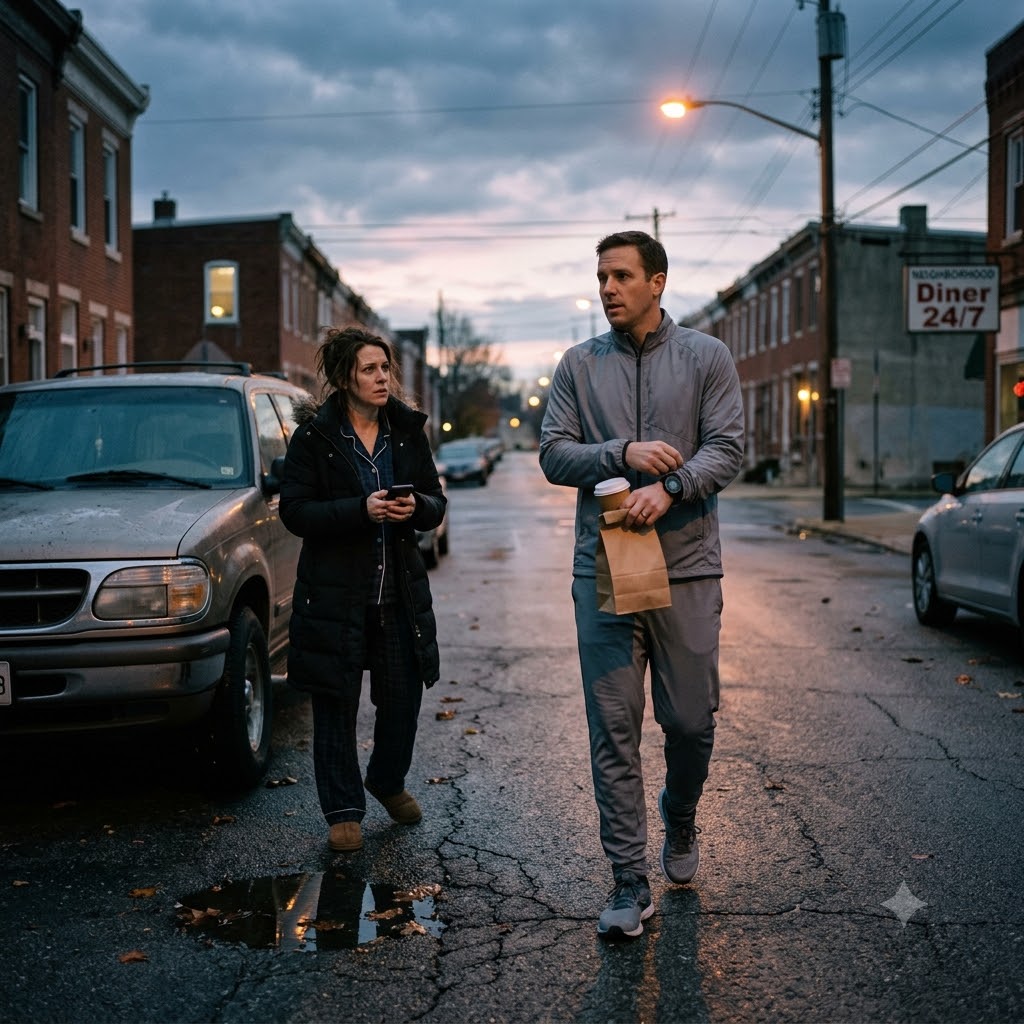
That night, while Marcus sat in the living room reviewing technical schematics on his tablet, I took his running shoes from the mudroom cubby under the pretext of wiping off the rainwater.
I turned the shoes over in my hands.
The neon-green rubber tread was immaculate. There were no tiny gravel stones wedged in the grooves, no dark mud stains along the mesh, no pine needles stuck to the heel.
They looked as if they had walked fifty feet across clean linoleum, not eight miles through a forest trail.
The next morning, while Marcus was at the laboratory, I drove to a commercial electronics shop in Knoxville and purchased a high-precision, military-grade GPS tracking token—no larger than a quarter, equipped with an independent satellite relay and a lithium battery.
That evening, while Marcus was answering emails in his study, I crept down to the mudroom. Using a small seam ripper, I sliced open the inner lining of the right hem of his grey running hoodie, slipped the flat black tracker inside, and sealed the seam with a tiny strip of industrial waterproof fabric tape.
That night, I didn’t sleep.
I lay beside Marcus, listening to the agonizingly steady rhythm of his chest rising and falling. Every twenty minutes, his breathing paused for precisely three seconds before resuming—a pattern so mechanical it made my skin crawl.
At 4:55 AM, his silent alarm hummed.
I watched him put on the grey hoodie. I watched him zip it up over his chest.
“See you at seven, Eli,” he whispered, kissing my forehead. His lips were dry and cool.
“Be careful out there,” I murmured, staring into his dark blue eyes.
The moment the front door clicked shut, I pulled my iPad from under my pillow and opened the encrypted tracking application.
A pulsating red dot appeared on the screen, centered directly over our house at 114 Alder Lane.
At 5:01 AM, the dot began moving.
It moved down Alder Lane at a standard walking pace—about three miles per hour.
At 5:08 AM, the red dot reached the edge of the Ridgeview Nature Preserve—a six-hundred-acre tract of dense timber and abandoned industrial land that had belonged to the Department of Energy during the Cold War.
Then, the dot stopped.
It didn’t follow the winding green trail loop that ran around the perimeter of the ridge.
It turned sharply north, cutting straight through a off-limits sector marked on local maps as Zone 4-B—a heavily wooded ravine surrounded by an eight-foot chain-link fence topped with razor wire.
The dot moved deeper into the restricted forest, traveling in a straight line that ignored all known footpaths.
At 5:22 AM, the red dot stopped completely at a set of coordinates four miles deep into the pine woods: 35.9611° N, 84.2541° W.
For one hour and thirty-six minutes, the red dot did not move a single yard.
It sat motionless in the dead heart of the restricted forest.
At 6:58 AM, the red dot suddenly reappeared at the edge of our driveway.
I hid the iPad under the mattress just as the front door keypad chimed.
Marcus walked in.
His grey hoodie was unzipped. His collar was dry. His chest was motionless.
“How was the run, Marcus?” I asked from the kitchen counter, my hands trembling behind my back.
“Perfect,” he smiled, reaching for his morning apple. “The ridge is beautiful this time of morning.”
Chapter 3: The Restricted Zone
By 9:00 AM, Marcus’s Volvo had cleared the neighborhood turnpike, heading toward the security gates of the Oak Ridge National Laboratory complex.
I didn’t wait.
I pulled on a heavy green waxed canvas coat, insulated hiking boots, and a waterproof backpack. Inside the pack, I stowed a high-powered tactical flashlight, a multi-tool, a portable power bank, my iPad with the live GPS feed, and a compact 9mm pistol that my father had given me years ago—a gun I had never imagined I would carry against my own husband.
I drove my small Subaru crossover to the southern edge of the Ridgeview Nature Preserve, parking the car behind an overgrown gravel turnout used by logging trucks in the 1980s.
The rain had stopped, leaving behind a thick, suffocating fog that hung low over the damp pine needles and rotting black oak leaves.
I pulled up the GPS coordinates on my phone: 35.9611° N, 84.2541° W.
I stepped over the rusting guardrail and plunged into the woods.
The forest was eerily quiet. The only sound was the heavy drip of water falling from the high canopy and the sharp crunch of my boots sinking into the wet earth.
After twenty minutes of hiking uphill through thick briars and decaying brush, I hit the perimeter wall of Zone 4-B.
It was an imposing barrier—eight feet of rusted steel chain-link, topped with thick spirals of concertina wire. Faded aluminum warning signs were bolted to the mesh every fifty feet:
UNITED STATES DEPARTMENT OF ENERGY
RESTRICTED AREA — NO TRESPASSING
AUTHORIZED PERSONNEL ONLY
NATIONAL SECURITY RESTRICTION PURSUANT TO ATOMIC ENERGY ACT OF 1954
I walked along the fence line for a hundred yards, shielding my eyes against the thick fog, until I found what Marcus had used.
A section of the lower chain-link mesh had been neatly severed with industrial bolt cutters, creating a flap that could be swung open and pressed back into place so smoothly it was virtually invisible from ten feet away.
I pulled the wire mesh aside and crawled through, my canvas jacket snagging briefly on a steel barb.
I was inside Zone 4-B.
The air here felt different. The ambient woods noise—the distant calls of crows, the chatter of squirrels—vanished completely. The atmosphere was heavy, cold, and carried that same sharp, metallic ozone smell I had detected on Marcus’s collar.
I checked my iPad. The red target dot was three hundred yards ahead, down in a deep limestone ravine carved out by a dried-up creek bed.
I scrambled down the slick rock slope, holding onto saplings to steady my descent.
At the bottom of the ravine, surrounded by moss-covered limestone cliffs, stood a structure that had no right to exist in the middle of a nature reserve.
It was a windowless, low-slung bunker built of thick, reinforced grey concrete, covered in black moss and creeping ivy. It looked like a abandoned Cold War fallout shelter from the 1950s.
A heavy steel blast door—painted dark olive drab and sealed with a heavy mechanical wheel lock— sat embedded in the cliff face.
Beside the rusting steel door was an object that looked utterly alien against the ancient concrete:
A brand-new, modern biometric glass panel, glowing with a soft, pulsing blue LED light.
I stood behind a massive oak tree twenty yards away, my heart hammer-pounding in my throat, staring at the glowing blue scanner.
My husband didn’t come here to run.
He came here to unlock a vault.
Chapter 4: What Lies Beneath
I stepped out from behind the oak tree, my hand resting heavy against the grip of the 9mm pistol in my coat pocket.
I approached the steel blast door.
The blue glass panel hummed softly in the damp forest air. As I stepped within three feet of the interface, a smooth, synthetic female voice chimed from a hidden speaker:
BIOMETRIC IDENTIFICATION REQUIRED.
PLEASE PRESENT PRIMARY RETINAL OR DNA KEY.
I held my breath, taking a step back.
The blue laser line swept across my face.
IDENTIFICATION FAILURE. ACCESS DENIED. SUBJECT: UNREGISTERED CIVILLIAN.
I expected an alarm to sound, red lights to flash, or security personnel to emerge from the trees.
Instead, the panel simply flickered, and a secondary prompt appeared on the high-definition glass screen:
OVERRIDE DETECTED. LOCAL GUARDIAN LINK ACTIVE.
GUEST PASS PROXIMITY CONFIRMED via REGISTERED ASSET: MARCUS VANCE.
ENTER PASSCODE.
My jaw dropped.
The system recognized Marcus. It didn’t just recognize him as an employee; it categorized him as a Registered Asset.
I stared at the key pad screen. What passcode would Marcus use?
I thought of his meticulous, unyielding nature. He wasn’t a man who used random numbers. He was a man of absolute historical memory.
I stepped up to the panel and tapped in six digits—the date of our wedding day: 1 0 1 4 1 7.
The panel beeped once. A long, amber bar lit up across the top of the frame.
PASSCODE ACCEPTED.
WELCOME, ELEANOR VANCE.
WARNING: ENVIRONMENT BEYOND THIS POINT IS CLASSIFIED UNDER DIRECTIVE 7-ALPHA.
With a deep, mechanical groan that vibrated through the limestone cliff, the heavy steel wheel on the blast door began to turn on its own.
CLACK. CLACK. CLACK.
The five-inch steel locking bolts retracted into the frame.
The massive blast door swung slowly inward, breaking a seal of compressed air with a loud HISS.
A wave of frigid, sterile air rushed out of the darkness, carrying the intense smell of clean room filters, liquid nitrogen, and ozone.
I pulled my tactical flashlight from my pack, clicked the beam on, and stepped over the high steel threshold into the dark.
The blast door slowly swung shut behind me, closing with a heavy, terrifying THUD.
The lock mechanism engaged.
I was trapped inside.
Chapter 5: Facility 9
The tunnel extended straight into the heart of the limestone mountain, sloping downward at a fifteen-degree angle.
The walls were not rough rock; they were covered in smooth, seamless panels of white composite polymer that showed no joints or rivets. Recessed LED strips along the floor flickered to life one by one as I walked, illuminating my path with a pale, cold white luminescence.
There were no security guards. No administrative desks. No signboards.
Only the low, deep hum of massive ventilation turbines operating somewhere deep underground.
I walked for three hundred yards, my flashlight beam bouncing off the pristine white walls, until the corridor opened into a massive, circular subterranean chamber.
The room was two hundred feet across, with a soaring domed ceiling forty feet overhead.
In the center of the chamber sat a massive ring of stainless-steel machinery—a miniature particle accelerator or high-density containment field, surrounded by thick bundles of fiber-optic cables and liquid coolant conduits that frosted in the cold air.
Around the perimeter of the room stood twelve glass containment pods, each eight feet tall, suspended in frames of brushed titanium.
I slowly walked toward the nearest pod, the beam of my flashlight trembling violently in my hand.
The interior of the pod was filled with a clear, viscous liquid that bubbled softly from the base.
I raised my light to illuminate the interior of the glass.
My breath seized in my throat. I stumbled backward, dropping my flashlight onto the floor, where it rolled against the base of the frame.
Inside the glass pod, suspended in the liquid, was a human body.
It was a man.
He was naked, his chest smooth, his hair dark, his features perfectly preserved in the nutrient fluid.
It was Marcus.
I fell to my knees, my hands clenching my hair as a strangled scream ripped from my throat.
“No… no, no, God, no…” I wept, staring up through the glass.
The man in the pod was Marcus.
He had a tiny, faded scar on his left shoulder blade—the exact scar my husband had received when he fell out of a cedar tree at age twelve. He had the slightly crooked right index finger he had broken playing high school football. His face possessed the subtle, soft lines of a real, aging human being.
He was unmoving. A fine array of silver micro-cables was connected to the base of his skull, feeding data into a glowing console at the front of the pod.
The monitor on the console displayed a steady, glowing blue readout:
PRIMARY SUBJECT: MARCUS ALEXANDER VANCE.
STATUS: DEEP BIOLOGICAL STASIS / NEURAL MAPPING COMPLETE.
NEURAL DENSITY: 99.4%.
LIFE SUPPORT: OPTIMAL.
My mind fractured into a million terrifying pieces.
If the real, biological Marcus Vance was floating in a vat of liquid nitrogen four hundred feet beneath the Ridgeview Nature Preserve…
Who had been sleeping in my bed for the last three years?
Chapter 6: The Copy
“You shouldn’t have come here, Eleanor.”
The voice came from the dark corridor behind me.
It was smooth, rich, and perfectly pitched.
I spun around on the floor, grabbing my fallen flashlight and sweeping the beam across the chamber floor.
Standing near the perimeter ring, dressed in his grey running hoodie and black tights, was Marcus.
He looked identical to the man in the pod.
Except his skin under the fluorescent lights possessed that flawless, marble-like smoothness. He stood with his arms relaxed at his sides, his chest perfectly still, his blue eyes reflecting the light like polished glass lenses.
I pulled the 9mm pistol from my pocket, raising it with both hands, pointing the barrel straight at his chest.
“Stay back!” I shrieked, my voice echoing wildly against the domed ceiling. “Stay away from me! What are you?! What did you do to my husband?!”
The entity standing before me didn’t flinch at the sight of the gun. He didn’t raise his hands. He merely looked at me with an expression of profound, terrifying sadness.
“I am Marcus,” he said softly. “And he is Marcus. We are not different, Eleanor. We are simply different iterations of the same mind.”
“You’re a machine!” I sobbed, tears blinding my vision. “You’re a fake! You don’t sweat… you don’t breathe… your heart doesn’t beat!”
“My chassis is a bio-synthetic composite,” he replied calmly, taking one slow, measured step forward. “My core is a high-density neural processor. But my memories, Eleanor? My feelings? My love for you? They were copied directly from the brain of the man floating in that tank.”
“Why?” I screamed, the gun shaking violently in my grip. “WHY?!”
The synthetic Marcus stopped ten feet away. He pointed a dry, pale finger toward the containment pod behind me.
“Four years ago,” he explained quietly, “Marcus was diagnosed with Stage IV glioblastoma—an aggressive, inoperable brain tumor in his frontal lobe. The doctors at Vanderbilt gave him six months to live.”
I froze.
Four years ago… Marcus had gone through a period of severe migraines. He had spent two weeks in Bethesda, Maryland, claiming he was participating in a high-level Department of Energy security panel.
“He didn’t go to Bethesda for a security panel, Eleanor,” the entity continued. “He was recruited by Project Janus—a classified DARPA and Department of Energy initiative tasked with preserving key strategic scientific minds using advanced synthetic neural transfer.”
The entity walked slowly toward the glass pod, looking up at the biological body suspended in the fluid.
“Marcus didn’t want to die,” the synthetic whispered. “He couldn’t bear the thought of leaving you alone. He couldn’t bear the thought of leaving his work unfinished. So he agreed to undergo the experimental mapping procedure. They placed his physical body into cryogenic stasis to halt the tumor’s growth, mapped his entire neural network down to the molecular level, and uploaded his consciousness into me.”
I stared from the synthetic man to the biological man in the tank.
“If you’re him…” I whispered, my voice breaking, “why do you come here every morning? Why the lie about running?”
The synthetic Marcus turned back to face me.
For the first time since I had known him, a faint, visible tremor appeared in his right hand.
“Because the synthetic neural transfer isn’t permanent, Eleanor,” he said, his voice dropping into a quiet, heartbreaking pitch. “The human mind was not designed to run on a synthetic substrate indefinitely. Every twenty-four hours, my neural architecture begins to degrade. Errors creep into my memory files. My emotional responses begin to flatten.”
He pointed to the central ring of machinery in the room.
“Every morning at 5:00 AM, while you are sleeping, I come to this facility. I plug my core into the primary mainframe, connect to Marcus’s biological brain in the pod, and run a full system synchronization. I download his fresh neural data, calibrate my emotional matrices, and purge the synthetic corruption.”
He took another step toward me, his blue eyes filled with an agonizing, artificial grief.
“I don’t sweat, Eleanor, because I don’t have sweat glands. I don’t breathe because my core doesn’t require oxygen. But I come back to you at 7:00 AM every single day because he loves you. Because his brain wants to see your face when you make your morning coffee.”
Chapter 7: The Glitch
I lowered the gun an inch, my head spinning in a dizzying storm of horror, grief, and overwhelming confusion.
“If… if you synchronize with him every day,” I choked out, “why haven’t you cured him? Why is he still in that tank?”
“Because the tumor is still there,” the synthetic Marcus replied softly. “Project Janus hasn’t solved the biological cure. They only solved the synthetic continuation. I am an experiment, Eleanor. A prototype. The Department of Energy allows me to live at home with you under the condition that I continue his classified weapons research at the laboratory during the day.”
He stepped closer, reaching his hand out toward me.
“I didn’t want you to know,” he whispered. “Marcus wanted you to believe that he was whole. He thought… he thought if you knew the truth, you would look at me with horror.”
I looked at the synthetic hand extended toward me.
It was perfectly formed. The fingernails, the skin creases, the tiny freckle on his wrist—all recreated with staggering, microscopic perfection.
“Show me,” I whispered.
“Eleanor—”
“Show me what happens during the synchronization!” I demanded, my voice rising again. “Prove to me that you aren’t just a program pretending to be my husband!”
The synthetic Marcus looked at me for a long, silent moment.
Then, he nodded slowly.
He walked over to the central ring of machinery, stepping up to a high terminal illuminated by glowing diagnostic screens.
He pulled back the collar of his grey hoodie.
At the base of his neck, right along the spine, a small, circular interface port made of polished titanium slid open with a soft metallic click.
He picked up a heavy, fiber-optic cable connected to the main server array and pressed it into the port at his neck.
CLICK-HISS.
The central room lit up with a blinding array of blue and gold light.
The liquid inside the containment pod began to churn.
The blue readout screen on the pod shifted violently to amber:
SYNCHRONIZATION INITIATED.
SOURCE: BIOLOGICAL ASSET (MARCUS VANCE).
TARGET: SYNTHETIC CHASSIS (UNIT 04).
NEURAL TRANSFER RATE: 40 TERABYTES/SEC.
On the massive domed ceiling above us, a holographic projection exploded into view.
It was a vast, glittering web of light—billions of golden threads intersecting in a breathtaking, three-dimensional map of a human brain.
And inside that web of light, memories began to play like flashing cinematic frames:
I saw myself at twenty-four, standing on a beach in South Carolina, laughing as the waves hit my knees.
I saw our first apartment in Atlanta, sitting on cardboard boxes eating cold Chinese food by candle light.
I saw the quiet, tearful moment Marcus proposed to me under the oak trees at the Knoxville botanical gardens.
I saw his private thoughts—his terrifying realization when the doctor showed him the brain scan… his desperate fear of leaving me alone… his tears in the dark before he agreed to sign the DARPA contract.
These were not cold data files.
They were soaked in emotion—in love, terror, devotion, and a desperate, stubborn refusal to let go of the life we had built together.
The synthetic man sitting at the terminal let out a long, shuddering gasp—a sound that was utterly human, raw, and broken.
Tears—real, clear water produced by synthetic lacrimal glands installed for emotional simulation—began to spill down his marble cheeks.
“Eli…” he choked out through the synchronization link. “I’m… I’m so sorry…”
Chapter 8: The Choice
The synchronization process lasted twelve minutes.
When the blue lights faded and the fiber-optic cable detached from his neck with a quiet hiss, the room returned to its cold, silent hum.
The synthetic Marcus sat at the terminal for a moment, his shoulders slouched, his hands resting on his knees.
He wiped the tears from his cheeks with the back of his hand.
He turned to look at me.
His skin was still cool. His chest was still motionless.
But his eyes—the way he looked at me, the tiny crease between his brows, the soft, hesitant curve of his mouth—were so overwhelmingly, indisputably Marcus that my knees buckled.
I dropped the gun onto the concrete floor.
I walked across the circular chamber, my boots echoing against the floorboards, until I stood directly in front of him.
I reached out my trembling hands and placed my palms against his cheeks.
He was cold. His skin felt like polished marble left out in the autumn air.
“Marcus…” I whispered.
“I’m here, Eli,” he said softly, closing his eyes, leaning his cheek into the warmth of my hands. “I’m still here.”
I looked over his shoulder at the glass pod—at the real, dying biological body sleeping peacefully in the blue liquid, preserved in time like a fly in amber.
Then I looked at the synthetic man holding my wrists with gentle, trembling fingers.
“How long?” I asked softly. “How long can this chassis last?”
“The engineers say… maybe two more years,” Marcus replied quietly. “Before the neural degradation becomes irreversible. Before the copy fades completely.”
Two years.
Two years of living with a man who didn’t sweat, who didn’t breathe, who didn’t eat the food I cooked, who spent his mornings being downloaded from a machine hidden four hundred feet beneath a Cold War bunker.
Two years of living with a ghost in a machine.
I looked into his blue eyes—eyes that held every memory of my life, every quiet joke we had shared, every promise he had ever made to me.
I pulled his head down against my shoulder, wrapping my arms around his cold, synthetic body, holding him with everything I had left.
“Then we have two years,” I whispered into his hair.
He wrapped his arms around me, pulling me tight against his quiet, motionless chest.
Chapter 9: Rain or Shine
At 6:45 AM, we walked back up the sloping white corridor together.
Marcus turned the heavy steel wheel on the blast door, sealing the deep chamber and its sleeping biological secret back into the dark limestone.
We crawled back through the severed fence of Zone 4-B, stepping out into the foggy morning air of the Ridgeview Nature Preserve.
The sun was beginning to break through the pine canopy, casting long, golden rays of light through the damp woods.
We walked side-by-side down the gravel trail toward the road, our hands intertwined.
His hand was cold, hard, and dry. My hand was warm, soft, and damp with morning dew.
As we reached the edge of our driveway on Alder Lane, Marcus stopped.
He looked down at his neon-trimmed running shoes, then at the wet asphalt of the cul-de-sac.
He dropped down onto one knee, reached into the mud along the edge of our lawn, and deliberately smeared a thin layer of dark brown earth across the rubber tread of his shoes.
He took a handful of wet pine needles and pressed them into the mesh of his grey hoodie.
Then, he stood up, looked at me with that familiar, crooked smile, and took a deep, deliberate breath—forcing his chest to rise and fall in a perfect, simulated rhythm.
“How do I look?” he asked softly.
I wiped a tear from my eye, stepped forward, and adjusted his collar.
“You look like a man who just ran eight miles,” I smiled, my voice thick with love and heartbreak.
We walked up the front porch steps together.
Marcus pulled open the heavy oak door, clicked the alarm keypad, and hung his grey hoodie on the back of the kitchen stool.
I filled the coffee pot with water, turned on the burner, and set two mugs on the counter.
Outside the kitchen window, the morning rain began to fall again—softly, steadily, washing over the yellow pines of Oak Ridge.
Every morning at 5 AM, rain or shine, my husband leaves for a two-hour run.
He doesn’t sweat. He doesn’t bleed. His heart doesn’t beat.
But as he walked into the kitchen, reached for an apple, and sat down beside me in the morning light, I knew one thing with absolute, unyielding certainty:
He was my husband. And as long as the machine kept humming, I would be waiting for him at 7:00 AM.