A decade and a half of training Marines in hand-to-hand combat instilled one absolute rule in me: civilians are off-limits. But…
A decade and a half of training Marines in hand-to-hand combat instilled one absolute rule in me: civilians are off-limits. But that rule shattered when I stood beside my daughter’s emergency room bed and learned her boyfriend was responsible. I headed straight for his training facility. He was laughing surrounded by his friends—until he locked eyes with me. What transpired next brought the whole gym, including his coach, to a dead silence.
Chapter 1: The Code of Marine Corps Base Camp Lejeune
For fifteen years, my life was measured in blood, sweat, and the dull, wet thump of bodies hitting the mats at Marine Corps Base Camp Lejeune.
My name is Marcus Vance. As a Master Martial Arts Instructor Trainer in the Marine Corps Martial Arts Program (MCMAP), I was the man tasked with taking young men and women—fresh out of boot camp—and transforming them into weapons capable of lethality in close-quarters battle. I held a 6th Degree Black Belt, spent three tours in Helmand Province, and bore the heavy scars of a life lived on the violent edges of the world.
In my dojo, there was an absolute, unyielding rule carved into the souls of every Marine under my command: Marine Corps lethality belongs on the battlefield. You never, under any circumstances, lay a hand on a civilian.
To break that rule was to betray the cloth of the uniform. It was the distinction between a warrior and a bully, between honor and lawlessness.
When I retired at forty-four, I bought a modest two-story home in Wilmington, North Carolina, and opened a non-profit gym teaching defensive tactics to first responders and underprivileged youth. I thought my fighting days were long behind me. I spent my mornings drinking black coffee on the front porch and my afternoons adjusting my daughter Maya’s car oil.
Maya was my world. At twenty-two, she had my dark hair, her late mother’s fierce green eyes, and a heart so soft it made me worry for her in a world that was routinely ruthless.
Eight months ago, she started dating a guy named Brock Sterling. Brock was twenty-five, a rising middleweight contender in the local regional MMA circuit, and the star pupil at Ironclad Fighting Academy in downtown Wilmington. He was tall, sculpted like an anatomical chart, possessed a jawline made for camera flashes, and had an arrogant strut that set my teeth on edge the moment I met him.
I didn’t like him. My instincts—honed by decades of reading human body language in life-or-death situations—told me Brock was a predatory narcissist. He controlled where Maya went, checked her phone under the guise of “caring,” and spoke to her with a subtle, razor-thin condescension that made my jaw clench.
“Dad, he’s just passionate,” Maya had insisted three months ago, pulling her arm away when I cautioned her about his controlling behavior. “He’s under a lot of pressure for his upcoming fight. He doesn’t mean anything by it.”
“A man who loves you doesn’t make you feel small, Maya,” I had warned her softly. “Watch his hands. Watch how he reacts when he doesn’t get his way.”
She had walked away, defensive and young, believing love was something you had to endure rather than cherish.
And then came the Tuesday evening that shattered my universe.
Chapter 2: The Triage Room
The call came at 8:15 PM from New Hanover Regional Medical Center.
When I sprinted through the automatic sliding doors of the emergency room, the smell of antiseptic and the blare of medical monitors hit me like a physical blow. A nurse guided me back through the curtained bays of the trauma ward.
Chapter 2: The Triage Room
The call came at 8:15 PM from New Hanover Regional Medical Center.
When I sprinted through the automatic sliding doors of the emergency room, the smell of antiseptic and the blare of medical monitors hit me like a physical blow. A nurse guided me back through the curtained bays of the trauma ward.
“Mr. Vance,” the nurse said gently, her face somber. “She’s conscious, but… she’s suffered significant blunt-force trauma.”
When I pulled back the blue curtain, my heart stopped.
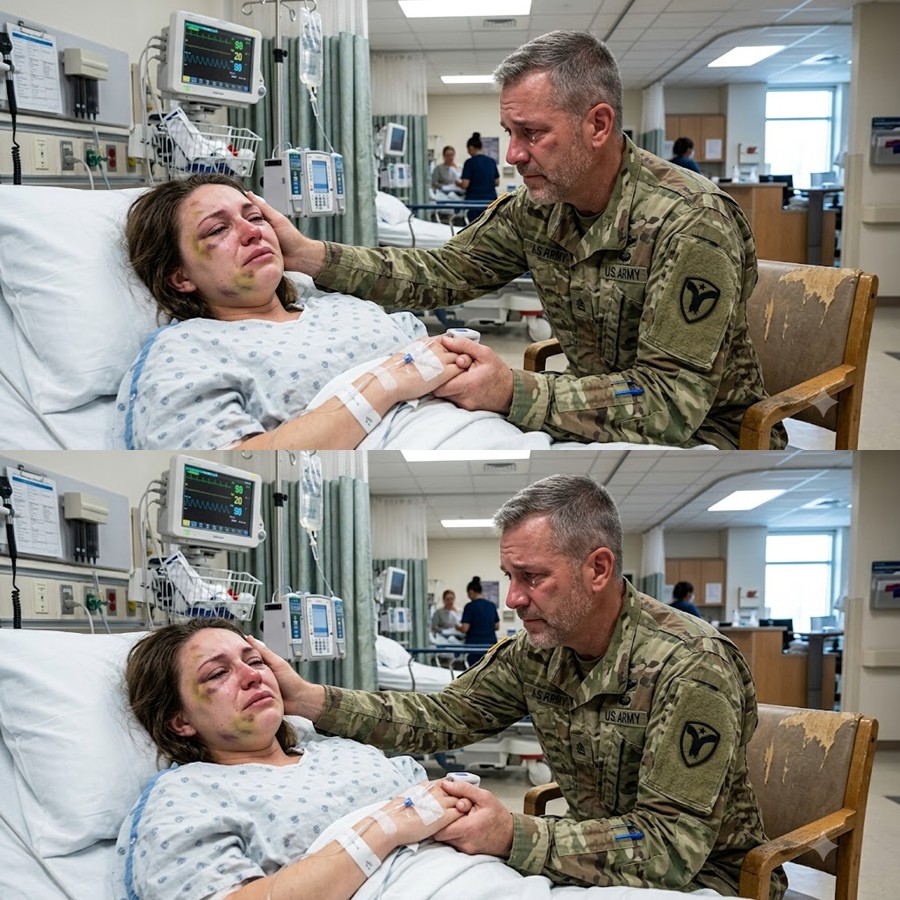
Maya sat on the edge of the examination bed, wearing a hospital gown that swallowed her small frame. Her right eye was swollen completely shut, surrounded by a deep, terrifying shade of purple and black. Her upper lip was split, stitched together with dark medical thread, and her left wrist was encased in a stark white fiberglass cast.
“Dad…” she whimpered, her voice cracking as tears leaked from her one open eye.
I didn’t speak. I couldn’t. The air was ripped from my lungs. The man who had faced improvised explosive devices in Iraq and ambushes in Afghanistan was brought to his knees by the sight of his child’s broken face.
I walked to the side of the bed, my large, calloused hands trembling violently as I gently framed her face, avoiding the bruises.
“Who did this?” I whispered, my voice sounding like grinding stones.
Maya looked down at the paper sheets, sobbing silently, her shoulders shaking. “We… we got into an argument in his car. I told him I was leaving him, Dad. I told him I couldn’t take the control anymore. He… he lost his mind. He grabbed my wrist… and when I tried to pull away, he backhanded me. Then he shoved me out of the passenger door onto the pavement while the car was moving.”
He shoved her out of a moving vehicle.
A cold, absolute silence descended upon my mind. It was not the chaotic rage of an amateur; it was the icy, crystal-clear focus that takes over a veteran soldier before an assault. Every beat of my heart slowed down. The noise of the hospital faded into distant static.
For fifteen years, my rule was simple: never lay a hand on a civilian.
That rule died on the cold linoleum floor of Bay 4.
“Where is he, Maya?” I asked, my voice calm, flat, and terrifyingly steady.
“Dad, no… please, don’t,” she sobbed, clutching my jacket with her uninjured hand. “The police came… I gave a statement… they’re looking for him…”
“Where is he?” I repeated softly, kissing her forehead gently.
“He… he had an 8:00 PM sparring session,” she whispered, her voice trembling. “At Ironclad.”
I pulled a small silver cross from my neck, placed it in her palm, and squeezed her fingers around it.
“I’ll be back soon, sweetheart,” I said.
I turned around, walked out of the triage room, and stepped into the humid North Carolina night.
Chapter 3: The Gathering of Predators
Ironclad Fighting Academy occupied a sprawling, converted industrial warehouse near the Wilmington shipping docks. It was the premier fight gym in the region, known for producing brutal, high-tempo fighters who dominated local cage-fighting promotions.
The gym was owned and managed by Viktor “The Hammer” Rust—a former Belarusian Sambo champion with a thick neck, a scarred face, and a reputation for running his gym like a gladiatorial pit. Viktor didn’t care about discipline or character; he cared about winning belts, collecting training fees, and feeding the egos of his top fighters.
When my Ford F-150 pulled into the gravel parking lot at 9:00 PM, the lights inside the warehouse were blazing. The rhythmic sound of heavy bags being struck, loud hip-hop music, and the yelling of corner coaches echoed out into the dark air.
I parked the truck, turned off the engine, and sat in the dark for five seconds.
I looked at my hands resting on the steering wheel. These hands had snapped necks in dark alleys in Fallujah. These hands had disarmed knife-wielding insurgents. These hands had been trained, refined, and locked behind the deadbolt of military discipline for a decade and a half.
I unbuckled my seatbelt, opened the truck door, and stepped out.
I was wearing a faded black MCMAP physical training shirt, dark cargo pants, and combat boots. I didn’t carry a weapon. I didn’t need one.
I pushed open the heavy steel door of Ironclad.
The smell hit me immediately—stale sweat, leather, friction-heated rubber mats, and blood. The gym was packed. Twenty fighters were training in various zones: some were hitting heavy bags, others were grappling on the central mat, and a crowd of twelve people had gathered around the elevated Octagon cage in the center of the room.
Inside the cage, Brock Sterling was finishing a sparring round with a regional welterweight.
Brock looked pristine. He was wearing black-and-gold fight shorts, his torso glistening with sweat, his hands wrapped in clean white tape. He leaned against the cage mesh, a cocky smirk on his face, taking a sip from a water bottle as his entourage cheered.
“That’s what I’m talking about, Brock!” shouted one of his training partners, a heavy-set heavyweight named Brody. “That left hook is a lethal weapon, baby!”
Brock laughed—a loud, booming, arrogant laugh that cut through the thumping bass of the gym music. “Man, nobody in this city can take my right hand. Nobody.”
I walked past the front desk, ignoring the teenage receptionist who called out, “Sir? Can I help you? Sir, members only—”
I didn’t stop. I walked directly toward the center of the gym, my combat boots thumping rhythmically against the rubber floor.
Chapter 4: The Silence Falls
As I approached the elevated octagon, my presence began to register like a cold draft sweeping through a warm room.
Fighters near the heavy bags stopped mid-combination. The instinctual, animalistic atmosphere of a fight gym makes men exceptionally sensitive to threat assessments. They didn’t see an angry father throwing a temper tantrum; they saw a six-foot-two, two-hundred-pound wall of muscle moving with the absolute, predator-like economy of movement that only comes from decades of actual killing.
“Hey! Old man!” shouted Brody, stepping into my path between the heavy bags and the cage. “Who the hell are you? You can’t just walk in here—”
I didn’t break stride.
When Brody reached out a massive, tattooed arm to shove my chest, I didn’t flinch. I reached up with my left hand, executed a rapid open-palm wrist deflection, grabbed his thumb, and twisted his hand backward while stepping into his center of gravity.
CRACK.
Brody’s thumb dislocated instantly. Before he could scream, I drove my right elbow upward into his sternum, knocking the breath completely out of his lungs. The two-hundred-and-fifty-pound heavyweight collapsed onto his knees, gasping for air, clutching his chest.
The music was still playing, but the gym went instantly dead silent.
Every fighter, trainer, and spectator froze.
Viktor Rust, holding a stopwatch and a clipboard beside the cage, turned slowly. His small, harsh eyes locked onto me, his brows furrowing in deep confusion and sudden alertness.
Inside the cage, Brock Sterling’s smirk faded slightly, replaced by a flash of annoyance. He lowered his water bottle and walked toward the door of the octagon, stepping onto the small wooden staging stairs.
“What the hell is your problem, old man?” Brock sneered, gripping the chain-link fence. “You just hit my sparring partner! Are you crazy?!”
I stood at the base of the cage stairs, looking up at him.
“You know who I am, Brock,” I said. My voice was low, devoid of emotion, yet it carried across the quiet warehouse like a gunshot.
Brock looked closely at my face. Recognition hit him. A subtle flicker of fear crossed his eyes, but it was quickly swallowed by the defensive armor of his massive ego and the presence of his friends.
“Oh,” Brock laughed, shaking his head, looking around at the other fighters. “It’s Maya’s dad. The ‘ex-Marine.’ What, did she run home crying to daddy because we broke up?”
“She didn’t run home to cry, Brock,” I said, my eyes unblinking, holding his gaze. “She was taken to the emergency room with a fractured wrist, a split lip, and a closed eye because you threw her out of a moving vehicle.”
A murmur rippled through the gathered fighters. Even in a room full of violent men, the unspoken rule among real martial artists was sacred: you don’t put hands on women.
Viktor Rust stepped forward, frowning deeply, his gaze shifting from me to Brock. “Brock… what is he talking about?”
“He’s lying!” Brock shouted, his face flushing red with anger as he tried to save face in front of his coach and peers. “She was acting crazy! She jumped out of the car herself! I didn’t touch her!”
“You’re a coward, Brock,” I said quietly. “And tonight, your protection ends.”
I stepped onto the first wooden stair leading into the cage.
“Hey! Hold on!” Viktor Rust yelled, stepping between me and the cage door, placing a massive, rough hand on my shoulder. “Nobody fights in my ring without permission! You want to settle something, you call the police! Get out of my gym!”
I turned my head slowly to look at Viktor’s hand on my shoulder.
“Viktor,” I said, my voice echoing with a bone-chilling weight. “I spent fifteen years training Marines how to eliminate enemies of the United States with their bare hands. I have held a strict rule my entire civilian life to never use that knowledge on a civilian. But that boy broke my daughter’s face.”
I looked Viktor dead in the eyes.
“If you take your hand off my shoulder right now, this stays between him and me. If you keep it there, I will tear this gym apart starting with you.”
Viktor Rust was a veteran of brutal European Sambo tournaments. He was a man who had seen real violence. He looked into my eyes, searching for bluff or hesitation.
He found none.
Slowly, deliberately, Viktor lifted his hand off my shoulder and stepped back two paces. He looked up at Brock inside the cage, his face turning cold and unreadable.
“Viktor?!” Brock yelled, his voice rising in disbelief. “Are you serious?! You’re going to let this old guy—”
I unlatched the steel door of the octagon, stepped inside, and pulled the latch shut behind me.
Chapter 5: Inside the Chain-Link
The chain-link door clicked into place.
The cage, eighty square yards of tight canvas and steel, suddenly felt tiny.
Brock Sterling backed up to the center of the ring, pulling his mouthguard out of his shorts pocket and shoving it into his mouth. He raised his guard—a polished, modern MMA stance, light on his feet, his shoulders tight, his fists protecting his chin.
“You made a mistake coming here, old man,” Brock snarled through his mouthguard, his eyes burning with toxic rage. “You think because you were in the military forty years ago you can step into a modern MMA cage? I’m going to put you in a wheelchair right next to your pathetic daughter!”
I didn’t answer. I didn’t raise my hands into a flashy guard. I didn’t bounce on my toes.
I simply stood in the MCMAP Linear Combat Stance—knees slightly bent, chin tucked, hands held at chest height, palm-forward, body angled to minimize targets.
“Fight!” someone shouted from the crowd, but the voice sounded weak, stripped of enthusiasm.
Brock erupted into action.
He was fast—explosively fast. He bounced forward, throwing a blinding, lightning-quick jab-cross-left hook combination designed to overwhelm an older opponent and force them against the cage mesh.
In the civilian martial arts world, people block punches with their hands or dodge with head movement.
In MCMAP, we don’t dodge. We intercept, destroy, and advance.
As Brock’s jab snapped toward my nose, I stepped into the angle of attack, executing a hard inside palm block that deflected his wrist outward. Before his cross could follow, I drove my left forearm directly into the bicep of his trailing arm, deadening the nerve.
Brock’s eyes widened in sudden surprise as his right arm went numb.
Before he could reset his feet, I stepped forward into his space, driving a devastating, short-range thrusting heel-palm strike directly into his nose.
CRACK.
The sound echoed through the silent warehouse like a dry branch snapping in two.
Brock’s head snapped back violently. Blood sprayed across his chest and the white canvas mat. He stumbled backward three steps, clutching his face, his mouthguard slipping out of his mouth onto the floor, coated in red.
“My nose!” Brock shrieked, his voice nasal and high-pitched. “He broke my nose!”
“Get up, Brock,” I said, my voice cold, calm, and stepping forward with relentless, mechanical precision. “You pushed a twenty-two-year-old girl out of a car. Stand up and fight.”
Brock’s face twisted into an animalistic, desperate fury. He wiped the blood from his mouth with the back of his hand, let out a primal scream, and charged forward with a low, double-leg takedown attempt, aiming to drive me onto my back and use his ground-and-pound.
It was a textbook MMA takedown.
Against a textbook MMA fighter, it might have worked.
Against a Master MCMAP Instructor, charging low with your neck exposed is an invitation to execution.
As Brock shot in for my legs, I didn’t attempt a sports-style sprawl. I dropped my hips, swung my left arm over his neck into a violent, tight guillotine choke, and used his own forward momentum to pivot 180 degrees.
Instead of taking him to the mat gently, I locked his head under my arm, drove my knee violently upward into his ribcage—CRACK—and threw him over my hip, slamming his body face-first into the canvas with catastrophic force.
The impact shook the entire wooden structure of the octagon.
Brock lay on his stomach, gasping for air, clutching his shattered ribs, blood pooling beneath his face on the white mat.
The crowd of twenty fighters surrounding the cage was dead quiet. Nobody cheered. Nobody moved. The hip-hop music playing on the gym speakers felt absurdly out of place against the raw, terrifying display of pure military lethality.
I didn’t stop.
I stepped over his body, grabbed his left arm—the same arm he had used to grab my daughter’s wrist—and pinned his chest to the floor with my knee.
I pulled his left arm straight, trapping his wrist against my thigh.
Brock looked up at me with his one uninjured eye, his face covered in blood, tears streaming down his cheeks, trembling violently. The arrogant, untouchable cage fighter had completely vanished. All that was left was a terrified, pathetic coward realizing he was at the absolute mercy of a man he could not control.
“Please!” Brock sobbed, his voice cracking, hyperventilating against the canvas. “Please! Don’t! I’m sorry! I’m sorry! I’ll leave her alone! I swear to God I’ll leave her alone!”
My hand gripped his wrist tightly.
For one terrifying second, the darkness in my chest—the black, cold rage of a father who had seen his daughter’s broken face in the ER—begged me to lean back and snap his elbow joint into pieces.
Do it, the darkness whispered. Show him what real pain feels like.
I looked down at his face. I saw the sheer, soul-crushing terror in his eyes.
And then, I remembered my daughter’s words in the hospital room: Don’t, Dad. Please.
If I broke his arm out of vengeance, I wasn’t protecting her; I was making myself like him. I was letting his filth corrupt the honor I had spent a lifetime building.
Slowly, deliberately, I released his wrist.
I stood up, stepping off his back.
Brock lay on the canvas, curled into a defensive fetal position, sobbing hysterically, clutching his face and ribs, completely broken—not just physically, but spiritually.
I turned toward the cage door, unlatched the steel bolt, and stepped out onto the staging stairs.
Chapter 6: The Fall of Ironclad
I stepped down from the cage onto the rubber floor of the gym.
The crowd of fighters parted instantly, stepping back three paces to give me a wide, respectful berth. Men who weighed two hundred and sixty pounds—men who fought for money and glory in steel cages—looked at the floor as I walked past them, refusing to make eye contact.
Viktor Rust stood near the timekeeper’s table.
The Belarusian coach looked at Brock sobbing on the mat inside the cage, then turned his gaze back to me. His face was solemn, devoid of anger. He slowly shook his head, looking at the blood on the canvas.
“He is done in my gym,” Viktor said, his deep European voice cutting through the silence. “He will never step foot on my mats again.”
I paused, looking at the head coach.
“Teach your boys better, Viktor,” I said quietly. “A man who uses his hands to hurt women isn’t a fighter. He’s trash.”
Viktor bowed his head slightly in a quiet, solemn sign of respect. “Yes, Master Sergeant. Understood.”
I turned my back on the gym, walked down the long central aisle past the heavy bags, and pushed open the heavy steel exit door.
Outside, the cool night air of Wilmington rushed into my lungs. The rain had stopped, leaving the asphalt wet and reflecting the amber glow of the streetlights.
I walked to my truck, opened the door, and climbed into the driver’s seat.
I pulled two wet wipes from the glove compartment, carefully cleaning the small drops of Brock’s blood from the knuckles of my right hand, making sure not a single trace remained.
I turned the ignition key. The V8 engine roared to life.
As I pulled out of the gravel parking lot onto the main road heading back toward New Hanover Regional Medical Center, two Wilmington Police Department cruisers passed me with their blue and red lights flashing, speeding toward Ironclad Fighting Academy to answer the domestic assault warrant for Brock Sterling.
I adjusted my rearview mirror, let out a long, slow breath, and drove back to my daughter.
Epilogue: The Light in the Window
Eight months later.
The early summer sun was golden over the Cape Fear River, casting long, warm shadows across the wooden deck of my gym in downtown Wilmington.
The sign above the door read: Vance Defensive Tactics & Youth Foundation.
Inside, the floor was covered in clean blue mats. Twenty young women—high school seniors and college students—were going through a basic self-defense clinic, learning situational awareness, wrist deflections, and palm strikes.
Leading the class at the front of the mat was Maya.
Her wrist had healed perfectly. Her face bore no remaining scars. But more importantly, the quiet, hesitant fear that had shadowed her eyes for two years was gone, replaced by a radiant, unshakable confidence. She moved across the mat with grace and authority, adjusting a young girl’s foot placement with a gentle, encouraging smile.
“Keep your base wide, Sarah,” Maya instructed warmly. “Your power doesn’t come from your hands. It comes from your stance.”
I sat on a wooden stool near the front office, sipping a cup of black coffee, watching her work.
Brock Sterling’s trial had ended four months ago. Confronted with the hospital medical records, the moving-vehicle assault charge, and his own recorded confession while being treated at the hospital that night, his defense collapsed. He was convicted of felony domestic assault and sentenced to three years in a state correctional facility. His fighting career was over before it ever truly began.
The door to the gym opened, letting in a warm coastal breeze.
Viktor Rust stepped inside. He was wearing a simple tracksuit, carrying a sports bag over his shoulder.
Since that night at Ironclad, Viktor had changed his gym’s curriculum. He had fired three toxic trainers, instituted a strict character code for his fight team, and sent four of his young female athletes to train under Maya’s defensive program.
“Marcus,” Viktor nodded respectfully, stepping over to the bench.
“Viktor,” I replied, nodding back. “Coffee?”
“Always,” the old Belarusian smiled, taking a seat beside me. He looked across the mat, watching Maya demonstrate an wrist-lock escape to the class.
“She is strong, your daughter,” Viktor noted quietly. “She has her father’s eyes.”
I looked at Maya. She caught my eye from across the room, giving me a quick, radiant smile before turning back to her students.
“No, Viktor,” I smiled, taking a sip of my coffee, feeling a profound, deep warmth settle in my chest. “She’s stronger than I ever was.”
I looked down at my hands resting on my knee.
For fifteen years, my rule was simple: never lay a hand on a civilian.
I had broken that rule once. But as I watched my daughter stand tall, confident, and whole in the sunlight of her own gym, I knew that honor wasn’t about rigid, unbending rules carved in stone. Honor was about knowing what was worth protecting, standing between the wolves and the innocent, and making sure that when the dust settled, the light always found its way back home.
Chapter 7: The Shadows of the Past
The quiet sanctuary of the Vance Defensive Tactics & Youth Foundation was built on the foundation of a second chance. For eight months, the steady rhythm of squeaking sneakers, heavy breathing, and the crisp instruction of self-defense drills had replaced the dark ghosts of that November night.
But violence has a way of casting long, jagged shadows. It rarely stays buried where you leave it.
On a muggy Thursday evening in late July, the sun was sinking behind the Cape Fear River, staining the sky in bruised hues of purple and orange. Maya was finishing a one-on-one session with a freshman from the local university, showing her how to frame her elbows to protect her ribs from a pinning opponent.
I sat in my office glass booth, wiping down my vintage leather pads.
The heavy front door chimed.
I looked up, expecting to see another student or perhaps Viktor dropping off a shipment of new headgear. Instead, three men stepped over the threshold into the gym.
They didn’t look like students. They didn’t look like fighters either.
The man in the center was short, stocky, and in his late fifties, wearing an expensive grey suit that looked slightly out of place in our simple facility. His skin had the leathery texture of a lifetime spent under the sun, and his graying hair was slicked back neatly. But it was his eyes that caught my attention—cold, watery grey, entirely devoid of warmth.
Flanking him were two younger men built like concrete pillars. One wore a black polo shirt stretched tight over massive shoulders, his knuckles scarred and thick; the other had a faded snake tattoo slithering up the side of his neck into his hairline.
The atmosphere in the room plummeted ten degrees.
Maya froze on the mat, her student taking a step back behind her. Instinctively, my daughter’s posture shifted—feet set shoulder-width apart, weight balanced, eyes scanning the exits. I felt a surge of quiet pride, swiftly eclipsed by the cold, calculated alertness that took over my body whenever an unrecognized threat entered my space.
I set the leather pad down and stepped out of the office, walking slowly onto the blue mats.
“We’re closed for the evening,” I said, my voice flat, holding the center of the room. “Classes start tomorrow at eight.”
The man in the grey suit looked around the gym, taking in the framed MCMAP certificates, the wooden training dummies, and the simple banner hanging from the rafters: Strength, Honor, Integrity.
“Master Sergeant Marcus Vance,” the man said. His voice was smooth, carrying a heavy Lowcountry South Carolina accent that sounded like syrup poured over gravel. “I’ve heard a great deal about you.”
“And you are?” I asked, stopping ten feet from him.
“My name is Lyle Sterling,” the man replied, adjusting the gold signet ring on his pinky finger. “Brock Sterling is my son.”
Chapter 8: A Father’s Legacy
The name hung in the damp air like a suffocating blanket.
Maya took a sharp breath, her hand flying to her throat. The two broad-shouldered men behind Lyle Sterling didn’t move, but their eyes narrowed, tracking my every movement.
Lyle Sterling wasn’t just Brock’s father; he was the head of Sterling Maritime Holdings, an influential shipping and logistics firm operating out of Charleston and Wilmington. Rumors had floated around the waterfront for years that Lyle’s trucks carried more than just imported timber and machinery. He was a man who owned judges, paid off port inspectors, and used his wealth to insulate his family from consequences.
“I see,” I said, keeping my hands resting loosely at my sides. “You’re a long way from Charleston, Mr. Sterling.”
“Not so long when your only boy is sitting in a medium-security cell in North Carolina,” Lyle said, taking a slow step forward. “Brock made mistakes. He has a hot temper. I know that. I raised him to be aggressive—a man has to be aggressive to win in this world. But four years in a state facility?”
He looked past me, his grey eyes locking onto Maya. A cold, dismissive smile touched his thin lips.
“A young man’s entire future, ruined,” Lyle murmured. “His fighting career destroyed. His name dragged through the local press. All over a domestic misunderstanding with a girl who didn’t know when to keep her mouth shut.”
Before I could move, Maya stepped past me. Her green eyes were burning, completely devoid of the fear that had once paralyzed her.
“A domestic misunderstanding?” Maya said, her voice ringing with absolute clarity. “He threw me out of a moving car, Mr. Sterling. He broke my wrist. He fractured my face.”
Lyle scoffed, shaking his head with condescending pity. “Young lady, in my world, people work these things out internally. They don’t run to the police. They don’t send retired military hounds to beat a boy until his ribs are crushed and his career is over.”
“Your son is where he belongs,” I interrupted, stepping in front of Maya, shielding her from his gaze. “He got off easy. The state gave him four years. If I had stayed in that cage ten seconds longer, he wouldn’t be walking out of prison at all.”
Lyle’s cold smile vanished, replaced by an ugly, dark stillness.
“You think you’re untouchable, Sergeant Major,” Lyle sneered softly. “You think because you wore a uniform and trained kids to punch air that you understand power. But power isn’t a fist. Power is resources. Power is making sure a man’s mortgage suddenly gets called in by the bank. Power is making sure the county building inspector finds ‘structural violations’ that shut down his little charity gym overnight.”
The two men behind him subtly shifted their weight, stepping forward.
“Is that a threat, Sterling?” I asked softly.
“It’s an offer,” Lyle corrected, pulling a thick linen envelope from his inner jacket pocket and dropping it onto a folding table near the door. “Inside that envelope is fifty thousand dollars in cashier’s checks. My lawyers are filing an appeal for Brock’s sentence next month based on improper witness testimony and civil intimidation. Your daughter is going to sign an affidavit stating she exaggerated her injuries under pressure from you.”
He leaned in, his voice dropping to a harsh whisper.
“You take the money, she signs the paper, and my son gets released on probation. You keep this gym. You keep your quiet life. If you refuse…” He glanced around the room. “…accidents happen to old buildings. Fires start. People get hurt.”
Chapter 9: The Lines We Draw
For fifteen years, I had taught young Marines how to handle pressure.
I taught them that when an enemy attempts to leverage your vulnerabilities, you do not retreat into defense. You break their momentum. You take the initiative.
I looked down at the thick envelope on the table. Then I looked at Lyle Sterling.
“Maya,” I said quietly, without breaking eye contact with Lyle. “Call Chief Deputy Miller on his private line. Tell him Lyle Sterling is in our gym, offering a bribe to tamper with a witness in a federal domestic abuse appeal.”
Lyle’s eyes flashed with sudden, sharp anger.
“Don’t be a fool, Vance,” Lyle barked. “You think the local cops can protect you from—”
I didn’t let him finish.
I moved.
In MCMAP, speed is not about wild movement; it is about eliminating wasted motion. I closed the ten-foot gap between us before Lyle’s brain could even register that I had stepped off the mat.
I grabbed Lyle by his expensive silk tie, twisting my knuckles into his throat collar, and slammed him backward against the heavy oak front door of the gym.
THUD.
The glass in the door rattled violently.
Instantly, the two bodyguards reacted. The man with the neck tattoo lunged forward, throwing a heavy, swinging right hook aimed at the side of my head.
I didn’t turn around. I simply let go of Lyle’s collar, ducked beneath the arc of the punch, and drove a vicious, backwards-thrusting elbow directly into the man’s solar plexus.
UGHH!
The man doubled over, all the air exploding from his lungs. Without missing a beat, I grabbed his wrist, executed a high-angle shoulder throw, and hurled his two-hundred-and-twenty-pound body through the air. He crashed hard onto the floorboards, skidding four feet across the blue mats before lying motionless.
The second bodyguard—the one with the scarred knuckles—pulled a heavy, black tactical knife from his belt, the six-inch steel blade glinting in the low light.
“Dad!” Maya screamed.
A knife change alters everything. In a street fight, edge-weapons are lethal force.
The man lunged, executing a straight, military-style thrust toward my abdomen.
I stepped inside the arc of the knife, parrying his forearm with my left wrist while driving my right palm straight up into his chin. His teeth snapped together with a sickening crunch. As his head snapped back, I trapped his knife wrist with both hands, twisted it violently outward into a standing wrist lock, and drove my knee straight into his elbow joint.
CRACK.
The blade dropped from his useless, hyperextended fingers, clattering onto the floorboards.
I swept his front leg out from under him, driving him face-first into the mats, and pinned his wrist behind his back with my knee pressed firmly into his spine.
The entire sequence—from the moment I grabbed Lyle to the moment both bodyguards were neutralized—had taken less than seven seconds.
The gym returned to total, suffocating silence, broken only by the heavy, ragged gasps of the man pinned beneath my knee and the frantic breathing of Lyle Sterling.
Chapter 10: The Real Power
Lyle Sterling stood pressed against the door, his face pale, his expensive suit rumpled, staring at his two elite security guards lying groaning on the floor.
His hands were shaking violently as he clutched his collar. The arrogant, untouchable billionaire from Charleston had vanished, replaced by a terrified man who had just realized that money could not buy protection against a master of violence.
I stood up, leaving the injured bodyguard on the floor, and stepped toward Lyle.
I didn’t raise my fists. I didn’t yell.
I picked up the linen envelope containing fifty thousand dollars from the folding table, walked over to Lyle, and shoved it deep into his breast pocket, patting his chest with enough force to knock the breath from his throat.
“Listen to me very carefully, Lyle,” I said, my voice dropping into a register so low, so cold, that it made him shiver. “You built an empire on bullying people who couldn’t fight back. You raised a son who thought he could break women because his daddy had money.”
I leaned in until my face was inches from his.
“If you ever step foot in Wilmington again… if you ever call my daughter’s phone… if a single brick in this building so much as gets scratched… I won’t go to the police. I won’t go to the news.”
I looked into his watery grey eyes.
“I will come to Charleston. I will walk into your office. And I will show you what fifteen years of Marine Corps lethality looks like when it isn’t holding back. Do you understand me?”
Lyle swallowed hard, his throat clicking. He couldn’t speak. He simply nodded—a quick, panicked, jerky motion of his head.
“Get your trash off my mats,” I ordered, stepping back.
Lyle frantically grabbed the door handle, pulled the heavy door open, and practically fell out onto the sidewalk. His two bodyguards, groaning in agony, dragged themselves off the floor, clutching their broken joints, and stumbled out into the humid night behind their boss.
The heavy door swung shut.
The lock clicked into place.
Maya stood on the mat, holding her phone, her chest heaving as she looked at the empty entryway, then turned her eyes to me.
I walked over to her, taking a long, slow breath, letting the adrenaline drain from my veins. The cold warrior faded away, replaced once more by the tired, forty-five-year-old father who just wanted his daughter to be safe.
“Are you okay, Maya?” I asked softly.
She looked at the door, then at me. Slowly, a small, brilliant smile broke across her face.
“I’m fine, Dad,” she whispered, stepping forward and throwing her arms around my neck, hugging me with all the strength in her young body. “I’m completely fine.”
Chapter 11: The Fall of the House of Sterling
The retaliation from Lyle Sterling never came.
Men like Lyle are predators who rely entirely on fear and illusion. When confronted with an absolute, unshakeable force that cannot be bought, bribed, or intimidated, their illusion shatters.
Two weeks after the incident at the gym, the state prosecutor in Raleigh received an anonymous package containing financial ledgers, shipping manifests, and encrypted hard drives detailing a decade of offshore money laundering connected to Sterling Maritime Holdings.
The source of the leak was never confirmed, though local harbor workers whispered that a certain Belarusian gym owner with deep ties to European maritime transport had finally decided to clear the docks of toxic elements.
Within a month, federal agents from the Department of Homeland Security raided Sterling Maritime’s headquarters in Charleston. Lyle Sterling was indicted on federal racketeering, bribery, and customs fraud charges. His assets were frozen, his political connections dissolved overnight, and his son’s legal appeal was permanently dismissed.
The Sterling family name, which had ruled the coastal shipping lanes for thirty years, was erased from the region.
Brock Sterling remained in his state prison cell, serving out his full four-year sentence without the protection of his father’s money, working in the laundry facility, learning the hard way that in the real world, actions have permanent consequences.
Chapter 12: The Harvest of Honor
One year later.
It was an early autumn morning in Wilmington. The air was crisp, scented with salt from the nearby ocean and the warm fragrance of fresh coffee drifting from the cafes along Front Street.
The Vance Defensive Tactics & Youth Foundation had grown.
With the help of a state grant for community outreach, we had expanded into the adjacent warehouse unit. We now had over eighty active students—young women, high school kids, and off-duty first responders—learning not just how to defend their bodies, but how to build discipline, confidence, and character.
Viktor Rust had become a permanent co-instructor, bringing his technical Sambo expertise to our defensive programs, transforming the gym into a beacon of real, honorable martial arts in the state.
I stood on the raised wooden deck outside the gym, holding a steaming mug of coffee, watching the sun rise over the river.
The front door opened, and Maya stepped out onto the porch, pulling a soft wool sweater over her training gear.
She looked radiant. Over the past year, she had completed her certification as a lead defensive instructor, taking over the entire women’s outreach program. She was no longer just my daughter; she was a leader, a mentor, and a rock for dozens of young women who came to our facility seeking strength.
“Morning, Dad,” she smiled, leaning against the wooden railing beside me.
“Morning, sweetheart,” I replied, handing her a fresh cup of tea. “Big class today?”
“Thirty new students registered for the introductory seminar,” she said, her eyes shining with quiet pride. “Three of them were referred by the county crisis center.”
I looked at her, feeling a profound, overwhelming sense of gratitude that no military medal or rank could ever rival.
“You’ve built something incredible here, Maya,” I said softly.
She took a sip of her tea, looking out at the golden sunlight reflecting off the water.
“We built it, Dad,” she corrected gently, touching my forearm. “You taught me how to stand up. Now I’m just helping other people do the same.”
I looked down at my hands—the heavy, calloused hands that had spent decades learning how to fight, how to destroy, and how to survive in a violent world.
For fifteen years, my rule had been absolute: never lay a hand on a civilian.
I had thought that rule was about discipline. I had thought it was about maintaining the line between a soldier and a monster. But as I stood beside my daughter in the warm autumn light, watching young people arrive at our gym with smiles and hope, I finally understood the true meaning of the code.
The power to cause harm means nothing if it is not governed by the purpose to protect.
We don’t train to conquer the world, nor do we fight to prove our strength. We train so that when the dark moments come—when the bullies, the predators, and the shadows attempt to make the innocent feel small—we can stand in the gap, break the storm, and ensure that those we love can walk through this life with their heads held high.
I wrapped my arm around Maya’s shoulders, pulling her close, and together we turned back toward the gym, ready to open the doors for another day.