My husband’s last wish was to become an organ donor—but after he passed away, his doctor hurried after me and said, “There’s something David made me promise not to give you until after he was gone.”
My husband’s last wish was to become an organ donor—but after he passed away, his doctor hurried after me and said, “There’s something David made me promise not to give you until after he was gone.”
Chapter 1: The Porch in Austin
The late August heat in Central Texas was oppressive, hanging in the air like a damp wool blanket even as the sun dipped beneath the horizon. On the back porch of their modest craftsman house in East Austin, the sound of cicadas hummed in rhythmic, electric surges from the old pecan trees in the yard.
Claire Miller rested her back against the woven mesh of her patio chair, her breathing shallow and deliberate. She was nearly eight months pregnant with their first child—a daughter they had named Lily after months of joyful, late-night deliberation. The pregnancy had been a hard-won victory; after four years of fertility treatments, specialist visits, and quiet, agonizing disappointment, the positive test in January had felt like a miracle that illuminated every corner of their lives.
For six months, their home had been filled with the restless, glowing energy of new parents. They had painted the nursery a soft sage green, assembled cribs, and spent hours debating whether Lily would inherit her mother’s dark wavy hair or her father’s steady hazel eyes.
Then came May.
What had started as persistent fatigue and a dull ache in David’s lower back soon revealed itself as a terrifying, fast-moving malignancy. The diagnosis at St. David’s Medical Center was as sudden as a car crash: stage-four pancreatic adenocarcinoma, already metastasized to his liver. The oncologist, a soft-spoken man named Dr. Nathan Hayes, had sat them down in a small consultation room and delivered the brutal arithmetic of the disease. Three months. Perhaps four if the aggressive palliative chemotherapy managed to buy him time.
David was thirty-four years old. He worked as an architectural draftsman for a local preservation firm—a quiet, methodical man who found peace in hand-drawn blueprints and old wooden joinery.
Now, sitting in the rocking chair beside Claire on the porch, David looked fragile. His skin had taken on a sallow, papery texture, and his shoulders, once broad and solid, seemed to shrink beneath his loose cotton shirt.
He leaned over slowly, his movements carefully measured to avoid triggering the sharp pain in his abdomen, and laid his thin palm gently over the curve of Claire’s stomach.
As if responding to his touch, the baby shifted, delivering a firm, rhythmic kick straight into his hand.
A faint, bittersweet smile touched David’s pale lips. “She’s strong today,” he murmured, his voice dry and raspy.
“She knows her dad is right here,” Claire whispered, placing her fingers over his.
David stared out into the darkening yard, where fireflies were beginning to blink in the shadows. He stayed quiet for a long time, listening to the crickets and the soft sound of Claire’s breathing.
“Claire,” he said quietly, his gaze remaining fixed on the trees. “When the time comes… if anything inside me is still healthy enough, I want it donated.”
Claire felt a cold knot tighten instantly in her chest. She pulled her hand back slightly. “David, please. Don’t talk like that while she’s kicking. Not tonight.”
David turned his head to look at her. His hazel eyes were sunken, framed by dark circles, but they held a profound, calm clarity that chilled her to the bone.
“That’s exactly why I have to talk about it tonight, sweetheart,” he said softly. He pressed his palm a little firmer against her belly. “If I can’t be here to watch her take her first steps, or pick her up when she falls, or walk her through her first day of school… maybe some part of me can give another father or another mother a few more years with the people they love. Maybe I can leave something behind that actually fixes a broken life.”
Tears pricked the corners of Claire’s eyes, hot and angry. She wanted to argue with him. She wanted to yell at the unfairness of the universe, to demand that he focus all his energy on fighting the cancer instead of planning his own departure. She wanted to tell him that she wasn’t ready to discuss what life would look like when his chair on the porch sat empty.
But as she looked at his face—at the quiet resolve etched into the fine lines around his eyes—she realized that David had already processed the inevitable. He wasn’t giving up; he was simply being David. Practical, selfless, and desperate to leave the world a little better than he found it.
Claire swallowed the lump in her throat, leaned over, and rested her forehead against his sharp shoulder. “Okay,” she whispered, her voice breaking. “Okay, David. I’ll make sure they honor it.”
Chapter 2: Private Conversations
By the time September arrived, the disease had accelerated its relentless march through David’s body.
The vibrant, independent man who had built their kitchen table with his own hands now needed help with the simplest daily tasks. Claire took a leave of absence from her job as a middle school librarian, stepping into the role of full-time caregiver while carrying the physical weight of her third trimester.
Every morning had become a slow, painful routine. Claire would help David sit up on the edge of the mattress, guiding his frail legs over the side. She would fasten the buttons of his flannel shirts, her fingers brushing against his protruding collarbones, while he rested his damp forehead against her shoulder to catch his breath. Walking the fifteen feet from the bedroom down the hallway to the living room required two stops so he could lean against the wall and recover his strength.
Yet, despite his physical collapse, David’s mind remained unnaturally sharp. And with that sharpness came a strange, quiet preoccupation.
During his bi-weekly visits to the oncology clinic for pain management and fluid drainage, David began making an unusual request.
The first time it happened was on a rainy Thursday morning. Dr. Hayes had just finished reviewing David’s bloodwork in the examination room. David looked up from the table, his breath coming in short, shallow puffs.
“Claire, honey,” David said gently, his voice barely a rasp. “Would you mind grabbing me a cold ginger ale from the machine in the main lobby? My throat is really dry.”
“Of course,” Claire said immediately. She stepped out into the hallway, walked down to the waiting area, bought the drink, and returned three minutes later.
When she reached the door, it was closed. She turned the brass handle, but it caught. The room was locked from the inside.
She stood in the corridor, the cold aluminum can sweating in her palm, listening to the muffled sound of David speaking earnestly behind the door, followed by Dr. Hayes’s deep, deliberate tone. A minute later, the lock clicked, and Dr. Hayes opened the door, looking slightly flustered.
“Sorry about that, Mrs. Miller,” Dr. Hayes said, offering a tight, professional smile. “Just adjusting some privacy protocols for David’s palliative care.”
Claire looked between the doctor and her husband. David was lying back against the crinkling paper of the exam table, looking exhausted but strangely composed.
She didn’t press the issue then. She assumed David was asking uncomfortable questions about the final stages of his illness—details he wanted to spare her from hearing while she was carrying Lily.
But the following week, it happened again.
And the week after that, during an emergency consultation after David suffered a severe spike in fever, he explicitly asked Dr. Hayes if they could have “ten minutes alone” before Claire came back into the room.
That evening, back in their quiet house, Claire sat on the edge of David’s hospital bed in the living room. She held his hand, tracing the blue veins visible beneath his translucent skin.
“David,” she began quietly, her eyes fixed on his knuckles. “What are you and Dr. Hayes talking about when I leave the room?”
David didn’t look away. His expression remained serene, though a small, sad curve touched the corner of his mouth. “Just arrangements, Claire.”
“Medical arrangements?” she asked. “Is the cancer spreading faster? Are there complications you aren’t telling me about?”
“No,” David whispered, squeezing her fingers with the faint strength he had left. “It’s nothing like that.”
“Then what is it?” Claire’s voice rose slightly, tinged with the exhaustion and anxiety that had been building inside her for months. “We’ve never kept secrets from each other, David. Especially not now. Whatever it is, I can handle it. Please… don’t shut me out.”
David looked at her for a long moment. His hazel eyes were filled with an overwhelming, tender sorrow that made her heart ache.
“I need you to trust me, Claire,” he said softly, repeating the words with a slow, deliberate emphasis. “Please. Just trust me on this one thing. You’ll understand when the time is right.”
Something in the way he spoke—a combination of absolute love and unyielding finality—told her that no amount of questioning would break his silence.
Claire closed her eyes, took a deep, shuddering breath, and nodded. She leaned down and kissed his cheek. “I trust you,” she whispered.
Chapter 3: Room 412
David passed away on a wet, dreary Tuesday morning in mid-October, just as the first gray light of dawn was breaking over the eastern skyline of Austin.
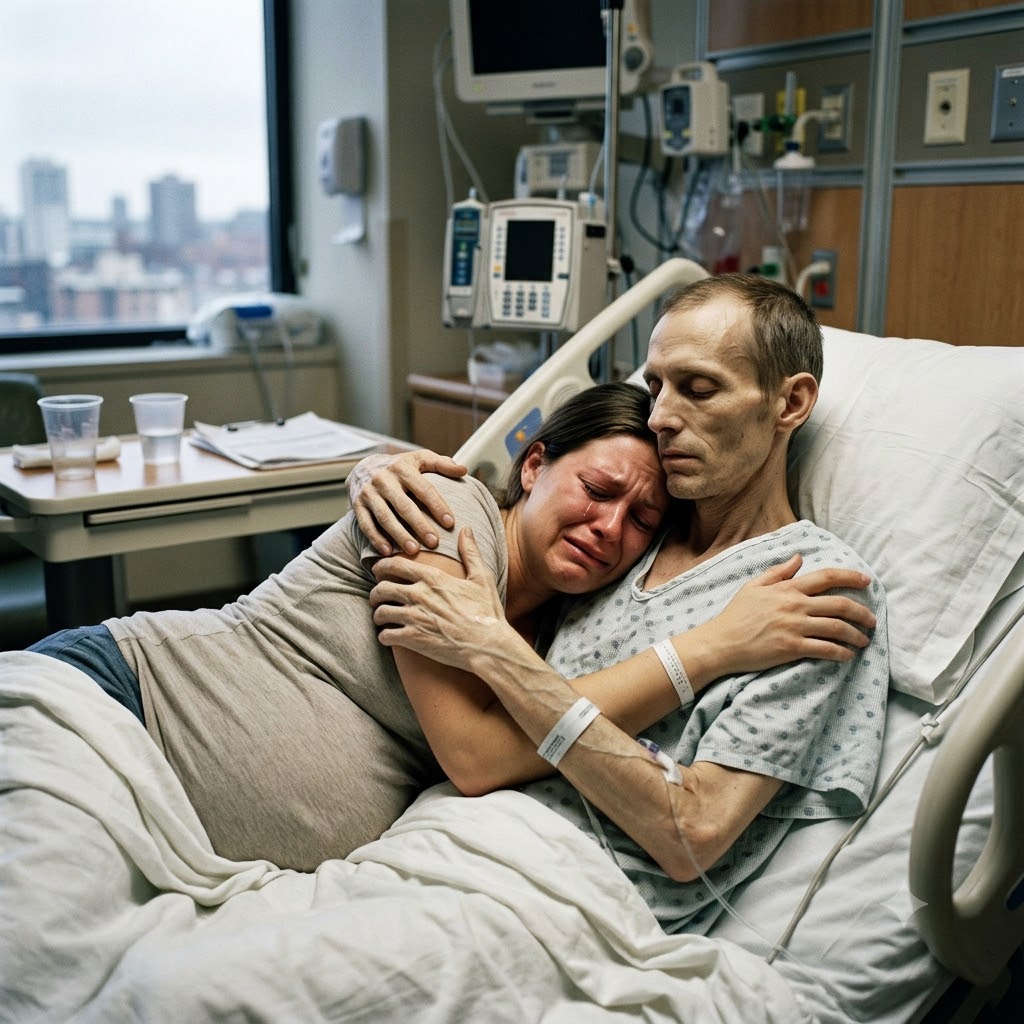
He died in Room 412 of St. David’s Medical Center, with the sound of steady rain tapping against the glass. Claire was sitting in the vinyl armchair beside his bed, her hand holding his tightly. His breathing had grown slower and more erratic over the preceding hours, stretching into long, agonizing silences until finally, with a gentle, barely audible sigh, his chest sank one last time and did not rise again.
The silence that followed was heavy and absolute.
For nearly twenty minutes, Claire stayed in the chair, resting her forehead against his motionless arm, letting her tears soak into the rough hospital blanket. She felt the heavy, rhythmic movement of Lily shifting inside her—a stark, surreal contrast of life continuing inside a room where life had just ended.
Eventually, the door opened quietly, and the palliative care team stepped in.
What followed was a cold, disorienting blur of protocol and paperwork. Nurses moved quietly around the bed, detaching monitors and turning off oxygen concentrators. Social workers offered hushed condolences and plastic cups of cold water.
Then came the representative from the Texas Organ Sharing Alliance.
Claire was guided down the hall into a small, windowless conference room under the bright, buzzing hum of fluorescent lights. A woman named Karen, wearing dark blue scrubs, set a thick clipboard down on the laminate table between them.
“Mrs. Miller,” Karen said, her voice soft and carefully measured. “I know this is an unimaginable moment for you. But David registered as an organ donor on his driver’s license, and you mentioned earlier that he specifically wished to proceed with donation.”
Claire wiped her nose with a crumpled tissue, staring at the thick stack of forms. “Yes,” she whispered. “It was his last wish. He was very clear about it.”
“Because of his cancer diagnosis, his major solid organs like his liver and kidneys cannot be harvested for transplant,” Karen explained gently. “However, his corneas, heart valves, skin grafts, and structural bone tissue are fully viable and completely unaffected by his illness. They can help up to fifty different people.”
Claire took the pen from Karen’s hand. Her fingers were trembling so badly that her first attempt to sign her name produced only a jagged ink line across the page.
Give someone else more time with the people they love.
She forced herself to breathe, stabilizing her wrist against the edge of the table, and signed page after page. Tears splashed onto the consent forms, smudging the black printed text, but she kept going until every box was checked and every line was complete.
She owed him this. It was the final promise she could keep for him.
When the paperwork was finished, Karen offered a brief, respectful hug. “Thank you, Claire. Your husband’s gift is going to change lives today.”
Claire stepped out of the conference room and began walking down the long, sterile corridor toward the main elevators. The hospital felt massive, cold, and hollow. Her feet felt heavy, like she was dragging them through wet cement. Her pregnancy was now in its thirty-fifth week, and the physical strain of the morning was setting into her lower back.
She had reached the end of the hallway, her hand reaching out to press the silver elevator call button, when she heard the distinct, hurried sound of rubber-soled shoes squeaking against the linoleum behind her.
“Claire! Wait! Please, wait!”
Claire turned around.
Dr. Nathan Hayes was jogging toward her, looking thoroughly out of breath. His hair was disheveled, his white lab coat flapped open, and his face was unusually pale beneath the corridor lights.
“Dr. Hayes?” Claire asked, her voice cracking with fatigue. “Is there… did I miss a signature on the donation papers?”
Dr. Hayes stopped two feet away from her, his chest heaving as he caught his breath. He looked around the empty hallway, checking the doorways on either side, before slowly bringing his right hand out from behind his back.
In his grip was a thick, heavy manila envelope, tied shut with a red string around a plastic button seal.
Across the front of the envelope, written in dark black ink in David’s neat, architectural handwriting, was a single word: CLAIRE.
Claire stopped breathing. The air seemed to leave her lungs all at once.
Dr. Hayes looked directly into her eyes, his expression a mix of profound solemnity and quiet anxiety.
“David gave this to me three weeks ago during our last private meeting in the clinic,” Dr. Hayes said, his voice dropping to a low whisper.
Claire stared at her name on the envelope. The handwriting was unmistakable—sharp, precise, with the stylized capital ‘C’ he always used when signing his blueprints.
“Why… why didn’t you give it to me then?” Claire asked, her heart beginning to hammer violently against her ribs.
Dr. Harrison hesitated for a moment, shifting his weight. “Because David made me swear an absolute medical oath, Claire. He made me promise on my professional license that I would not put this envelope into your hands until after he had taken his last breath.”
He extended his hand, offering the heavy envelope to her.
“He was very specific,” Dr. Hayes added softly. “He said, ‘She needs to focus on holding my hand while I’m here. Give her this when I’m gone, so she knows how to live when I’m not.'”
And suddenly, standing in the cold, fluorescent light of the hospital hallway, Claire understood. All those private, locked-door conversations between her husband and his doctor had never been about his declining health, or his pain medication, or his cancer at all.
Chapter 4: The String on the Envelope
Claire’s hands shook so violently that she could barely untie the red string wrapped around the plastic seal of the manila envelope.
Dr. Hayes had led her into an empty family consultation room off the main hallway, pulling the door closed behind him to give her complete privacy. The room contained only a faux-leather couch, a small coffee table, and a box of tissues.
Claire sank onto the couch, setting the heavy envelope on her lap. Her stomach tightened with a sudden, sharp contraction—not a labor pain, but the sheer physical manifestation of her racing pulse.
She unwrapped the string, lifted the flap, and reached inside.
Her fingers pulled out three items: a thick, legal-sized document stamped with a red notary seal; a small, metallic silver USB drive; and a four-page letter written on heavy cream stationery in David’s neat handwriting.
Claire set the documents aside and held the letter in her hands. She brought the paper to her face; it still carried the faint, familiar scent of cedarwood and faint tobacco—the cologne David had worn for years before he got sick.
She unfolded the pages and began to read.
My dearest Claire,
If you are holding this letter, it means the pain is finally over for me, and you are standing in the quiet shadow of what comes next. I am so sorry I had to keep this from you during our final weeks together. I know how much you hated the locked door at the clinic. I know you felt like I was pulling away.
Please forgive me, sweetheart. If I had told you while I was still sitting beside you on the porch, you would have spent my last days worrying about contracts, attorneys, and logistics instead of just sitting with me, holding my hand, and listening to the rain.
When Dr. Hayes first told us that I had three months left, my greatest fear wasn’t dying. Dying is easy; it’s just letting go. My real nightmare—the terror that kept me awake every night while you were sleeping—was the thought of leaving you and Lily vulnerable.
I knew what our savings looked like. I knew the medical bills from the chemotherapy were already stacking up. I knew that after I was gone, you would be forced to go back to work weeks after giving birth, struggling alone to pay the mortgage on our house while raising our daughter on a single librarian’s salary.
I couldn’t fix my cancer, Claire. But I refused to let my death destroy your future.
Do you remember my grandfather, Arthur Vance? Do you remember the story about the sixty acres of scrub land he bought in Reeves County, deep in West Texas, back in 1974?
Claire paused, wiping a tear from her eye with the back of her wrist.
She did remember. Arthur Vance had been a eccentric, stubborn man who had spent three thousand dollars at a county land auction in the 1970s, buying a parcel of arid, sun-baked desert that everyone in the family had considered completely worthless. When Arthur died in 2012, he had left the deed to David in his will. For over a decade, it had been nothing more than a running joke between them—a piece of land covered in mesquite bushes and rattlesnakes that they paid fifty dollars a year in property taxes to maintain.
She returned her eyes to the paper.
Three months ago, right after my diagnosis, I received a cold call from an land acquisition attorney representing a renewable energy consortium out of Houston. They were quietly buying up contiguous acreage in Reeves County for a massive, utility-scale geothermal and mineral extraction project.
They assumed I was an unsuspecting heir who didn’t know what I had. They offered me forty thousand dollars for the parcel.
Instead of accepting, I spent two thousand dollars of our emergency savings—forgive me for keeping that from you—to hire an independent petroleum and mineral surveyor in Midland to run a core analysis on Grandfather Arthur’s land.
Claire, Arthur didn’t just buy desert. He bought the surface and mineral rights directly over one of the richest lithium-bearing brine formations and deep geothermal reservoirs discovered in the state of Texas in twenty years.
Claire gasped, her hand flying to her mouth. The paper trembled in her grip.
During those private meetings with Dr. Hayes at the clinic, I wasn’t discussing my cancer prognosis. Dr. Hayes’s brother, Marcus Hayes, happens to be a senior partner at one of the premier commercial energy and estate law firms in downtown Austin.
Dr. Hayes arranged for Marcus to meet me privately in the clinic’s conference room while you were getting my drinks in the lobby. Over the past six weeks, while you thought I was resting, Marcus and I negotiated a comprehensive, long-term mineral lease and land use contract with the energy consortium.
I signed the final documents four days ago from my hospital bed.
Claire picked up the legal document stamped with the red notary seal. She flipped to the summary page near the front, her eyes scanning the dense, formal legalese until they landed on the bolded financial figures.
The upfront signing bonus alone, which had been executed and wired forty-eight hours before David’s death, was $1.8 million.
The ongoing monthly mineral royalties, secured by an irrevocable twenty-year commercial contract, guaranteed an estimated payment of $35,000 to $50,000 per month, adjusted annually for production volume.
Claire returned to the letter, her tears now flowing freely, obscuring the ink on the page.
The notarized deed attached to this letter officially places the entire Reeves County property, along with the lease agreement and all financial proceeds, directly into an irrevocable family trust: The Lily Evelyn Miller Foundation Trust.
You are the sole trustee, Claire. The money is yours and Lily’s. The house is paid off—I had Marcus draft the wire to clear our mortgage principal yesterday morning.
You don’t have to worry about medical bills. You don’t have to worry about college tuition. You don’t have to go back to work unless it brings you joy. You can stay home with our baby girl for as long as you want. You can give her the life we always dreamed of giving her.
I couldn’t be there to protect you with my hands, Claire. So I built a fortress around you with my final weeks on this earth.
The USB drive attached to this letter contains eighty-four separate video files. I recorded one for every birthday Lily will have until she turns twenty-one, along with videos for her graduation, her wedding day, and the days when she feels lost and needs her dad’s advice. Dr. Hayes helped me set up the camera in his private office during those extra ten minutes after my appointments.
I gave everything I had left to make sure you two would be safe.
Now, my darling girl, put this letter away. Go home. Raise our daughter. Tell her how much her daddy loved her before he ever saw her face. And live a long, beautiful, joyful life.
I will be loving you from somewhere far away.
Forever yours,
David
Chapter 5: The Gifts Left Behind
Claire sat alone in the quiet consultation room for a long time, holding the letter against her chest, her body shaking with deep, cleansing sobs that seemed to purge months of built-up horror, fear, and exhaustion.
David had known he was dying. He had known his body was failing him day by day. Yet, in the midst of his own terminal agony, he had quietly, meticulously moved mountains to ensure that the woman he loved and the child he would never see were protected from the cold realities of the world.
He had given his organs to save the lives of strangers, and he had given his final days to save hers.
Slowly, Claire gathered the documents, the notarized trust deed, and the silver USB drive, sliding them carefully back into the manila envelope. She tied the red string securely around the button seal.
She stood up, straightened her clothes, and opened the door to the hallway.
Dr. Hayes was still standing near the nurses’ station fifty feet away, leaning against the counter. When he saw her step out, he walked over, his eyes filled with quiet concern.
“Are you alright, Claire?” he asked gently.
“Yes,” Claire whispered, her voice surprisingly strong. She wiped her cheeks and offered him a genuine, tearful smile. “Thank you, Nathan. Thank you for helping him do this.”
Dr. Hayes nodded softly, his own eyes glistening. “He was an extraordinary man, Claire. In thirty years of practicing medicine, I’ve never seen anyone fight through that kind of pain with such absolute purpose.”
Before Claire could answer, a young woman wearing surgical scrubs ran up the hallway from the ICU service elevators, holding a digital tablet.
“Dr. Hayes!” the nurse called out, her tone urgent but bright. “The organ procurement flight just landed at Austin-Bergstrom! The surgical team from Texas Children’s Hospital in Houston is upstairs right now. They’ve confirmed a match for David’s heart valves—they’re being prepped for a four-year-old girl with a congenital defect.”
Claire stopped, turning toward the nurse.
“And the tissue team from San Antonio,” the nurse continued, checking her tablet, “has already cleared the skin graft match for a firefighter who suffered third-degree burns in a structural fire on Tuesday. They’re moving into OR Three right now.”
Dr. Hayes looked at Claire, offering a quiet, respectful nod. “His gifts are already moving.”
Claire placed her hand over her abdomen. Right at that moment, beneath her palm, Lily kicked—a sharp, clear, unmistakable burst of life.
Claire smiled through her tears. She turned toward the hospital exit, clutching the manila envelope tightly against her side.
As she pushed open the glass double doors and stepped out into the cool, rain-washed Texas air, the storm clouds overhead were finally beginning to part, revealing a brilliant sliver of autumn sunlight breaking over the horizon.
David was gone, but he had left behind a fortress of love that would stand forever. And as Claire walked toward her car, she knew that she and their daughter were going to be more than okay.