A humble maid who had spent years serving a powerful millionaire family was suddenly accused of stealing an invaluable piece of jewelry.
A humble maid who had spent years serving a powerful millionaire family was suddenly accused of stealing an invaluable piece of jewelry. She was taken to court without a lawyer, humiliated before the entire world, and left completely alone against the power of the rich. Everyone assumed she was guilty, because the word of the powerful carried more weight than her tears or her truth.
But in the middle of the trial, when it seemed that nothing could save her, the unexpected happened. The millionaire’s youngest son, who loved her like a second mother, broke free from his nanny, ran into the courtroom, and revealed a shocking secret that would change the course of the case forever….
Chapter 1: The Weight of Steel and Silences
The bronze doors of Courtroom 302 in the Cook County Circuit Court were thick enough to muffle the roar of Chicago’s morning traffic, but they could not keep out the oppressive hum of public judgment.
I sat at the defense table, my knees pressed tightly together, my hands resting palms-down on the polished oak surface to hide their uncontrollable trembling. The cheap, stiff navy wool of the donated blazer I wore scratched against my neck. I was thirty-four years old, but looking at my reflection in the dark glass of the prosecution’s tablet screen across the aisle, I saw a woman carved thin by ten years of invisible labor.
My name is Elena Gomez. For nine years, eight months, and twelve days, I was the head housekeeper at the Sterling Estate in Lake Forest, Illinois.
“The State of Illinois versus Elena Gomez,” the court clerk announced, his voice flat, exhausted, and devoid of drama. “Case number 26-CR-8821. Count one: Class X Grand Larceny.”
To the right of the aisle sat the Sterling family.
Victor Sterling—the founder and chief executive officer of Sterling Global Logistics, a hedge-fund titan whose net worth hovered somewhere north of six hundred million dollars—sat upright in his bespoke charcoal suit. His posture was rigid, his expression a mask of stony, aristocratic disgust. Beside him sat his wife, Victoria, a woman draped in tailored cream cashmere, her manicured fingers twisting a silk handkerchief. Her eyes never once met mine. To them, I was not a human being who had polished their silver, folded their clothes, and comforted their children through fevers at two in the morning. I was a broken fixture. A leech. A thief.
“Is the defense ready to proceed?” asked Judge Harold Vance, looking down over the top of his half-moon spectacles. His gaze lingered on me with a mixture of quiet pity and impatience.
I turned to my left. Sitting beside me was Mr. Timothy Brooks, a court-appointed public defender who had been handed my file exactly twenty-four minutes before the courtroom doors opened. His briefcase was held together by duct tape, and his shirt collar was frayed.
“We are as ready as we can be, Your Honor,” Brooks muttered, shuffling a thin stack of handwritten notes. He hadn’t asked me about my life. He hadn’t asked me about the night of October 14th. He had simply sat me down in the hallway and whispered, “Elena, if they offer a plea for eight years, take it. Victor Sterling owns half the judges in this district. You can’t win.”
I had refused the plea. Because to take the plea was to admit that I had touched the Duchess’s Tear.
The Duchess’s Tear was a sixty-four-carat pear-cut Sri Lankan sapphire surrounded by forty-eight flawless pink diamonds. It was an heirloom brought into the Sterling family in 1928, valued at fourteen million dollars, and kept in a biometric vault inside Victor Sterling’s private study on the third floor of the Lake Forest mansion.
On the morning of October 15th, the vault was opened. The velvet box was empty. By noon, two private security contractors hired by Victor had searched my small basement staff quarters. By 2:00 PM, a detective from the Lake Forest Police Department claimed to have found a microscopic scratch on the internal lock mechanism that matched a set of brass pick tools planted at the bottom of my laundry hamper.
I had no lawyer. I had no money. I had no high-society friends to stand as character witnesses. All I had were my tears, my raw knuckles, and a truth that nobody in that courtroom cared to hear.
“The prosecution may deliver its opening statement,” Judge Vance declared.
Senior Assistant State’s Attorney Marcus Kane stood up. He buttoned his coat, smoothed his red tie, and turned to face the bench and the packed gallery. Cameras from two local news stations were aimed at his face. The media loved the story: The Ungrateful Maid and the Fourteen-Million-Dollar Betrayal.
“Your Honor, ladies and gentlemen of the gallery,” Kane began, his voice dripping with smooth, practiced outrage. “This case is not merely about a stolen stone. It is about the absolute betrayal of human trust. For nearly a decade, the Sterling family opened their home to the defendant. They gave her employment. They gave her shelter. They paid her a generous wage. And how did she repay them?”
Kane walked slowly toward the defense table, pointing a long, accusing finger directly at my face.
“She waited,” Kane spat. “She observed their schedules. She learned the vulnerabilities of their home. And on the night of October 14th, driven by base greed, she used her access to slip into Mr. Sterling’s private study, bypass a state-of-the-art security system, and strip this family of an invaluable piece of their heritage.”
I closed my eyes, a single hot tear slipping down my cheek. Across the gallery, a dozen camera lenses clicked in unison, capturing my grief to sell as proof of my guilt.
Chapter 2: The Architecture of an Accusation
“Let the record reflect,” Kane continued, turning back to his evidence board, “that the defendant had accumulated over forty-two thousand dollars in personal debt due to medical expenses incurred by her aging mother in Jalisco. A classic motive. A desperate woman in a house of immense wealth.”
My public defender, Brooks, leaned over and whispered, “Don’t react, Elena. It makes you look unstable.”
“It’s a lie,” I whispered back, my throat tight. “My mother passed away three years ago. That debt isn’t mine—it was my late brother’s, and it was settled last year.”
“It doesn’t matter,” Brooks muttered, tapping his pen against his yellow legal pad. “The paper trail looks bad. The jury—if we had one—would swallow it whole. Judge Vance is looking at the financial summaries right now.”
I looked up at the bench. Judge Vance was flipping through the prosecution’s binder, his face devoid of emotion. Behind him, the oak-paneled wall bore the seal of the State of Illinois. Everything in this room was massive, heavy, and designed to make a person like me feel microscopic.
Kane called his first witness: Arthur Pendelton, the head of Sterling Estate Security.
Pendelton, a former police captain with a broad neck and a sharp mustache, took the stand with practiced ease. He swore the oath, sat down, and adjusted his microphone.
“Mr. Pendelton,” Kane asked, walking back and forth before the witness box. “Who had physical access to the third-floor master suite on the evening of October 14th?”
“Only three people, sir,” Pendelton replied, his voice firm and authoritative. “Mr. Victor Sterling, Mrs. Victoria Sterling, and the defendant, Elena Gomez. The third floor requires a keycard sweep at the elevator banks. The defendant held Master Keycard 04.”
“And did the security cameras record anyone else entering the corridor leading to the study between 8:00 PM and midnight?”
“No, sir. The hallway camera log shows Master Keycard 04 was swiped at 9:14 PM.”
“9:14 PM,” Kane repeated, turning to face the judge to ensure the detail landed with maximum weight. “And what did the defendant claim she was doing on the third floor at 9:14 PM?”
“She claimed she was turning down the bed in the master suite and leaving a tray of chamomile tea,” Pendelton answered, offering a small, condescending smile. “However, upon inspecting the tea tray the following morning, the pot was completely untouched. She was in that corridor for eleven minutes. The study door was unlocked from the inside.”
“Eleven minutes,” Kane mused aloud. “Plenty of time to pick a secondary mechanical lock, palm a Sri Lankan sapphire, and slip back down the servant stairs.”
“Objection,” Brooks mumbled, half-heartedly raising his hand. “Speculation.”
“Sustained,” Judge Vance said flatly. “Rephrase, Mr. Kane.”
“No further questions for this witness, Your Honor,” Kane said, bowing his head slightly. He looked over at me with a look of supreme triumph.
Brooks stood up for cross-examination. He walked to the lectern, looked at his notes for ten agonizing seconds, and cleared his throat.
“Mr. Pendelton… isn’t it true that the security cameras on the rear terrace were undergoing routine maintenance on the night of October 14th?”
“They were,” Pendelton admitted easily. “A scheduled software update from 8:00 PM to 10:00 PM.”
“So someone could have climbed the rear trellis onto the second-floor balcony and accessed the study without being seen on those specific cameras?”
“If they were a professional acrobat, perhaps,” Pendelton sneered softly. “And if they possessed the internal mechanical key to the study balcony doors, which were locked from the inside when my officers arrived at 6:00 AM.”
Brooks sighed, looking down at his yellow pad. He had run out of questions. “Nothing further, Your Honor.”
I felt a cold sweat break out across my lower back. I looked toward the gallery. The prosecution’s narrative was seamless. It was a net of circumstantial facts woven so tightly that no truth of mine could break through it.
To the world, I was the girl who came from nothing, who spent ten years staring at diamond necklaces she could never afford, until her envy finally overwhelmed her sense of morality.
Nobody asked why I had stayed at the Sterling Estate for ten years despite receiving job offers from luxury hotel chains that paid double my salary. Nobody asked about the little boy who lived on the second floor.
Chapter 3: The Forgotten Boy
His name was Leo. He was seven years old.
Leo was Victor and Victoria Sterling’s youngest son—an unexpected child born late in their marriage, diagnosed at age three with severe non-verbal autism and sensory processing disorder.
To Victor, Leo was a tragic error in his legacy—a child who could not be showcased at polo matches or groomed for an Ivy League education. To Victoria, Leo was an exhausting social embarrassment, a child whose sudden meltdowns threatened the pristine silence of her polished home. They hired a revolving door of elite, certified nannies who arrived with thick portfolios and left within three weeks, unable to handle Leo’s intense, wordless storms.
It was I who had stayed.
I remembered the first time Leo had let me hold him. It was a stormy night in July six years ago. The thunder had rattled the antique stained-glass windows of his nursery, and he was screaming, striking his own chest with his small fists, his face purple with terror. His nanny had locked herself in the staff bathroom, crying.
I had walked into the room, turned off the sharp overhead chandelier, and sat on the carpeted floor. I didn’t try to hold him by force. I simply began to hum an old Spanish lullaby my grandmother used to sing in Jalisco—Duerme, duerme, mi pequeño cielo.
It took forty-five minutes. Slowly, inch by inch, the tiny boy had crawled across the floor, laid his hot, wet cheek against my knee, and let me wrap him in a heavy velvet blanket.
From that night on, I became Leo’s hands, his voice, and his safe harbor.
I learned the silent language of his fingers. I knew that two taps on his left collarbone meant he was thirsty; I knew that pressing his forehead against my shoulder meant the lights in the dining room were too bright. I taught him how to paint with water on stone slates. I spent my unpaid evenings sitting beside his bed, holding his hand until his racing heart slowed down enough for sleep to claim him.
Victor and Victoria were happy to let me carry the burden. They paid me my housekeeper’s salary, looked the other way when I spent three hours a day in the nursery instead of dusting the chandeliers, and treated my bond with their son as a convenient domestic amenity.
And now, as I sat in this courtroom facing ten years in a maximum-security state prison, Leo was miles away, trapped in that vast, cold house with a new team of cold-eyed security guards and high-priced behavioral therapists who didn’t know that he was afraid of the dark.
“The State calls its next witness,” Marcus Kane announced, his loud voice snapping me out of my memory. “Mrs. Victoria Sterling.”
Chapter 4: The Performance of Innocence
Victoria Sterling stepped down into the well of the court. Her heels clicked with sharp, rhythmic precision against the terrazzo floor.
She took the stand, her posture immaculate, her hands folded over her designer handbag. When the court clerk administered the oath, her voice was soft, tremulous, and carefully modulated to project the image of a deeply wounded matriarch.
“Mrs. Sterling,” Kane began gently, stepping toward the witness stand with an expression of profound empathy. “Could you describe for the court what the Duchess’s Tear meant to your family?”
Victoria produced her lace handkerchief, dabbing delicately at the corner of her eye—though I could see from fifteen feet away that there were no tears on her face.
“That sapphire was given to Victor’s grandmother by the Duke of Devonshire,” Victoria said softly. “It was not merely an asset, Mr. Kane. It was the emotional centerpiece of our family’s history. We intended to pass it down to our children.”
“And on the night of October 14th, Mrs. Sterling… did you observe anything unusual about the defendant’s behavior?”
Victoria looked up. For the first time in three weeks, her cold, pale blue eyes met mine. There was no hatred in them. Worse—there was absolute indifference. To her, I was already gone.
“Elena was… distant that evening,” Victoria testified smoothly. “She seemed agitated. She asked twice if my husband and I were attending the opera gala downtown. When we told her we were staying home due to Leo’s evening therapy session, she seemed visibly disappointed.”
“She was checking your schedule,” Kane suggested.
“Objection!” Brooks shouted, finally showing a spark of energy. “Leading the witness!”
“Sustained,” Judge Vance said. “Strike Mr. Kane’s remark from the record.”
“Mrs. Sterling,” Kane rephrased, unfazed. “Did you give the defendant permission to enter the study at 9:14 PM?”
“I did not,” Victoria said firmly. “The study is my husband’s private sanctuary. No staff member is permitted inside after 6:00 PM without explicit instruction.”
“And when you discovered the sapphire missing the following morning… how did the defendant react when confronted?”
“She wept,” Victoria said, shaking her head with an air of tragic pity. “She fell to her knees and began babbling in Spanish. She tried to claim she knew nothing about it. But when the police found those locksmith tools in her quarters… we were heartbroken. We trusted her. We treated her like family.”
Like family.
The words burned in my chest like swallowed acid.
“Thank you, Mrs. Sterling,” Kane said, turning back to his desk. “Your witness, Mr. Brooks.”
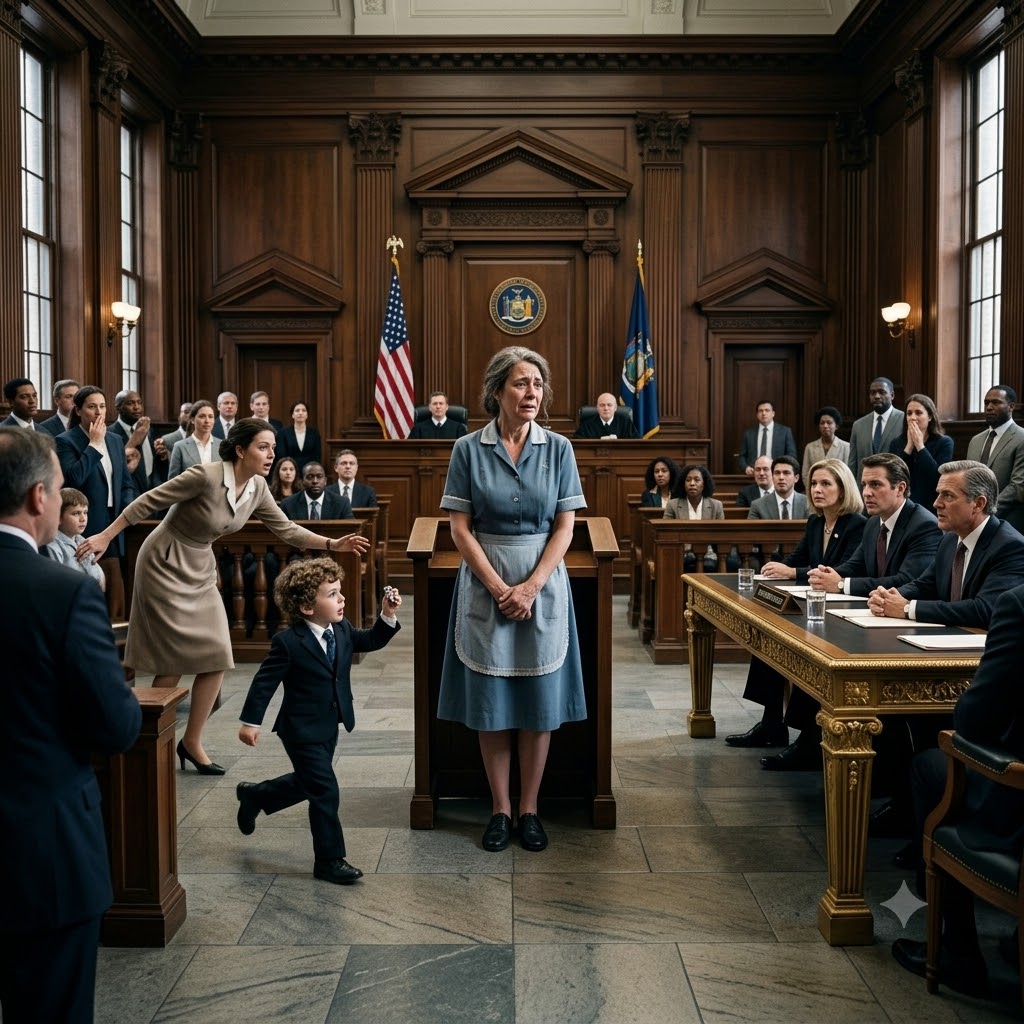
Brooks stood up, but before he could reach the lectern, a low, unusual commotion echoed from the heavy double doors at the back of the courtroom.
Chapter 5: The Disturbance at the Gates
The heavy oak doors of Courtroom 302 did not open quietly. They slammed against the brass wall stoppers with a loud, sudden BANG that caused Judge Vance to drop his pen.
Every head in the gallery turned.
Standing in the doorway was a tall, stern-faced woman in a tailored dark suit—Ms. Margaret Vance, the newly hired chief nanny for the Sterling family. Her hair was unspooling from her tight bun, her neck was flushed red, and she was breathing heavily, as if she had just sprinted up three flights of stairs.
“Stop!” a voice squeaked from behind her skirt.
A small, thin boy in an oversized grey wool coat escaped from her grip.
It was Leo.
He was wearing no shoes—only a pair of thick navy socks, one of which was soaked through with mud. His hair was messy, his face streaked with tears and dirt, his tiny chest heaving under his coat. In his left hand, he was clutching a heavy, rectangular object wrapped in a faded yellow flannel pillowcase—the old pillowcase from his nursery bed that I had mended for him three summers ago.
“Ms. Vance!” Victor Sterling barked, standing up from his seat in the gallery, his face darkening with sudden rage. “What is the meaning of this?! Why is my son here?!”
“Mr. Sterling, I am so sorry!” the nanny gasped, trying to reach down to grab the boy’s arm. “He slipped through the garage doors while the driver was loading the trunk! He ran three blocks down Washington Street! I couldn’t stop him—”
“Order!” Judge Vance shouted, slamming his gavel down twice. “Bailiff, secure the gallery! Who brought a child into this courtroom?!”
Leo didn’t look at the judge. He didn’t look at the bailiff who was stepping toward him. He didn’t look at his father or his mother.
His wide, luminous dark eyes scanned the high oak pews, searching through the sea of strange, staring faces, until they landed on the small, navy-clad figure sitting behind the defense table.
“E… El… Elena!”
The sound that came out of his mouth was high, cracked, and clumsy—a sound he had not made in front of another human being in four years.
I stood up so fast my chair fell backward onto the floor with a loud clatter.
“Leo!” I cried, my hand flying to my mouth.
“Silence!” Judge Vance warned, though his gavel hovered mid-air as he stared at the scene unfolding in the center aisle.
Leo ignored the bailiff’s outstretched arm. He dodged past the railing, his wet socks sliding slightly across the polished floor, and ran with all the desperate, uncoordinated speed his small legs could manage. He didn’t run to his mother, who was reaching out her hands with a look of sharp embarrassment. He didn’t run to his father, who was stepping into the aisle to intercept him.
He ran straight to the defense table, threw his arms around my waist, and buried his face into the cheap wool of my blazer.
Chapter 6: The Unspoken Language
The courtroom descended into a stunned, absolute silence.
The news cameras swung away from the prosecution desk, their lenses focusing entirely on the small boy weeping against my stomach, his fingers clutching my coat with a terrifying, iron grip.
“Elena… Elena… Elena…” he repeated, the word tumbling out of his throat in a breathless, rhythmic chant—the only name he had ever learned to say.
I dropped to my knees on the hard floor, completely unmindful of the judge, the lawyers, or the cameras. I wrapped my arms around his shaking shoulders, pulling him against my chest, kissing his hair, wiping the cold rain and dirt from his temples with the sleeve of my jacket.
“I’m here, mi corazón,” I whispered in Spanish, my tears falling freely into his dark hair. “I’m here. It’s okay. You’re safe.”
“Mr. Sterling,” Judge Vance said, his voice dropping its authoritative boom, replaced by a tone of severe confusion. “Control your child immediately.”
Victor Sterling stepped into the well of the court, his face flushed deep red with anger and social humiliation. He grabbed Leo by his upper arm, attempting to pull him away from me. “Leo! Let go of her! Get up right now!”
The moment Victor’s hand tightened on the boy’s arm, Leo let out a piercing, high-pitched shriek of terror. He didn’t pull toward his father; he dug his heels into the floor and pulled closer to me, his fingers sinking deeper into my clothes.
“Don’t touch him like that!” I snapped at Victor, my voice ringing across the courtroom with a sharp, fierce authority that made every lawyer in the room jump. “You’re sensory-overloading him! Let go of his arm!”
Victor hesitated, caught off guard by the sheer rage in my eyes. He released his grip, stepping back half a pace, looking around at the staring gallery with a mixture of panic and disgust.
Leo, panting heavily, lifted the heavy object he was clutching in his left hand.
He didn’t hand it to his father. He didn’t hand it to the judge. He lifted the yellow flannel pillowcase and pressed it directly into my hands.
“Look,” Leo stammered, tapping his collarbone twice—Listen to me. Pay attention. “Look… Elena… look!”
“What is that?” Judge Vance asked, leaning over his bench, peering down at the defense table.
“Your Honor,” Marcus Kane interrupted quickly, stepping forward to block the view of the cameras. “This is an absurd family distraction! The child is severely disabled and mentally incompetent! He should be removed from the court immediately so we can resume the cross-examination of Mrs. Sterling!”
“Shut up, Mr. Kane,” Judge Vance said flatly. He looked down at me. “Ms. Gomez… what did the boy bring you?”
My hands trembled as I untied the small piece of twine holding the top of the yellow pillowcase closed.
I reached inside.
My fingers touched cold, polished metal first—a small, silver leather-bound iPad case with a broken corner strap. Beneath it was something hard, square, and heavy wrapped in a silk hand towel.
I pulled the second object out first.
As the silk hand towel unwrapped and fell to the floor, the bright fluorescent lights of Courtroom 302 caught the object inside.
Gasps erupted from the gallery.
Sitting in the palm of my hand was a heavy, pear-cut Sri Lankan sapphire, sixty-four carats of deep, liquid blue, surrounded by forty-eight shimmering pink diamonds.
The Duchess’s Tear.
Chapter 7: The Digital Ledger
Victoria Sterling let out a sharp, choked gasp, her hand flying to her throat as she stepped back from the witness stand so fast her heel caught on the carpet.
Victor Sterling stared at the blue stone in my hand, his mouth opening and closing like a landed fish. “That… that’s impossible. We searched his room! Pendelton searched the nursery!”
“Silence!” Judge Vance roared, slamming his gavel down three times with terrifying force. “Nobody moves! Bailiffs, lock those doors! Mr. Kane, sit down!”
Judge Vance leaned over the bench, his eyes wide as he stared directly at the sparkling stone sitting on the defense table.
“Ms. Gomez,” Judge Vance said, his voice remarkably calm despite the tension filling the room. “Is that the stolen property?”
“Yes, Your Honor,” I whispered, staring at the sapphire that had nearly cost me my life.
“And where did your son get that, Mr. Sterling?” the judge demanded, turning his gaze toward Victor.
“I… I have no idea!” Victor stammered, his aristocratic composure shattering into panicked fragments. “The boy must have found it! He must have taken it from her hiding place!”
“No,” a small, raspy voice broke through the silence.
Leo was standing beside me now, his shoulder pressed against mine. He reached down with his tiny index finger and tapped the second object I had pulled from the pillowcase—the silver iPad.
It was an old model—a child-proof tablet with a rubberized frame that Victor had bought for Leo three years ago to play basic matching games. Because Leo could not speak, his behavioral therapists had installed an auto-recording accessibility app that captured short video clips whenever the tablet’s front or rear motion sensors detected movement within three feet of the screen. It was meant to help his doctors monitor his involuntary tics during the night.
Leo pressed his thumb against the home button. The screen glowed to life.
“Your Honor,” my public defender, Brooks, suddenly spoke up, stepping forward with an intensity he hadn’t shown all morning. “Under Illinois Rules of Evidence 901, the defense requests an immediate bench review of the media file presented by the minor witness.”
“Granted,” Judge Vance declared. “Bring the device to the bench.”
Marcus Kane tried to step in. “Your Honor, this is completely unauthenticated—”
“I said sit down, Mr. Kane!” Judge Vance barked. “Bailiff, bring me that tablet.”
A court deputy walked to the defense table, picked up the silver iPad, and carried it up the wooden steps to the judge’s bench.
Judge Vance pulled the device toward him. He adjusted his glasses, tapped the screen, and selected the recent video log directory.
The courtroom held its breath. The only sound was the low hum of the air conditioner and the quiet, rhythmic breathing of the small boy holding onto my jacket.
Judge Vance clicked on a file timestamped October 14, 2026 — 9:08 PM.
A tiny, tinny sound played from the iPad’s internal speakers, echoing clearly across the silent courtroom.
It was the sound of a heavy wooden door creaking open.
Chapter 8: The Video on the Screen
On the screen of the iPad—captured from the top shelf of the nursery linen closet where Leo often hid his tablet to watch its glowing screen in the dark—a figure appeared in high-definition video.
It was not me.
The camera clearly captured the study’s connecting interior door—a hidden mahogany panel that led directly from the third-floor hallway through the nursery dressing room.
Stepping through the door was Victoria Sterling.
She was wearing a black silk robe. She walked quickly, glancing over her shoulder toward the corridor. In her left hand, she was carrying a velvet-lined jewelry case. In her right hand, she was holding a set of brass pick tools and a small velvet pouch.
The video was crystal clear.
The camera caught her face as she sat down at the nursery desk, mere inches from where the tablet’s motion sensor was active. The timestamp on the bottom right corner read 9:10 PM.
On the screen, Victoria opened the velvet case, pulled out the Duchess’s Tear, and set it on the desk. Then, pulling a second, identical stone from her robe pocket—a cheap, glass costume replica—she placed the replica into the velvet box.
She picked up the brass pick tools, walked over to the laundry chute in the hallway, and dropped the tools straight down the chute, where they fell directly into the staff basement laundry hamper.
Then, turning back to the desk, she reached into her pocket to grab her phone.
The tiny iPad speaker captured her voice clearly—hushed, sharp, and confident:
“It’s done, Julian. I’ve placed the replica in the vault and dropped the tools into the maid’s hamper. The insurance claim for fourteen million can be filed on Monday. Make sure the jeweler in Geneva has the wire transfer ready. Nobody will question it—the police will look at Elena’s debt history and lock her away before the week is out.”
The audio cut off as Victoria closed her phone, grabbed the velvet box with the glass replica, and walked out of the frame, leaving the real sapphire sitting on the corner of the nursery desk.
A second later, on the video, a small, thin arm reached out from beneath a pile of blankets on the floor.
Leo’s hand reached up, snatched the sparkling blue stone from the desk, and pulled it down into his pillowcase, hiding it away like a shining beetle he had found in the garden.
Chapter 9: The Anatomy of a Collapse
Inside Courtroom 302, the silence didn’t just break; it detonated.
Judge Vance lifted his head from the screen. His face was no longer pale or neutral. It was dark, thunderous, and filled with a cold, terrifying judicial fury.
He slowly turned his head to look down at Victoria Sterling.
Victoria was standing near the witness box, her eyes wide with horror, her face the color of wet chalk. She looked at her husband. Victor was staring at her, his jaw hanging open, his hands shaking violently as he realized that every TV camera in Chicago had just broadcast his wife’s voice confessing to a fourteen-million-dollar insurance fraud and framing their housekeeper.
“Mrs. Sterling,” Judge Vance said, his voice dropping into a register that made the glass light fixtures vibrate above our heads. “Do not move an inch.”
“Your… Your Honor,” Marcus Kane stammered, his face bright red as he backed away from the prosecution desk as if it were on fire. “The State… the State was entirely unaware of this footage… we—”
“Silence, Mr. Kane!” Judge Vance roared, standing up from his chair.
He slammed his gavel down so hard the wooden block cracked down the center.
“The State’s motion against Elena Gomez is dismissed with prejudice!” Judge Vance declared, his voice echoing into every corner of the room. “She is cleared of all charges immediately and fully exonerated!”
The gallery erupted into a frantic roar of shouting reporters, flashing camera bulbs, and chatter.
“Bailiffs!” Judge Vance shouted over the din, pointing his gavel directly at Victoria Sterling and Victor Sterling. “Take Mrs. Victoria Sterling into immediate custody on charges of Aggravated Insurance Fraud, Evidence Tampering, Perjury, and Obstruction of Justice! Issue an immediate material witness hold for Mr. Victor Sterling and impound all financial records of Sterling Global Logistics!”
Four armed sheriff’s deputies swarmed into the well of the court.
Victoria let out a shrill, hysterical scream as a female deputy grabbed her wrists, pulling her hands behind her back and snapping steel handcuffs over her cream cashmere sleeves.
“Victor! Do something! Victor!” she shrieked, thrashing against the officers as she was dragged toward the side custody doors. “Call Arthur! Call the Governor!”
Victor didn’t answer her. He collapsed into his wooden bench, his head in his hands, as two federal investigators who had been sitting in the back row stood up and walked toward him with federal subpoenas already drawn.
In the middle of the storm, surrounded by shouting journalists and flashing cameras, my public defender, Brooks, sank back into his chair, letting out a long, disbelieving laugh. “My God… Elena… you did it.”
I didn’t look at Victoria being dragged away. I didn’t look at Victor. I didn’t look at the news cameras pushing against the railing.
I dropped back to my knees on the cold floor, wrapped my arms around Leo, and held him tight against my heart.
The small boy looked up at me, his wide dark eyes calm and clear amidst the chaos. He lifted his tiny hand, touched my cheek, and wiped away a fresh tear with his thumb.
“No… cry… Elena,” he whispered, his voice steady and true. “Safe.”
“Yes, my sweet heart,” I sobbed, kissing his forehead. “We are safe.”
Chapter 10: The Reckoning
The fall of the House of Sterling was swift, brutal, and thoroughly documented across every news outlet in the United States.
The story of the “Maid and the Boy” dominated international headlines for months.
When the federal investigation concluded six months later, it was revealed that Sterling Global Logistics was already on the brink of insolvency due to Victor’s disastrous illegal offshore trades. Victoria’s attempt to steal the Duchess’s Tear and frame me was a desperate, cold-blooded scheme to secure fourteen million dollars in untraceable insurance cash before their empire collapsed.
Victoria Sterling pleaded guilty to federal counts of Wire Fraud, Perjury, and Framing an Innocent Person under Color of Law. She was sentenced to twelve years in a federal penitentiary in Pekin, Illinois.
Victor Sterling, implicated in the broader financial fraud uncovered during the seizure of his home devices, lost his firm, his Lake Forest estate, and his assets to federal receivership. He spent the remainder of his fortune on criminal defense lawyers to stay out of prison, ending up bankrupt, disgraced, and utterly alone in a small rented apartment in downtown Chicago.
Arthur Pendelton, the head of security who had helped plant the tools in my laundry hamper in exchange for a fifty-thousand-dollar bribe from Victoria, lost his license and was sentenced to three years in state custody.
As for me, my life changed in a way I could never have imagined on that terrifying morning in Courtroom 302.
A high-profile civil rights firm in Chicago took on my civil lawsuit against the Sterling estate and the Lake Forest Police Department on a pro-bono basis. Eight months after the trial, a federal judge approved a twenty-two-million-dollar settlement funded by the Sterling estate’s liquidating trust and corporate insurance policies.
I was no longer a maid. I was no longer invisible.
Chapter 11: The House on the Lake
One year later.
The summer sun reflected brightly off the blue waters of Lake Michigan, sending shimmering ripples of light across the wide lawn of a beautiful, warm stone house in Evanston, Illinois.
There were no high iron gates. There were no security guards with cold eyes. There were no biometric locks or silent corridors filled with expensive, hollow antiques.
The house was surrounded by gardens of yellow sunflowers, lavender, and wild roses. Inside, the rooms were filled with warm sunlight, soft rug runners, and the sweet smell of baking vanilla bread.
I sat on a wooden bench on the back porch, holding a warm cup of coffee, looking out over the water.
From the garden below came the sound of loud, joyous laughter.
Leo was running across the grass, wearing bright blue sneakers, holding a wooden butterfly on a stick. Beside him ran Dr. Sarah Martinez—a world-renowned pediatric speech specialist whom I had hired to work with Leo four days a week.
Following the bankruptcy of the Sterling family, the state family court had opened a formal custody hearing regarding Leo’s future. Victor Sterling, facing federal prosecution and financial ruin, had formally signed away his parental rights without a fight.
I had petitioned the court for legal guardianship.
When Judge Vance—the very same judge who had presided over my trial—read my petition in court, he signed the final adoption papers without a single moment of hesitation.
“He chose his mother a year ago in my courtroom,” Judge Vance had remarked from the bench, his eyes warm as he stamped the gold seal on the document. “I am simply making it official.”
Now, Leo stopped running near the lavender bushes. He looked up toward the porch, his face bright, his dark eyes sparkling with health, joy, and peace.
He didn’t tap his collarbone. He didn’t look afraid.
He ran up the wooden steps of the porch, his sneakers squeaking softly on the cedar planks, and set a bright yellow sunflower on my lap.
“For… for you… Mama,” he said clearly, his voice ringing like a small silver bell in the quiet afternoon air.
I put my coffee cup down, pulled my son onto my lap, and wrapped my arms around him, resting my chin on his shoulder as we looked out together over the vast, beautiful lake.
The world had tried to crush us with its power, its money, and its lies. But in the end, it was not wealth or status that had won the day.
It was the quiet, unbreakable love between a boy who had no words and a woman who had no voice—two souls who had found each other in the dark and brought each other home.