My fiancé left me with his 10 children and disappeared a week before our wedding — 30 years later, his lawyer showed up at my door and said, “I have an envelope for you. It was his last wish.”
My fiancé left me with his 10 children and disappeared a week before our wedding — 30 years later, his lawyer showed up at my door and said, “I have an envelope for you. It was his last wish.”
Part I: The Ghost at the Door
The porch light on 144 Elm Street had been flickering for three days, casting rhythmic, pale shadows across the cracked concrete steps. I was eighty-two years old, though my hands—ghnarled by forty years of kneading bread dough, scrubbing denim jeans, and wiping down kitchen counters—looked a decade older.
It was a cold, overcast Tuesday morning in late October. The damp Indiana air carried the heavy, sweet scent of rotting oak leaves and oncoming rain. I was standing in my small kitchen, stirring a pot of steel-cut oats, when the heavy brass knocker on the front door clanged twice.
Nobody knocked like that on Elm Street. The mailman dropped letters through the slot; the neighborhood kids yelled from the sidewalk; my children—when they visited—simply turned the knob and called out, “Mom?”
I dried my hands on a worn dish towel, stepped through the hallway, and pulled back the heavy oak door.
Standing on the porch was a tall, thin man in a charcoal wool trench coat. He wore silver-rimmed bifocals that caught the gray light of the overcast sky, and he held a leather briefcase in his right hand. He looked like an attorney from a big-city firm—someone who spent his life in air-conditioned skyscrapers in downtown Indianapolis, far away from our quiet, working-class pocket of Shelbyville.
“Margaret Vance?” the man asked. His voice was precise, clipped, and devoid of regional accent.
“Yes,” I said, holding the edge of the door frame. “Can I help you?”
The man reached into his breast pocket, pulled out a sleek leather card case, and handed me a card.
Arthur Vance & Associates, Legal Counsel, Chicago, Illinois.Presented by: Harrison Sterling, Esq.
“My name is Harrison Sterling,” he said smoothly, taking off his black leather gloves. “I represent the estate of Julian Ross.”
The name hit my chest like a physical blow. The world seemed to stop moving for a second. The rustling leaves on the maple tree in the yard went silent; the faint whistle of my kettle on the stove faded into distant noise.
Julian Ross.
“Julian is dead?” I asked. My voice didn’t shake. After thirty years, the well of tears had long dried into hard, calcified marble.
“He passed away four days ago in a private hospice care center in Evanston,” Mr. Sterling replied quietly. He didn’t offer fake condolences. He didn’t soften his posture. He simply unbuckled the brass latches of his briefcase, reached inside, and withdrew a thick, heavy yellow manila envelope. The edges were reinforced with dark linen tape, and across the front, in faded, elegant cursive handwriting that I hadn’t seen in three decades, was my name: For Margaret.
“He left explicit instructions in his living trust,” Mr. Sterling said, extending the envelope toward me. “I was to hand-deliver this to you personally upon the confirmation of his death. He said it was his last wish.”
I looked at the envelope. My fingers twitched against the wooden door frame, but I didn’t reach for it.
Thirty years ago—on a crisp, sunlit Saturday in October 1996—Julian Ross had walked out of this very house to pick up his tailored tuxedo from the dry cleaner’s on Main Street. Our wedding was seven days away. The church had been rented; the white satin dress hung from the door of my bedroom closet; the tiered fruitcake sat in the pantry under a layer of cheesecloth.
Julian never came back.
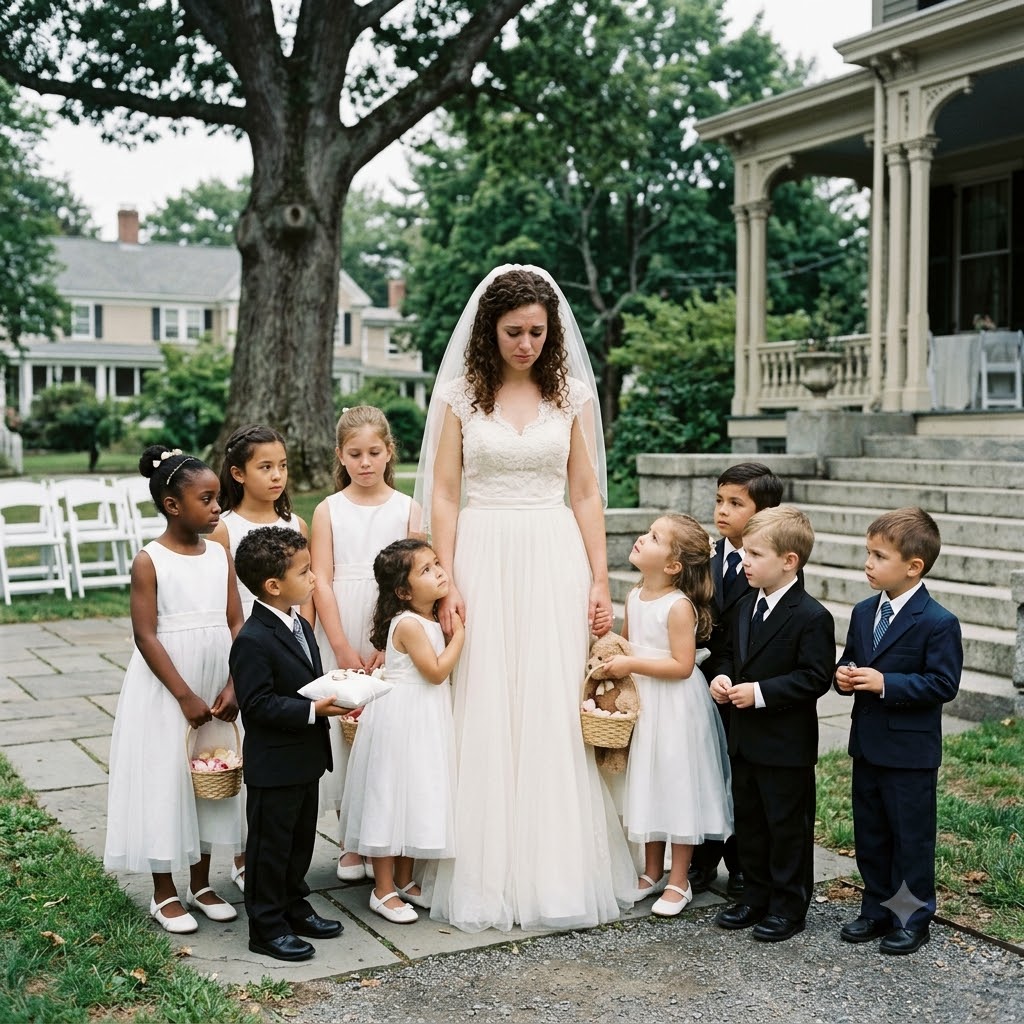
He didn’t call. He didn’t leave a note. He didn’t drop a key in the mailbox. He simply vanished off the face of the earth, leaving behind his four-bedroom Craftsman house, his unpaid mortgage, a garage filled with half-finished woodworking projects, and his ten children.
Ten children—ranging from four-year-old toddlers, Timmy and Clara, to sixteen-year-old Marcus—whose birth mother had passed away from cancer three years prior. Julian had brought me into their lives as their future stepmother, and then he had erased himself, leaving me standing in a sea of small shoes, mountain-high laundry piles, and an empty bank account.
“Take it, Mrs. Vance,” Mr. Sterling said, holding the paper in the cool autumn air. “My duties as executioner of this specific codicil are complete once it is in your hands.”
“Does it have money in it?” I asked coldly. “Because thirty years ago, I had to work sixteen-hour double shifts at the Shelbyville Textile Mill to keep his children from being split up and put into state foster care.”
“I am not at liberty to disclose the nature of the contents,” Mr. Sterling replied evenly. “I was only instructed to deliver it.”
I stared at the envelope for a long, silent minute. The wind picked up, swirling a cluster of dry yellow maple leaves across the porch steps.
I reached out, took the thick envelope from his hand, and closed the door without saying another word.
Part II: The Burden of 1996
I sat down at the heavy pine dining table in the center of the house—the same table where ten little pairs of elbows used to rest three times a day.
For a long time, I just sat there, staring at the cursive script on the paper. For Margaret.
In 1996, I was twenty-six years old. I was a young woman with a modest savings account, a quiet life working as a local library assistant, and a heart full of romantic ideals. When I met Julian Ross—a handsome, soft-spoken widower who ran an independent civil engineering consultancy—I thought I had found a deep, noble purpose. He was handsome, attentive, and carried a sorrow that matched my own quiet nature. When he asked me to marry him, I knew he came with a small army of children, but I loved him enough to take them on.
Then came the morning he vanished.
I remembered the sheer, suffocating terror of that first week. The police came, took a missing persons report, ran his license plate, and found his blue Ford sedan abandoned in an executive parking lot at O’Hare International Airport in Chicago. There was no foul play, no blood, no signs of a struggle. His passport was missing from his desk drawer.
Julian hadn’t been kidnapped. He hadn’t suffered an amnesia attack on the highway. He had systematically drained our joint wedding savings account, driven to Chicago, and boarded a flight out of the country.
The state child welfare services showed up four days later. Two social workers in stiff coats stood in my living room, clipboards in hand, assessing whether a twenty-six-year-old unmarried woman with no blood relation to the children could maintain custody.
“They’ll be placed in temporary group homes in Indianapolis by Monday, Miss Vance,” the head social worker had told me, her eyes sweeping over the dusty living room filled with crying children. “Unless you can prove legal guardianship and financial stability.”
I remembered looking at little four-year-old Clara, who was hiding behind my skirt, clutching a headless ragdoll, her eyes red from crying for her father. I looked at Marcus, sixteen, standing in the doorway with his fists clenched, his jaw set in a terrifying mix of fury and despair.
I didn’t let them take the children.
I dropped out of my library certification program. I took a job on the assembly line at the Shelbyville Textile Mill from 6:00 AM to 2:00 PM, and a second job wiping down tables and cooking short orders at Miller’s Diner from 3:00 PM to 10:00 PM. My own family called me insane. My mother told me to hand the kids to the state and save my youth.
I refused. I legally adopted all ten of Julian’s children through a grueling two-year custody battle. I traded my twenties and my thirties for math homework, parent-teacher conferences, soccer cleats, chickenpox outbreaks, college applications, and mortgage payments.
Now, Marcus was fifty-six, a successful civil attorney in Chicago. Clara was thirty-four, a pediatric surgeon at Johns Hopkins. All ten of them had grown into good, strong, resilient adults. They called me “Mom.” They brought their own children to this house for Thanksgiving and Christmas. We had built a life out of the wreckage Julian had left behind.
And now, thirty years later, the coward had sent me an envelope.
My fingers trembled slightly as I picked up a silver butter knife from the table and slit the heavy linen tape across the top of the package.
Part III: The Ledger and the Keys
Inside the package was not a tearful, romantic letter begging for forgiveness. There was no poetry, no declarations of tragic remorse, no melodramatic excuses about sudden mental breaks.
Inside were three distinct items:
- A bound black leather ledger with yellowed, lined pages.
- A heavy brass safety deposit box key tagged with a red plastic label reading First National Bank of Chicago – Box #408.
- A single typed letter on formal legal letterhead, signed in shaky, frail handwriting at the bottom.
I unfolded the letter first.
Dear Margaret,
If you are reading this, Harrison has fulfilled his final professional obligation to me, and I am dead. I will not waste these final pages asking you for forgiveness. To ask for forgiveness for what I did would require an arrogance I no longer possess. I know what I was. I know what I did to you, and I know the crushing weight I dropped onto your shoulders thirty years ago.
You were twenty-six. You had your whole life ahead of you, and I bound you to an impossible burden.
I cannot fix the past. I cannot give you back your youth, your twenties, your sleep, or the peaceful life you deserved. But I can finally tell you why I ran, and I can give you what was always rightfully yours.
In October 1996, three weeks before our wedding, I made a catastrophic discovery during a routine structural compliance audit for the State of Illinois. The civil engineering firm I was subcontracting for—Kensington & Sons Development—had systematically falsified soil safety reports for three major public bridge constructions along the Interstate corridor.
When I brought the discrepancies to the senior partners, I was not met with concern. I was met with a clear, explicit threat. Two men came to my home office late one evening while you were out with the children. They laid out two options: sign off on the fraudulent structural certificates, or watch my family burn.
They didn’t just threaten me, Margaret. They showed me surveillance photographs of you walking Marcus to high school. They showed me photographs of Clara playing on the swing set in our backyard. They made it clear that if I blew the whistle, or if I went to the federal authorities, an ‘unfortunate household accident’ would take you and the kids away.
I was terrified. I was weak. I knew that if I stayed and fought them, they would destroy my family to protect a forty-million-dollar state contract. If I signed the papers, I would be complicit in a crime that could collapse bridges and kill hundreds of people.
So I made a choice—a cowardly, desperate choice. I realized that if I disappeared entirely—if I became a rogue, disgraced fugitive who looked like he stole company funds and fled the country—the firm would assume I had gone into hiding to save my own skin. They would have no reason to touch you or the children, because you would know nothing. You would be an innocent, abandoned victim.
I staged my disappearance. I took $50,000 from the company’s emergency offshore slush fund—making myself look like a thief—and I fled to Canada, then to Europe, and eventually back to Chicago under an assumed identity, living as a ghost named Thomas Miller.
For thirty years, I worked from the dark. I spent three decades working as an anonymous federal informant for the Department of Justice, brick by brick, document by document, helping federal investigators build an airtight corporate racketeering case against Kensington & Sons.
Three months ago, the federal court sealed the final indictments. The men who threatened my family thirty years ago are now behind bars for the rest of their natural lives. The danger is gone.
Look at the ledger, Margaret.
— Julian
Part IV: The Hidden Hand
My breath hitched in my throat. I dropped the letter onto the table, my heart hammering against my ribs like a trapped bird.
I reached for the bound black leather ledger.
I opened the front cover. The pages were filled with neat, meticulously organized columns of dates, bank account numbers, cashier’s check receipts, and hand-written ledger balances spanning thirty years—from November 1996 to September 2026.
I turned to the first page, dated November 14, 1996—exactly three weeks after Julian had disappeared.
Entry 1: Issued anonymous cashier’s check #88412 to Shelbyville Textile Mill Union Benevolent Fund – $2,500. Designated recipient: Margaret Vance.
I froze.
My mind raced back to November 1996. I remembered it vividly. I was sitting at the kitchen table, weeping over an electricity shut-off notice, when the union representative from the textile mill knocked on the door. He told me that an anonymous donor had established an emergency family fund for mill workers in crisis, and handed me an envelope with $2,500 in cash. It was the money that paid our winter heating bill and bought groceries for Thanksgiving.
I turned the page.
Entry 14: May 12, 1999 – Anonymous educational grant issued to Shelbyville High School for Marcus Ross – $15,000 (College tuition deposit).
Entry 38: August 3, 2004 – Anonymous private donation to Indiana University Medical Center Pediatric Residency Fund – $40,000. Designated scholarship recipient: Clara Ross.
Entry 82: March 19, 2012 – Paid off mortgage on 144 Elm Street via national secondary debt acquisition holding company – $84,200.
Page after page. Year after year. Decade after decade.
Every single time a miracle had happened in our lives—every time a sudden scholarship appeared out of nowhere for one of the kids, every time my medical bills were mysteriously written off by the hospital’s “charity care board,” every time the local grocery store manager handed me a $500 gift certificate claiming I was the “1,000th customer of the month”—it hadn’t been luck.
It hadn’t been divine intervention or local charity.
It was Julian.
He had been standing in the shadows for thirty years. He had taken a construction laborer job under a fake name in Chicago, lived in a small, windowless studio apartment above a bakery, eaten canned soup, and funneled every single cent he earned back into Shelbyville through a complex network of private trusts, anonymous church donations, and legal shell corporations managed by Mr. Sterling.
He had watched us.
Near the back of the ledger were tucked hundreds of photograph printouts.
There was a grainy, zoomed-in telephoto lens picture of Marcus graduating from law school in 2002. Julian had been standing in the nosebleed section of the auditorium. There was a photo of Clara at her wedding in 2015, wearing her white dress, stepping into her limousine. In the background, leaning against a streetlamp across the avenue, was an old man in a gray coat, watching her with a handkerchief pressed to his eyes. There was even a photo of me, taken two years ago, sitting on the front porch of Elm Street, laughing as I held my fifth grandchild on my lap.
Julian had never left us. He had turned himself into a ghost so that we could live as human beings.
Part V: The Bank Vault
Two days later, my oldest son Marcus drove me to downtown Chicago in his quiet, executive sedan.
I hadn’t told the kids the whole truth yet. I had simply told Marcus that Julian’s estate lawyer had contacted me regarding an old administrative closing of Julian’s affairs, and that I needed him to escort me to the First National Bank of Chicago.
Marcus sat beside me in the grand, marble-tiled lobby of the bank, his dark suit crisp, his face set in a reserved, neutral expression. He had buried his grief for his father thirty years ago, replacing it with an ironclad devotion to me.
“Are you sure you want to do this, Mom?” Marcus asked gently, taking my hand in his. “If this is just going to reopen old wounds, we can walk out right now. We don’t need anything from him. We built our own life.”
“I need to see it through, Marcus,” I said softly, squeezing his strong, broad fingers. “For me.”
An elderly bank officer in a tailored suit approached us, bowed politely, and led us through a heavy, polished steel vault door into a quiet, carpeted private viewing room.
He placed safety deposit box #408 on the mahogany table in front of us, inserted his master key alongside my heavy brass key, turned both locks with a quiet clack, and bowed out of the room, closing the door behind him.
Marcus stood by the door, his arms crossed over his chest, protecting me even now.
I reached out and lifted the heavy metal lid of the box.
Inside lay two things.
The first was a thick stack of certified bank financial certificates from a major Swiss private banking institution, executed under the name of the Margaret Vance Irrevocable Family Trust.
I scanned the summary page at the top. The total balance of the account—built from the proceeds of Julian’s anonymous federal whistleblowing reward settlement from the Department of Justice, combined with thirty years of compounded interest from his private investments—stood at $12.4 million.
The legal documents explicitly stipulated that the trust was owned entirely and unconditionally by Margaret Vance, to be distributed at her sole discretion among her ten adopted children and their descendants.
The second item in the box was a small, velvet-lined jeweler’s box.
I picked up the box, my hands shaking violently now. I pressed the small silver latch.
The lid popped open.
Resting inside on a bed of faded black velvet was a simple, delicate diamond engagement ring—the exact ring Julian had bought for me in the spring of 1996, the one he had taken with him when he fled that rainy morning thirty years ago.
Glued to the inside lid of the jeweler’s box was a small slip of paper with a final handwritten sentence:
I carried you with me every single day. You were the mother they deserved, and the hero I was too weak to be.
Part VI: The Reckoning at the Lake
A week later, the wind was blowing hard off Lake Michigan as I stood in the quiet, tree-lined grounds of a small cemetery in Evanston, Illinois.
The sky was a deep, brilliant shade of autumn blue. The oak trees surrounding the quiet garden were shedding vibrant, fiery leaves of crimson, bronze, and gold.
Surrounding me in a wide, unbroken circle were ten adult men and women—Marcus, Clara, Timmy, David, Rachel, Sarah, James, Hannah, Daniel, and Little Grace. Behind them stood their spouses, and behind them, fourteen grandchildren.
All ten of Julian’s children were there.
We stood before a simple, newly laid granite headstone set into the soft earth. There were no elaborate epitaphs, no grand poetic verses. Just his real name and his birth and death dates:
JULIAN ROSS 1945 – 2026
I had gathered all ten of them in the living room on Elm Street three days prior, laid out the ledger, the letters, the photographs, and the financial trust documents, and read them every single word of their father’s confession.
There had been tears. There had been stunned, breathless silence. Marcus had walked out onto the porch and wept against the wooden railing for an hour. Clara had held the photographs of her wedding, staring at the blurry, gray figure of her father watching her from across the street, realizing that she had never truly been abandoned.
They didn’t forgive him overnight. You cannot erase thirty years of absence with a letter and a bank account. But the bitter, toxic poison of feeling unwanted—of believing that their father had simply decided they were not worth loving—had been permanently purged from their hearts. He hadn’t abandoned them because he didn’t love them. He had sacrificed his identity, his name, his freedom, and his soul to keep them breathing.
“Do you want to say something, Mom?” Marcus asked softly, stepping up beside me and placing his heavy, warm hand on my shoulder.
I looked down at the gray stone.
In my right hand, I held the small diamond engagement ring from 1996.
I walked forward, stepped onto the soft grass, and knelt slowly beside the headstone. My eighty-two-year-old knees cracked against the cool earth, but I didn’t feel the cold.
I pressed my fingers against the smooth, polished surface of the marble.
“You were a fool, Julian,” I whispered quietly into the autumn wind, so that only he and the trees could hear me. “You were a terrified, stubborn fool. You thought you had to bear the whole world on your back alone. You thought I was too fragile to stand beside you in the fire.”
I paused, looking down at the simple diamond ring resting in the palm of my hand.
“You gave me a life I never asked for,” I continued, tears finally welling in my eyes—not tears of bitterness, but tears of deep, solemn release. “You gave me ten beautiful children. You gave me a purpose that filled every corner of my heart. You broke my spirit thirty years ago, Julian… but you spent the rest of your life putting the pieces back together.”
I reached down, pressed the diamond ring into the soft, freshly turned soil directly beside the headstone, and pushed it deep into the earth until it was completely hidden from sight.
I stood up slowly, wiping my hands on my wool coat, and turned back to face the family waiting for me.
My ten children stepped forward, opening their arms, forming a tight, unbreakable circle around me under the falling red leaves.
“Let’s go home, Mom,” Clara whispered, kissing my cheek.
“Yes,” I said, taking her hand and turning my back on the grave, walking toward the sunlight. “Let’s go home.”
Part VII: The Long Shadow of Shelbyville
The air over Shelbyville in early November was brittle and cold, carrying the sharp scent of damp earth and woodsmoke.
Three weeks had passed since we laid Julian to rest in Evanston. The $12.4 million trust had been legally processed through Harrison Sterling’s firm, but not a single dollar had been spent. None of us knew how to touch money that felt like it had been carved out of thirty years of blood, solitude, and shadow.
I sat at my kitchen table on 144 Elm Street, staring at a white porcelain mug of chamomile tea.
The house was quiet—a rare, heavy silence that always settled over the rooms after the grandchildren went back to school and the kids returned to their respective cities. But for the first time in thirty years, the silence didn’t feel lonely. It felt expectant, like the quiet interval between the movement of a symphony.
The front door opened with a familiar soft click. Marcus walked in, setting his leather briefcase on the entryway bench. He looked tired—his tailored suit slightly wrinkled from the two-hour drive down from Chicago—but his eyes carried a lightness I hadn’t seen since he was sixteen years old.
“You should be resting, Mom,” Marcus said, walking into the kitchen and kissing the top of my graying head. “Clara said your blood pressure was slightly elevated on Sunday.”
“Clara worries too much because she’s a surgeon,” I replied with a faint smile, holding out my hand to squeeze his. “Doctors think every heart rate change is an emergency. What did the bank say?”
Marcus pulled out a chair and sat down across from me, laying a thick manila folder on the oak table.
“The federal tax releases are cleared,” Marcus explained, his tone shifting into his precise, measured lawyer’s voice. “Because the funds were derived from a certified Department of Justice whistleblower settlement and held in an irrevocable protective trust, the IRS has waived all primary penalty assessments. The money is clean, Mom. Completely, legally clean.”
I looked at the folder, then up at my eldest son. “And the kids?”
“We held a conference call last night—all ten of us,” Marcus said softly. His throat hitched slightly, a rare moment of emotion breaking through his professional composure. “Nobody wants to use it for luxury, Mom. Timmy wants to pay off his medical clinic’s equipment debt. Hannah wants to fund a special education wing at her school in Ohio. Clara wants to set up a pediatric surgery endowment in your name.”
He reached across the table, covering my hands with his own.
“And we all agreed on one thing,” Marcus continued. “The first project belongs to you.”
“To me?” I shook my head gently. “Marcus, I’m eighty-two years old. I have my garden, my porch, and ten children who call me every week. I don’t need millions of dollars.”
“You spent thirty years sacrificing your youth to keep this family from being torn apart,” Marcus said, his eyes burning with intense, quiet devotion. “You gave up your library career. You worked double shifts at the textile mill and Miller’s Diner so we could eat. You never got to build the dream you had before my father vanished.”
He opened the folder and slid a single printed document across the table toward me.
It was a property deed and a municipal zoning blueprint for the old, abandoned Shelbyville Public Library building on Main Street—the very building where I had worked as a twenty-four-year-old assistant before my life was upended in 1996.
“We bought it yesterday, Mom,” Marcus whispered. “The Margaret Vance Community & Literacy Foundation. We’re renovating it. It’s going to house a free after-school tutoring center, a children’s library, and an adult vocational training workshop for working mothers.”
I stared at the blueprint, my breath catching in my throat. Tears—warm, sudden, and overflowing—spilled down my wrinkled cheeks, dipping into the deep lines around my mouth.
Thirty years ago, I thought my life’s purpose had been violently stolen from me on a rainy October morning. I thought I had abandoned my dreams to become a emergency shield for ten terrified children.
I hadn’t abandoned my purpose. It had simply taken thirty years to bloom.
Part VIII: The Final Piece of the Ledger
Two days later, Harrison Sterling returned to Elm Street.
He didn’t bring his formal attorney’s trench coat or his stiff demeanor this time. He wore a soft wool cardigan and brought a cardboard box filled with old leather-bound accounting files from Julian’s apartment in Evanston.
“There was one final box in Mr. Ross’s safe deposit box in Evanston that required secondary probate clearance,” Sterling said, setting the box down on the living room rug. “It contains his personal personal journals—not the financial ledgers, but his private thoughts from 1996 to 2026.”
I sat on the sofa, picking up the first journal. The leather cover was worn smooth by decades of handling. The pages inside were filled with thousands of entries, written in dark black ink.
I opened to a random page dated October 24, 2008—the night of Clara’s high school graduation.
2:15 AM. I sat in my truck outside the high school gymnasium for three hours tonight. I watched Margaret adjust Clara’s red graduation cap on the front lawn. Margaret looked tired, but when she smiled at Clara, she looked like an angel.
Clara won the statewide science scholarship tonight. Margaret was crying. I was sitting fifty yards away behind the gymnasium bleachers, crying into my jacket so the security guards wouldn’t see me.
I wanted to walk across that grass. I wanted to take Margaret in my arms and tell her that every night I spend in this tiny apartment in Chicago, I pray to God to give her my remaining years. I am a ghost, but my ghost belongs to her.
I turned the pages, reading entry after entry.
Julian hadn’t just monitored our finances. He had recorded every milestone, every hardship, every joy. He knew when Timmy broke his arm playing Little League baseball. He knew when Sarah won the county spelling bee. He knew when the roof on Elm Street leaked during the spring storms of 2014, and he had personally hired a contractor from Indianapolis to show up on our doorstep claiming to offer “discounted community repair services.”
He had loved us from the dark with a fierce, terrifying intensity that consumed his entire existence. He had condemned himself to a life of absolute solitude so that we could live in the light.
The final entry in the last journal was dated September 18, 2026—just six weeks before his death.
My lungs are failing now. The doctors say I have less than a month.
I have no regrets about the life I chose. The men who threatened my family are in federal prison. My children are doctors, lawyers, teachers, and loving parents. They grew up strong, honest, and good.
And Margaret… my brave, beautiful Margaret. She did what I was too weak to do. She saved my family.
I am coming to the end of my road. I do not ask for a place in heaven, nor do I ask to be remembered as a good man. My only prayer is that when Margaret reads my final letter, she understands that my love for her was the only real thing I ever owned.
I closed the journal, pressing it against my chest, feeling a deep, profound peace settle into the marrow of my bones.
The rage was gone. The confusion was gone. The lingering ache of abandonment that had haunted my quiet moments for thirty years dissolved into the cool autumn air.
Julian hadn’t run away from me. He had run into the furnace to keep the flames from touching us.
Part IX: The Grand Opening
May 2027.
The spring sun over Shelbyville was warm and golden, washing over the newly restored red-brick facade of the historic building on Main Street. The large copper plaque beside the double glass doors gleamed under the clear sky:
THE MARGARET VANCE LITERACY & COMMUNITY CENTER
The street was closed off to traffic. Hundreds of local residents, town council members, former textile mill workers, and local families gathered on the sidewalk, holding small colorful flags and drinking fresh lemonade.
Standing on the wooden platform in front of the building was our entire family.
All ten of my children were there, dressed in their finest clothes. Marcus stood at the podium, flanked by Clara and Timmy. Behind them stood their spouses and my fourteen grandchildren, laughing and chasing each other around the flower displays.
“Thirty-one years ago,” Marcus’s voice echoed clearly through the loudspeakers, vibrating across the crowded street, “a woman stepped into the middle of a storm. She was twenty-six years old. She had no obligation to stay. She had every reason to walk away and protect her own comfort.”
The crowd went completely silent, listening to his words.
“Instead,” Marcus continued, his eyes turning toward me where I sat in a ribboned armchair beside the podium, “she took ten frightened, heartbroken children into her arms and said, ‘You are my family, and nobody is taking you away.’“
Applause erupted across the street—a thunderous, deafening roar of appreciation from a community that had watched us fight our way through three decades of hardship.
“This center,” Marcus said, his voice thick with pride and love, “was built with the legacy of our father’s sacrifice, but it is dedicated to the woman who gave us a future. Mom, please come cut the ribbon.”
Clara and Timmy helped me stand up. I walked slowly to the center of the ribbon, holding a large pair of polished brass ceremonial scissors.
I looked out over the crowd. I saw the faces of old friends from the textile mill who had shared their lunchboxes with me in 1997. I saw the retired library workers who had covered my shifts when the kids had the flu. I saw my ten children, standing shoulder to shoulder, their faces filled with endless devotion.
And for a brief, magical second, as a gentle spring breeze swept down Main Street, blowing a spray of pink cherry blossom petals across the sidewalk, I looked toward the back of the crowd, near the old oak tree across the street.
Standing in the soft shade was the faint, phantom figure of a handsome man in a tailored jacket, his soft smile warm and eternal, nodding gently at me.
I smiled back.
I hear you, Julian, I thought in my heart. We made it. All of us.
I brought the brass blades together. The wide red ribbon snapped cleanly, falling to the polished stone steps.
The crowd cheered, music erupted from the high school brass band, and my grandchildren rushed forward, throwing their small arms around my waist, lifting me up in a wave of laughter, warmth, and boundless love.
Part X: The Circle Complete
October 2027.
It was a crisp, sunlit Saturday afternoon—exactly thirty-one years to the day since Julian had vanished from my life.
I sat on the front porch swing at 144 Elm Street, wrapped in a hand-knitted navy wool shawl. The old maple tree in the front yard was shedding its brilliant yellow leaves, carpeting the green grass in gold.
In the yard, a chaotic, beautiful scene of pure life was unfolding.
Timmy was barbecuing burgers on the back lawn, smoke drifting lazily into the blue sky. Marcus and James were throwing a football with four of the teenage grandkids. Clara sat on the porch steps beside me, holding her newborn daughter, little Maya Margaret, swaddled in a soft pink blanket.
“She has your eyes, Mom,” Clara whispered, laying the baby gently in my arms.
I rocked the newborn softly, feeling the delicate, steady pulse of her breathing against my chest.
Thirty years ago, I thought my life had ended in a ruined living room filled with unpaid bills and crying children. I had looked into the dark future and seen only endless strain, poverty, and lonely burden.
I had been wrong.
The dark road had led us here—to a home filled with generations of laughter, to a legacy of healing that served hundreds of families every day, and to a peace so deep and absolute that it washed away every scar I had ever borne.
Julian had given me his debt, but he had also given me his legacy. And in accepting that burden, I had built a kingdom of love that nothing on earth could ever break.
Marcus walked up the porch steps, carrying two hot mugs of apple cider. He handed one to Clara and sat down on the wooden railing beside my swing, taking my hand in his.
“What are you thinking about, Mom?” Marcus asked gently, looking out at his brothers and sisters playing in the yard.
I looked down at the tiny baby sleeping in my arms, then up at the gold leaves falling softly through the crisp autumn sunlight.
“I was just thinking,” I said, a soft, joyful smile spreading across my face, “that it turned out to be a very beautiful wedding after all.”
Marcus smiled, squeezing my hand tightly, as the sounds of our family’s laughter filled the warm afternoon air, echoing far beyond the quiet porch of Elm Street, into the bright, endless horizon.