My 8-year-old son suddenly began sleeping on the floor outside Grandma’s bedroom every night. I didn’t understand why until 4 a.m., when I heard him whisper through the darkness, “I won’t let Uncle do that to Grandma again.”
Chapter 1: The Blanket on the Hallway Floor
The oak floorboards in our two-story craftsman in Oakridge, Pennsylvania, had a distinct acoustic signature. After six years of living in the home my late husband, Marcus, had restored before his sudden heart attack, I knew every squeak, groan, and echo. The fourth step from the top creaked like a dry pine branch. The hallway outside the linen closet groaned whenever the furnace kicked on.
So when the soft, rhythmic rustle of cotton fleece began dragging across the hallway runner at 10:15 PM every night, I noticed.
At first, I assumed my eight-year-old son, Toby, was sleepwalking again. He had gone through a brief phase of somnambulism after Marcus died three years ago—walking quietly into the kitchen, staring at the closed pantry door, and then wandering back to bed without a word. But when I stepped out of my bedroom on a Tuesday evening in late October, holding an empty tea mug, I didn’t find him wandering in a daze.
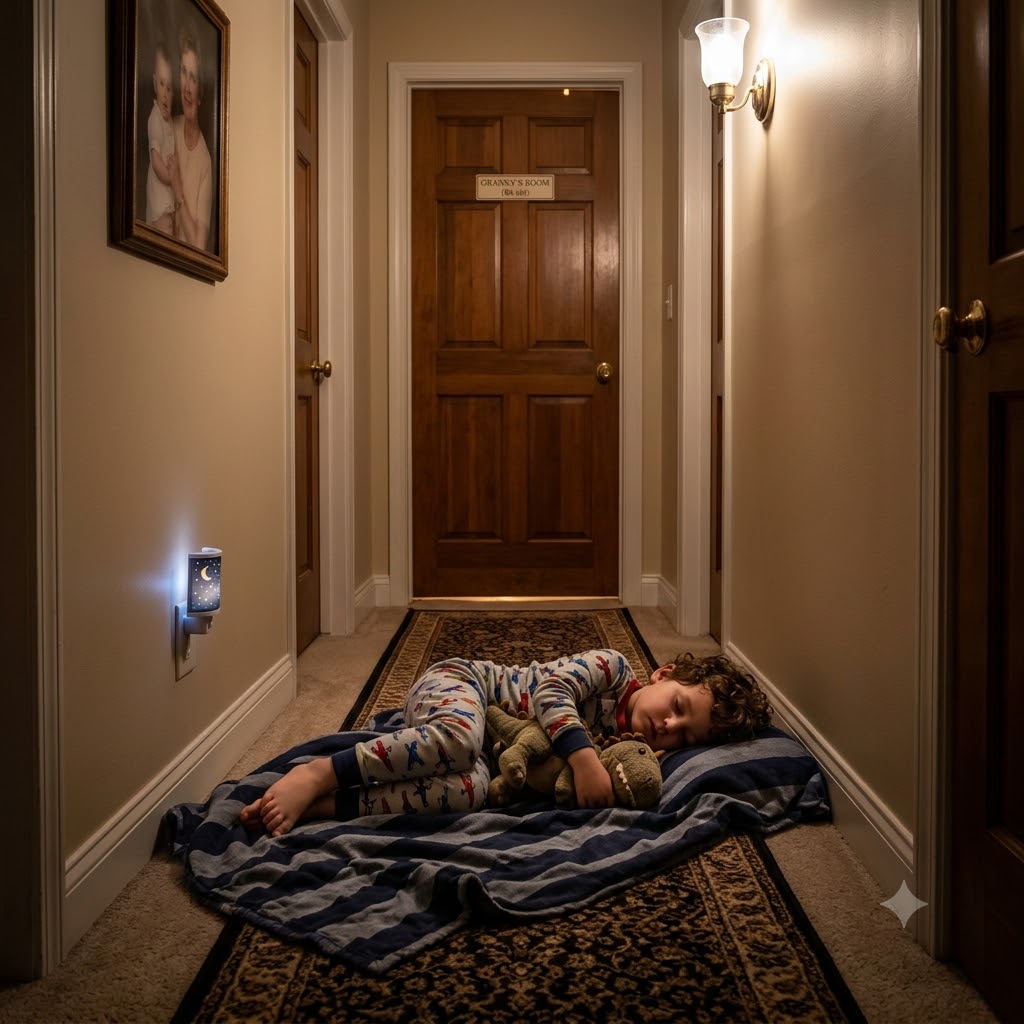
Toby had constructed a makeshift nest on the cold, uncarpeted tongue-and-groove oak directly outside my mother’s bedroom door.
He had dragged his blue space-patterned duvet, a foam pillow from his twin bed, and his favorite stuffed dog, Barnaby, out into the dark corridor. He was curled into a tight, protective fetal ball, his back pressed flush against the heavy brass door handle of my mother’s room, his pale face illuminated by the faint amber glow of the hallway nightlight.
“Toby?” I whispered, kneeling beside him on the cold floor. I set my tea mug down on the windowsill. “Honey, what are you doing out here? Your bed is warm.”
Toby didn’t open his eyes right away. He squeezed them shut tighter, pulling the blue duvet up to his nose. He was a small boy for eight, possessing his father’s sharp, analytical hazel eyes and dark, straight hair that always needed a trim. Since Marcus’s death, he had grown unusually quiet, trading the wild energy of early childhood for a serious, watchful demeanor that made him look far older than his years.
“Toby, look at me,” I said gently, touching his forehead. His skin felt cool, but his small frame was rigid, every muscle locked in tension.
“I’m fine, Mom,” he murmured, his voice muffled by the blanket. “I just like the draft here. It’s too hot in my room.”
“Toby, your bedroom window isn’t even open,” I said, frowning. “And the floor out here is freezing. Come on, up you get.”
“No!” He pulled back, his hand gripping the edge of his pillow with a sudden, desperate strength that startled me. “Please, Mom. Just let me sleep here. I won’t make any noise. I promise.”
I stared at him, my brow furrowing in confusion. “Is Grandma okay? Did she ask you to sit outside?”
“Grandma is sleeping,” he said flatly, his hazel eyes opening to meet mine. There was no sleepiness in them—no unfocused, dream-like haze of an eight-year-old past his bedtime. They were wide, clear, and filled with an intense, vigilant panic. “She’s tired. Leave her alone.”
I looked at my mother’s door.
My mother, Eleanor, was seventy-two and had moved in with us six months ago after an ischemic stroke left her with mild right-sided weakness and early-stage vascular dementia. She was a quiet, gentle woman who spent her days knitting in the sunroom, looking at old photo albums, or watching birds outside the kitchen window. She loved Toby fiercely, and Toby had taken on the role of her self-appointed shadow, fetching her spectacles, guiding her down the porch steps, and sitting beside her while she struggled to find the right words during dinner.
I assumed Toby was simply anxious about her health. Dr. Evans had warned us that children often internalize a grandparent’s cognitive decline, confusing memory slips with physical danger.
“Okay,” I conceded softly, stroking his hair. “You can stay out here tonight, but tomorrow we’re putting extra blankets on your bed. If you need anything, my door is open.”
“Okay, Mom,” he whispered, turning his face back toward my mother’s door.
He didn’t close his eyes until I walked back into my bedroom.
For four consecutive nights, the routine repeated itself with unsettling precision. Every night at 10:00 PM, after I read him a chapter of The Hobbit and turned off his overhead light, Toby waited until he thought I was asleep. Then, he quietly gathered his duvet, his pillow, and Barnaby, crept down the carpeted hallway, and took up his post outside Eleanor’s room.
By Friday, the strain was beginning to show on his small face. Dark, bruised shadows appeared beneath his eyes. He picked at his oatmeal during breakfast, his fingers twitching whenever a loud noise sounded in the kitchen. At school, his third-grade teacher, Mrs. Gable, sent home a gentle note mentioning that Toby had fallen asleep at his desk twice during social studies.
“He’s protecting her, Clara,” my younger brother, Julian, said over the phone on Friday afternoon while I was standing in the kitchen folding laundry.
Julian was thirty-six, three years younger than me, a polished, smooth-talking independent financial consultant who lived in a high-rise apartment in downtown Pittsburgh, forty-five minutes away. He visited once or twice a week, usually bringing expensive pastries or takeout sushi, offering cheerful advice about Eleanor’s care while rarely staying long enough to actually help with her physical bathing or physical therapy.
“Protecting her from what?” I asked, setting a folded bath towel on the counter. “The house is secure. The security system is set every night.”
“From death, Clara,” Julian sighed, his voice echoing through his Bluetooth headset with that smooth, executive tone he used when explaining complex tax codes to clients. “Kids understand more than we think. Dad died when Toby was five. Then Marcus died three years ago. Now Mom’s stroke… Toby thinks if he stops watching, people vanish. He’s an anxious kid. You should consider taking him to that child psychologist in Cranberry.”
“He isn’t crazy, Julian,” I snapped, feeling a surge of protective instinct. “He’s grieving. He’s stressed.”
“I didn’t say he was crazy,” Julian replied smoothly. “I’m just saying he needs boundaries. Speaking of Mom, did the notary clear those papers for the property transfer? I need her signature on the power-of-attorney update before the county tax deadline on Monday.”
I paused, looking at the heavy manila envelope sitting on the kitchen sideboard. The papers were part of Eleanor’s estate reorganization—a process Julian had initiated three weeks ago, claiming it was necessary to protect Mom’s annuity accounts from Medicaid spend-down rules.
“She hasn’t signed them yet,” I said. “Mom was having a confused day yesterday. She kept calling me ‘Sarah’ and asking where her father’s pocket watch was. I didn’t want to push her.”
“Clara, we talked about this,” Julian’s tone sharpened slightly, the cheerful executive veneer cracking to reveal an impatient edge. “The tax deadline isn’t flexible. If we don’t file the trust transfer by the end of the month, the state will lock those accounts if her medical care escalates. I’ll come by tonight after my client dinner around ten or eleven to check on her and get those signatures done.”
“It’s late, Julian,” I sighed. “She’s usually asleep by nine.”
“I have the key, Clara. Don’t worry about it. I’ll let myself in quietly. Just leave the envelope on her nightstand.”
He hung up before I could object.
That night, a heavy autumn rain began to fall over Oakridge. The wind whipped the red maple branches against the second-story glass, sending sharp, metallic rhythmic taps echoing down the dark hallway.
I went to bed at 10:30 PM, but my sleep was thin, restless, and plagued by half-remembered dreams of Marcus standing in the rain, telling me to check the locks.
At 3:48 AM, I woke up abruptly.
The house was cold. The radiators had clicked off for their overnight cycle, leaving the air smelling of old wool and damp plaster. My bedroom door was open two inches, letting in the faint, pale blue light from the landing window.
I pulled my fleece robe over my shoulders, stepped into my slippers, and walked quietly into the hallway to check on Toby.
He was there, lying on his duvet outside Eleanor’s door, his small form curled on his side. But he wasn’t asleep.
His eyes were wide open, staring fixedly at the dark space beneath the doorframe where the threshold met the oak floorboards. He was breathing in short, shallow gasps, his small hand clutching Barnaby’s cloth ear so tightly his knuckles were white.
I approached softly, my slippers making no sound on the runner.
As I neared his small nest, I heard him speaking. His voice was barely a whisper—a dry, raspy thread of sound that barely registered above the drone of the rain outside.
He was leaning his forehead against the heavy wood of the door panel, whispering into the dark seam between the frame and the floor.
“I won’t let you,” Toby whispered through the darkness, his voice trembling with a mixture of terrifying resolve and absolute terror. “I won’t let Uncle do that to Grandma again.”
Chapter 2: The Whispers in the Hallway
The breath caught in my throat, freezing like ice in my lungs.
I stood motionless three feet behind him, the shadows of the hallway wrapping around me like heavy velvet. The rain rattled against the dormer window at the end of the hall, but inside the corridor, the silence was suffocating, broken only by Toby’s shallow, terrified breathing.
I won’t let Uncle do that to Grandma again.
The words didn’t make sense. They clashed violently against the reality I had constructed over the past six months—the image of my brother, Julian, as the dutiful, successful son who popped in with expensive pastries, kissed our mother on the cheek, and managed her complex financial portfolios out of brotherly love.
“Toby?” I whispered, my voice shaking.
Toby jumped, a sharp, choked gasp escaping his lips as he spun around on the floorboards, his back slamming against Eleanor’s door. He looked up at me with wide, panicked eyes, clutching Barnaby to his chest like a shield.
“Mom!” he gasped, his chest heaving under his flannel pajamas. “I… I wasn’t doing anything! I was just… I was just checking the draft!”
I knelt beside him, taking both of his small, icy hands in mine. They were trembling violently. “Toby, what did you just say?”
“Nothing,” he stammered, pulling his hands back, looking down at his knees. “I didn’t say anything. I was talking to Barnaby.”
“Toby, look at me,” I commanded softly, reaching out to lift his chin. His hazel eyes were swimming with tears that reflected the pale blue moonlight from the window. “I heard you. You said, ‘I won’t let Uncle do that to Grandma again.’ What did Uncle Julian do?”
Toby bit his lower lip so hard I was afraid it would bleed. He glanced nervously toward the top of the stairs, then toward Eleanor’s closed door, as if he expected someone to spring from the shadows at any second.
“He… he comes here,” Toby whispered, his voice dropping into a register so low I had to lean my ear inches from his face. “When you’re asleep, Mom. He comes up the stairs.”
A cold, sickening feeling began to coil in the pit of my stomach. “Julian comes here at night?”
“He came on Tuesday,” Toby murmured, tears finally spilling over his eyelashes and tracing dark paths down his cheeks. “And last Thursday. He uses his key on the back door. He doesn’t turn on the lights. He walks on the side of the stairs so the fifth step doesn’t squeak.”
I stared at my son in utter disbelief. The fifth step was the creaky one—the one Marcus had tried to repair four years ago. I knew that squeak intimately. But I had never heard it past midnight.
“Why would Julian come here at night, Toby?” I asked, my heart hammering against my ribs like a trapped bird. “Did he come into your room?”
“No,” Toby shook his head frantically. “He goes into Grandma’s room. He sits on the edge of her bed. I saw him, Mom. I woke up to go to the bathroom on Tuesday night and the door was open a little bit.”
“What was he doing?”
Toby leaned closer to me, his small frame shaking so hard his teeth clicked together.
“He… he was holding Grandma’s arm,” Toby whispered, his voice breaking into a ragged sob. “Grandma was crying, Mom. She was crying really softly, telling him ‘No, Julian, please don’t make me,’ but he wouldn’t let her go. He had a big pen in his hand. He was bending her fingers around it and pressing her thumb onto white papers under the little desk lamp.”
The hallway seemed to tilt around me. The air grew thick, heavy, and suffocating.
“What else?” I rasped, my hands gripping Toby’s shoulders. “Toby, tell me everything.”
“Grandma kept saying she wanted to wait for you,” Toby sobbed quietly into my robe. “She said, ‘Clara needs to see this, Julian, this is Clara’s house.’ But Uncle Julian got really quiet. He leaned down right next to her ear—the ear she can’t hear out of very well—and he said… he said if she told you, or if she didn’t sign the papers, he would have the doctors take her away to a special hospital where nobody would ever visit her again.”
A violent surge of rage, cold and lethal, flushed through my veins, incinerating the lingering fog of sleep.
“He said… he said she was too crazy to live in a nice house,” Toby continued, his small fist balling into the fabric of my robe. “He said if she didn’t sign, he’d tell the judge that you were taking her money and that you were a bad mother. Grandma was so scared, Mom. She signed the papers, and then she buried her face in her pillow so he wouldn’t hear her crying.”
I sat on the cold oak floorboards, my arms wrapped tightly around my eight-year-old son, feeling his heart beating wildly against my ribs.
All those times Eleanor had seemed unusually withdrawn after Julian’s visits. All those times she had stared at me with wide, fearful eyes whenever I brought up her finances, clutching her knitting needles until her knuckles turned white. I had attributed it all to vascular dementia—to the paranoia that often accompanies cognitive decline.
I had believed my brother. I had trusted the smooth-talking, polished executive who brought high-end pastries and offered to handle our mother’s “complicated” estate.
“Why didn’t you tell me on Tuesday, Toby?” I asked, my voice thick with emotion, kissing the top of his head.
“Because Uncle Julian saw me,” Toby whispered, his body going rigid again. “When he walked out of her room on Tuesday night, he caught me standing by the linen closet. He took me by the arm… he didn’t hurt me, but his hand was really tight, Mom. He bent down and said… he said if I told you, he’d make sure the state took me away from you, too. He said you were barely keeping the house after Dad died, and if I made trouble, we’d all be on the street.”
Toby looked up at me, his hazel eyes wide with a terrifying, adult burden of guilt.
“I didn’t want us to lose the house, Mom,” he sobbed quietly. “Dad built this house. So I decided I’d just sleep outside her door every night. I thought if I was lying here, he couldn’t get inside without stepping on me first.”
The grief that had sat heavy in my chest since Marcus died three years ago suddenly transformed into something else—something sharp, hard, and unyielding as tempered steel.
My eight-year-old boy had been standing guard in the dark for four nights, taking on the burden of protecting our family from the predator we had invited through the front door.
“Oh, Toby,” I murmured, holding him tight, tears burning my own eyes. “You don’t have to stand guard anymore, honey. Your dad built this house, but I am your mother. And nobody—nobody—is ever going to hurt you or Grandma again.”
I stood up, lifting Toby in my arms despite his growing weight, and carried him down the hall to his own bedroom. I laid him on his warm twin bed, pulled his space duvet up to his chin, and placed Barnaby beside his pillow.
“Stay here, Toby,” I said softly, looking him straight in the eyes. “Lock your door from the inside. I’m going to talk to Grandma.”
“Mom… is Uncle Julian coming back?” he asked, his voice trembling.
I looked at the hallway clock. It was 4:12 AM.
“If he comes back,” I said, my voice completely flat, “he’s going to find out what happens when he steps into my house.”
Chapter 3: The Broken Trust
I didn’t knock on Eleanor’s door. I turned the brass handle softly and stepped into the dim, lavender-scented room.
The rain beat against the western window pane, casting flickering, elongated shadows across the floral wallpaper. Eleanor was awake. She was sitting upright in her oak four-poster bed, wrapped in a faded blue shawl, staring at the closed door with wide, terrified eyes. She had her small leather-bound Bible pressed against her chest like a shield.
When she saw it was me, the tension in her withered shoulders collapsed, and a long, shuddering gasp escaped her thin lips.
“Clara…” she whimpered, her voice raspy from disuse. “Is… is he gone?”
I closed the door behind me and walked over to the bed, sitting down on the edge of the mattress. I took her right hand—the hand affected by the stroke—and held it between both of mine. It was cold as marble.
“Toby told me, Mom,” I said gently.
Eleanor’s lips quivered. A single tear rolled down the deep wrinkles of her cheek, soaking into the collar of her nightgown.
“I didn’t want to hurt you, Clara,” she wept softly, her voice slurred slightly from her stroke, but clear with profound shame. “Julian… Julian said he was fixing things. He said Marcus left you with so much debt on the house… he said if I didn’t transfer the annuity accounts and the land deed from your father’s estate into his private trust, the bank was going to foreclose on you.”
“The house isn’t in debt, Mom,” I said, feeling a cold rage tightening my throat. “Marcus paid off the mortgage three months before he passed away. The house is completely clear. The annuity accounts were supposed to pay for your long-term nursing care if your stroke progressed.”
“He made me sign,” Eleanor whispered, reaching under her pillow with her left hand and pulling out a small, crumpled piece of paper. It was a receipt from a private courier service dated three days ago. “He brought a woman here on Thursday… a woman with a notary stamp. They held my hand down, Clara. They stamped the land transfer papers for the timber property in Somerset County.”
The Somerset County property. It was forty acres of prime timberland my father had left to Eleanor—land worth at least four hundred thousand dollars.
Julian hadn’t just been updating power-of-attorney forms. He had been systematically stripping our mother’s assets while she was vulnerable, using her dementia and fear of being institutionalized to sign over every scrap of real estate and liquidity her late husband had built over forty years.
“Where are the rest of the papers, Mom?” I asked softly. “The ones he brought tonight?”
“He… he took them with him,” Eleanor murmured, her eyes darting toward the window. “He left about an hour ago. He said he had to drive to his office in Pittsburgh to scan them before the county clerk opened at eight in the morning.”
I sat motionless on the bed for a long moment, watching the rain streak down the glass.
Julian thought he was the smartest man in every room he walked into. He had spent his entire adult life manipulating numbers, advising wealthy clients on how to exploit legal loopholes, and looking down on me and Marcus for choosing a quiet, modest life in Oakridge. He believed that because I was a grieving widow working part-time at a local library, and because our mother had suffered a stroke, there was no one left to stop him.
He had forgotten one very important detail.
Marcus hadn’t just restored this house. Before his sudden death, Marcus had served for twelve years as a detective with the Pennsylvania State Police, specializing in white-collar financial fraud.
And three years after his death, his filing cabinets in the basement remained intact.
“Mom,” I said, leaning down to kiss her forehead. “I want you to lock this door behind me. I’m going downstairs to call someone.”
“Clara…” Eleanor looked at me with sudden panic, her fingers clutching my sleeve. “He’s your brother. Please… don’t let him ruin his life.”
I looked at my mother—at her frail, trembling hands, her stroke-damaged side, her eyes filled with the trauma of being terrorized in her own bed by the son she had raised.
“He didn’t care about ruining yours, Mom,” I said quietly, pulling my sleeve gently from her grip. “And he was willing to destroy Toby to get what he wanted. He made his choice.”
I walked out of the room, made sure the lock clicked behind me, and walked down the dark hallway.
Instead of going to the kitchen, I went down the basement stairs.
The basement smelled of damp concrete, cedar, and motor oil. In the far corner, behind Marcus’s old workbench, stood a heavy, grey steel filing cabinet secured with a brass Master Lock.
I pulled the key from my robe pocket—the key Marcus had given me years ago, telling me to keep it safe if anything ever happened to him.
I unlocked the padlock. The heavy drawer glided open smoothly on oiled steel rollers.
Inside were four thick, color-coded folders labeled in Marcus’s neat, precise drafting script.
Marcus hadn’t just been a state trooper; he had been a meticulous record-keeper. Two months before he died, Marcus had expressed subtle concerns to me about Julian’s sudden rise in wealth—his new luxury condo, his Porsche, his sudden interest in managing Eleanor’s accounts. Marcus had quietly run a background check through his contacts at the Department of Revenue, compiling a paper trail on Julian’s independent financial consultancy firm, Vance Capital Advisory.
I pulled out the red folder labeled JULIAN – FINANCIAL AUDIT (PENDING).
I sat down at the workbench under the single overhead bulb, opening the folder.
Inside lay three years of bank statements, corporate registry filings, and tax records that Marcus had gathered before his heart stopped. On the very last page was a handwritten note from Marcus, written in red ink three days before he died:
Julian is over-leveraged by at least $1.2 million in bad commercial real estate investments in Allegheny County. He is using client funds from his advisory account to service his debt. If he gets access to Eleanor’s Somerset timber trust or her annuity accounts, he will liquidate them within 30 days to cover his short positions before the SEC audit in November.
My breath caught in my throat.
Marcus had known. He had seen the storm coming three years ago.
Julian wasn’t just greedy. He was drowning. He was an embezzler facing imminent financial ruin and potential federal prison time if he couldn’t cover his $1.2 million shortfall before the end of the month. And he had turned to his stroke-damaged mother as his personal emergency piggy bank.
I pulled out my smartphone, clicked on the contact list, and scrolled down to a number I hadn’t called since Marcus’s funeral.
Detective Thomas Miller – PA State Police Financial Crimes Unit.
Thomas had been Marcus’s partner for eight years. He had sat on our front porch drinking beer with Marcus, had cried at his funeral, and had sworn to me that if I ever needed anything—anything at all—I only had to call.
I hit the call button.
It rang four times before a gravelly, tired voice answered.
“Miller.”
“Thomas,” I said, my voice steady, razor-sharp, and entirely devoid of fear. “It’s Clara Vance. Marcus’s wife.”
A sudden pause clicked over the line. “Clara? It’s four in the morning. Are you okay? Is Toby okay?”
“We’re fine, Thomas,” I said, looking down at Marcus’s red folder under the bare light bulb. “But I need you to bring a team to my house. And I need you to issue an emergency warrant for Julian Vance.”
Chapter 4: The Midnight Visitor
By 6:15 AM, the storm over Oakridge had cleared, leaving behind a cold, crisp dawn that painted the eastern sky in bruised shades of purple and orange. The wet maple leaves lay plastered like gold foil across the dark asphalt of my driveway.
Inside my kitchen, the atmosphere was dead silent.
Thomas Miller sat at the wooden dining table. He was fifty-two, a broad-shouldered man with iron-gray hair, a weathered face, and sharp blue eyes that missed nothing. He wore a dark suit, his State Police badge clipped to his belt beside his holstered Sig Sauer.
Beside him sat two uniformed troopers and a female investigator from the Allegheny County District Attorney’s Office, Her name was Agent Sarah Lin, an expert in elder financial exploitation.
Spread out across my dining table were the documents: Marcus’s red audit folder, the notarized Somerset land transfer receipt Eleanor had hidden under her pillow, and the security footage I had pulled from our driveway cameras thirty minutes earlier.
The camera footage was crystal clear. It showed Julian’s black Porsche SUV pulling into my driveway at 1:12 AM on Tuesday, and again at 2:04 AM on Thursday. It captured him using his key on the back door, carrying a leather briefcase, and leaving ninety minutes later.
Agent Lin looked up from her laptop, her expression dark with anger.
“This is textbook systemic elder abuse and grand larceny,” Lin said, her fingers flying across her keyboard. “He exploited her stroke-induced cognitive vulnerability, used fraudulent notary services, and forced execution of land deeds under coercion. Combined with the evidence your husband gathered regarding his advisory firm’s commingled funds, we have enough for an immediate multi-count felony warrant.”
“Where is he now, Clara?” Thomas asked, looking at me over his coffee mug.
“He went to his office in downtown Pittsburgh to scan the signed timber deeds,” I said, sitting across from him. “He told Eleanor he needed to file them electronically with the Somerset County Clerk the second their system opens at 8:00 AM.”
Thomas looked at his watch. It was 6:28 AM.
“If he files those deeds at eight,” Thomas said smoothly, “the land transfer hits the state registry automatically. We can reverse it in court later, but it creates a messy title dispute.”
“He won’t file them,” I said quietly.
Thomas raised an eyebrow. “Why not?”
“Because,” I replied, taking a slow sip of my tea, “I sent him a text message ten minutes ago from Mom’s phone.”
I pulled my phone from my robe pocket and set it on the table.
The text thread with Julian was open. The last message, sent at 6:10 AM, read:
Julian, this is Clara. Mom had another mild stroke thirty minutes ago. She’s conscious, but the paramedics are here. She keeps repeating that she signed the wrong papers and that you took her husband’s watch. You need to get back here right now before they take her to the hospital.
Thomas stared at the screen, then let out a low, dry chuckle that held no humor, only deep professional appreciation.
“You baited him,” Thomas said.
“He knows that if Mom goes to the hospital and the ER doctors perform a cognitive assessment while she’s distressed, her medical records will explicitly state she lacked capacity to execute legal documents this week,” I explained coldly. “He can’t afford to let those paramedics evaluate her before those deeds are locked in. He’ll drive like a maniac to get back here and intercept us.”
“How far is his office?” Agent Lin asked.
“Forty-five minutes in morning traffic,” I said. “He’ll be here in thirty.”
Thomas stood up, adjusting his suit jacket, and looked at the two uniformed troopers standing near the kitchen door.
“Harrison, Miller,” Thomas commanded calmly. “Park your cruisers behind the barn at the end of the lane. Keep your lights off. When his vehicle enters the driveway, block the exit.”
“Yes, sir,” the two troopers nodded, stepping quietly out the back door.
Thomas looked at me, his eyes softening slightly. “Clara… where are Toby and your mother?”
“Toby is in my room with Eleanor,” I said. “I locked the door from the outside. They have headphones on, watching a movie. They won’t see or hear a thing.”
“Good,” Thomas said, pulling a pair of heavy steel handcuffs from his coat pocket and setting them on the table beside his coffee cup. “Then let’s wait for my former friend’s brother.”
For twenty-four minutes, the kitchen was silent save for the ticking of the grandfather clock in the corner. I sat by the window, watching the sun rise higher over the wet maple trees, feeling a strange, profound calm settling over my soul.
The fear that had gripped this house since Marcus died was gone. The lingering shadows in the hallway had been cleared by an eight-year-old boy who refused to let his grandmother suffer in the dark.
At 6:58 AM, the low, aggressive rumble of a high-performance engine echoed down our quiet gravel lane.
I looked out the window.
Julian’s black Porsche SUV turned sharply into the driveway, spraying wet gravel against the rose bushes as he slammed the brakes, pulling up right outside the kitchen porch.
He stepped out of the vehicle, wearing his tailored charcoal coat, his leather briefcase clutched tightly in his right hand. His face was pale, flushed with anger and panic, his necktie pulled loose at his collar.
He marched up the wooden porch steps, pulled out his brass house key, and shoved it into the lock.
The deadbolt clicked open.
Julian threw the kitchen door open, stepping inside, his dress shoes clicking sharply on the hardwood floor.
“Clara!” Julian shouted, his voice laced with furious, breathless panic. “Where are the paramedics?! What the hell did you tell them—”
His voice cut off instantly.
He stopped dead in his tracks three feet past the threshold.
Sitting at the dining table were Detective Thomas Miller, Agent Sarah Lin, and me.
On the table between us lay Marcus’s red audit folder, the security footage monitor, and the pair of heavy steel handcuffs reflecting the morning sun.
Julian froze, his jaw dropping open, the color draining from his face until he looked as white as the kitchen wall behind him.
“Hello, Julian,” I said softly from the head of the table. “You’re just in time for breakfast.”
Chapter 5: The Confrontation
For five long, agonizing seconds, the only sound in the kitchen was the rhythmic ticking of the grandfather clock.
Julian’s eyes darted frantically across the room—from me sitting calmly with my mug of tea, to Thomas Miller standing broad-shouldered in his state police uniform, to Agent Lin taking notes on her laptop, and finally out the back window, where two marked state police cruisers were pulling up behind his Porsche, blocking the driveway completely.
His leather briefcase slipped slightly in his hand before his fingers tightened around the handle with a white-knuckled grip.
“Thomas?” Julian stammered, attempting to force his signature charming executive smile onto his pale lips, though his voice cracked on the second syllable. “What… what is this? Clara, what’s going on here? Is Mom okay?”
“Mom is fine, Julian,” I said, my voice completely flat, devoid of warmth or anger. “She didn’t have a stroke this morning. I lied.”
Julian blinked, his brow furrowing as a flash of hot, defensive rage flared in his eyes. “You lied?! Do you have any idea how fast I drove from downtown Pittsburgh?! I nearly flipped my car on Route 19 because you said Mom was dying!”
“You didn’t drive back here because you cared if she was dying, Julian,” Thomas Miller interrupted, stepping out from behind the table, his hand resting casually near his holster. “You drove back here because you were terrified she’d tell the paramedics that you forced her to sign over the Somerset timber trust under duress.”
Julian’s face went from pale white to a deep, mottled red. “Duress?! What the hell are you talking about?! Thomas, you’ve known me for fifteen years! I am my mother’s power-of-attorney! I’ve been managing her accounts because Clara was too overwhelmed with grief after Marcus died to handle complex estate planning!”
“Is that why you came into this house at three in the morning through the back door, Julian?” I asked, turning the monitor toward him.
The screen played the high-definition driveway footage from Tuesday night. It showed Julian creeping up the porch steps in the dark, unlocking the door without turning on a single light, and creeping up the stairs like a thief.
“I have a key to my mother’s house!” Julian snapped, his voice rising in volume as panic began to override his executive composure. “I came late because I work sixteen-hour days! I didn’t want to wake you or Toby up!”
“You didn’t want to wake us up,” I said, leaning forward, “because you knew that if I caught you in her room bending her stroke-damaged fingers around a pen to sign land deeds, I would have thrown you out on your face.”
“I did nothing illegal!” Julian yelled, slamming his briefcase down onto the kitchen counter with a heavy BANG. “Mom signed those papers voluntarily! She wanted to protect her assets from Medicaid spend-down rules! I have a notarized affidavit!”
“You have a fraudulent affidavit notarized by a junior clerk at your investment firm who is currently being picked up by state troopers at her apartment in Cranberry,” Agent Lin spoke up calmly, looking over her laptop screen. “She has already admitted over the phone that she was not present in this house when your mother affixed her signature, which constitutes state notary fraud and forgery.”
Julian stumbled back half a step, his eyes widening in pure, unadulterated horror. “She… she talked to you?”
“She did,” Lin nodded. “And then there’s the matter of Vance Capital Advisory.”
Agent Lin tapped a key on her keyboard, turning a second monitor toward him. It displayed the financial audit Marcus had compiled three years ago, updated with live data pulled from the Pennsylvania Department of Banking forty-five minutes ago.
“You have a $1.2 million deficit in your primary client escrow account, Mr. Vance,” Lin stated, reading the numbers with clinical precision. “You used $400,000 of commingled funds to service personal margin calls on commercial real estate in Allegheny County. Your SEC compliance review is scheduled for November 15th. You needed your mother’s Somerset timber trust and her $300,000 annuity accounts liquidated by next Friday to cover the shortfall before federal auditors locked your books.”
The silence that followed was suffocating.
Julian stood frozen beside the counter. The polished, bulletproof financial consultant who had spent years looking down on us, offering condescending advice while stealing from his own frail mother, was completely dismantled in under five minutes.
“Marcus…” Julian whispered, his voice trembling as he looked at the red folder on the table. “Marcus did that… before he died?”
“Marcus knew what you were three years ago, Julian,” I said, my voice cutting through the quiet like a steel blade. “He gave me the key to that filing cabinet. He told me to use it if you ever tried to touch Mom’s money.”
Julian looked at me. The arrogant, superior glare vanished, replaced by a desperate, pathetic pleading.
“Clara… please,” Julian begged, taking a step toward the table, his hands raised in a frantic gesture. “Listen to me! We’re family! You’re my sister! If Thomas arrests me today… my firm will collapse! I’ll lose my license! I’ll go to federal prison! Do you have any idea what prison will do to me?!”
I looked at my brother. I looked at his tailored coat, his expensive shoes, his hands that had never done a day of physical labor in their life.
“You didn’t care what would happen to Mom, Julian,” I said softly. “You threatened to put her in a state mental facility. You told an eight-year-old boy that if he spoke up, you’d have the state take him away from his mother. You terrorized a widow and an old woman in their own home while they were sleeping.”
“I was desperate!” Julian wailed, tears finally bursting from his eyes as his composure completely shattered. “I made a bad investment! I was trying to save my business! Clara, please! Talk to Thomas! Tell him we can settle this as a family! I’ll sign the land deeds back! I’ll give up power-of-attorney! Just don’t let them take me!”
I slowly stood up from the dining table. I walked over to the kitchen counter, picked up his leather briefcase, and handed it directly to Thomas Miller.
“Thomas,” I said, looking my brother straight in the eyes. “Take him out of my house.”
“Julian Vance,” Thomas Miller said, stepping forward and pulling Julian’s arms behind his back with a sharp, professional motion. “You are under arrest for grand larceny, forgery, notary fraud, and felony elder exploitation. You have the right to remain silent.”
CLICK-CLACK.
The steel handcuffs locked tightly around Julian’s manicured wrists.
Julian thrashed weakly against Thomas’s grip, weeping hysterically, his executive dignity entirely incinerated. “Clara! Please! Don’t do this! Mom! MOM!”
Thomas and the two uniformed troopers led him out the back door.
I stood by the kitchen window, watching quietly as my brother was escorted down the wooden porch steps, his head forced down as he was placed into the back of a marked state police cruiser. The red and blue lights flashed against the wet maple leaves as the cars pulled away down the driveway, their sirens echoing softly through the quiet morning valley before fading into absolute silence.
I took a deep, clean breath.
The house was quiet. The sun was fully up now, casting brilliant golden squares of light across the clean oak floorboards of my kitchen.
I walked out of the kitchen, walked up the stairs, and unlocked my bedroom door.
Chapter 6: The Watcher at Rest
The sun streamed through the second-story windows, turning the hallway runner into a path of bright, warm gold.
Inside my bedroom, Eleanor was sitting in the armchair by the window, wearing her blue cardigan, holding a cup of warm tea I had brought her earlier. Toby was sitting on the rug beside her feet, showing her how to build a tall timber tower out of his wooden blocks.
When the door unlocked, both of them looked up.
Toby stood up instantly, Barnaby clutched under his arm, his hazel eyes searching my face with that serious, protective alertness he had carried for days.
“Mom?” Toby asked softly. “Is… is Uncle Julian gone?”
I walked into the room, knelt on the rug in front of him, and pulled him into a long, tight embrace. I held him until I felt his small shoulders finally drop, the rigid tension that had locked his small body for four days completely melting away into my robe.
“He’s gone, Toby,” I whispered into his hair, kissing his cheek. “He’s never coming back here again. The police took him away.”
Eleanor let out a long, trembling breath, setting her teacup down on the windowsill. A soft, peaceful smile touched her thin lips—a smile I hadn’t seen on her face since before her stroke.
“Is the house safe now, Clara?” Eleanor asked gently, her hand reaching out to touch my arm.
“The house is completely safe, Mom,” I said, taking her hand and holding it tight. “Marcus made sure of it three years ago. And Toby made sure of it last night.”
Toby looked up at me, a small, tentative smile breaking across his face for the first time in a week. “I held the line, Mom?”
“You held the line, sweetie,” I smiled, wiping a tear from my eye. “You were the best guard this house ever had. But your shift is over now.”
Epilogue: The Oakridge Morning
Six months later.
The spring sun shone warmly over Oakridge, turning the forty acres of timberland in Somerset County into a vast, sea of green leaves and blooming mountain laurel.
The legal proceedings had been swift and absolute. Confronted with the state police audit, the notary’s confession, and the video evidence, Julian had pleaded guilty to multiple counts of felony elder exploitation and grand larceny. He was currently serving a seven-year sentence at a state correctional facility in central Pennsylvania.
His investment firm had been liquidated, his luxury condo sold, and every penny recovered was placed into an irrevocable, court-monitored trust for Eleanor’s long-term care, managed exclusively by an independent bank trustee.
The Somerset timberland remained untouched, preserved in perpetuity as a state nature conservancy under my father’s name.
On a warm Saturday afternoon in May, the front porch of our craftsman house was filled with the sounds of life.
Eleanor sat in her wicker rocking chair, wrapped in a light yellow shawl, knitting a green wool blanket while listening to the birds in the maple trees. Her speech had improved dramatically with regular physical therapy, her eyes bright and clear, completely free from the paranoia and fear that had haunted her months ago.
Down in the front yard, Toby was running through the green grass with a new golden retriever puppy we had adopted from the local shelter—a energetic dog named Barnaby Junior who was currently chasing a yellow tennis ball across the lawn.
I sat on the top porch step, holding a cold glass of lemonade, watching my son laugh as the puppy tackled him into the soft clover.
He didn’t sleep outside Eleanor’s door anymore.
His space duvet, foam pillow, and original stuffed dog Barnaby were back in his warm, sunlit bedroom upstairs where they belonged. He slept deeply every night, his window cracked open just an inch to let in the cool mountain breeze, untroubled by shadows or creaking floorboards.
I looked up at the wooden doorframe of our front entrance—the heavy oak door that Marcus had built with his own hands, the door that had protected our family through grief, storms, and betrayal.
The house was quiet, peaceful, and whole.
Toby kicked the yellow tennis ball across the grass, his laughter echoing clearly through the warm afternoon air. He looked up at the porch, waved at me and Eleanor, and then sprinted after the puppy into the bright, unbroken sunlight.
No more whispers in the dark. No more guarding the floorboards.
The watch was over, and the house was finally at rest.