Before Being Poisoned to Death by His Wife, Eric Richins Left a Final Letter with a Dying, Fearful Accusation for His Family, This is Irrefutable Evidence Convicting the Black Widow Kouri for the Horrific Malice She Secretly Sowed
The Facade of Grief: The Calculated Murder of Eric Richins and the Conviction of a “Black Widow” Author
The image of Kouri Richins standing before television cameras, clutching a children’s book titled Are You With Me?, was designed to evoke profound sympathy. She presented herself as a grieving widow, a mother of three boys trying to help her children navigate the sudden, tragic loss of their father, Eric Richins. She spoke of his warmth, his presence, and the “hole” left in their lives. However, beneath this carefully curated exterior of maternal devotion and mourning lay a chilling reality that a Utah jury has now officially recognized as cold-blooded murder. After a trial that captivated the nation, Kouri Richins has been found guilty on five counts, including aggravated murder and attempted criminal homicide, proving that the woman who wrote about grief was, in fact, the architect of it.
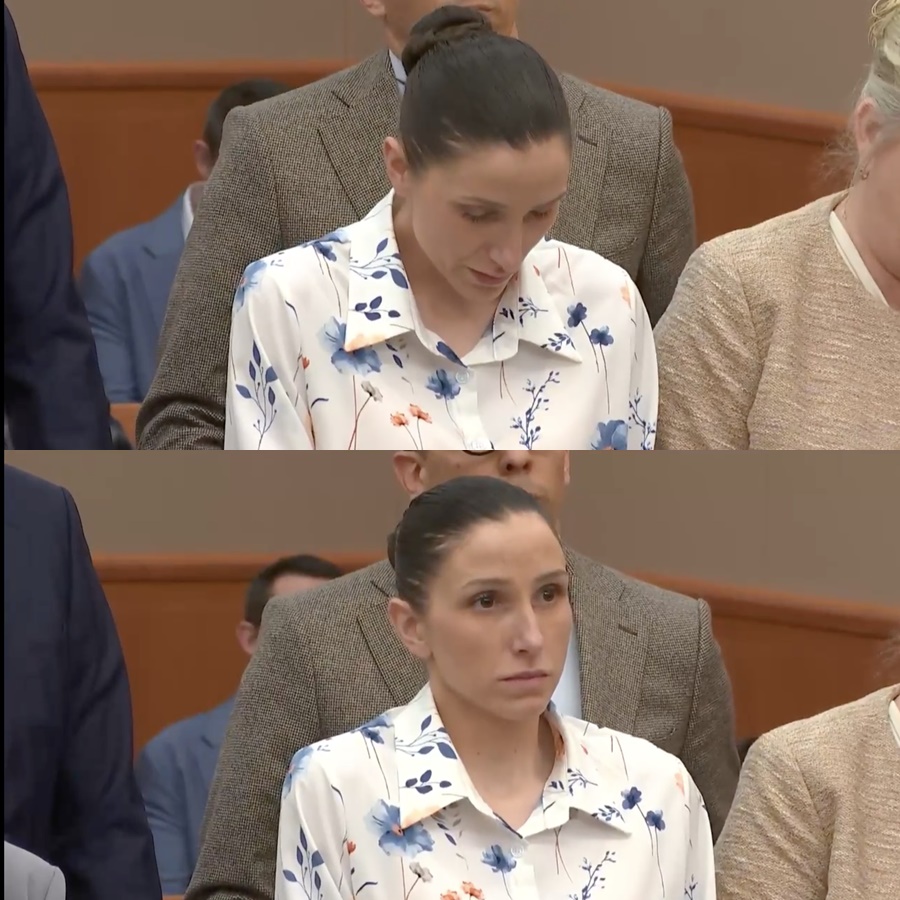
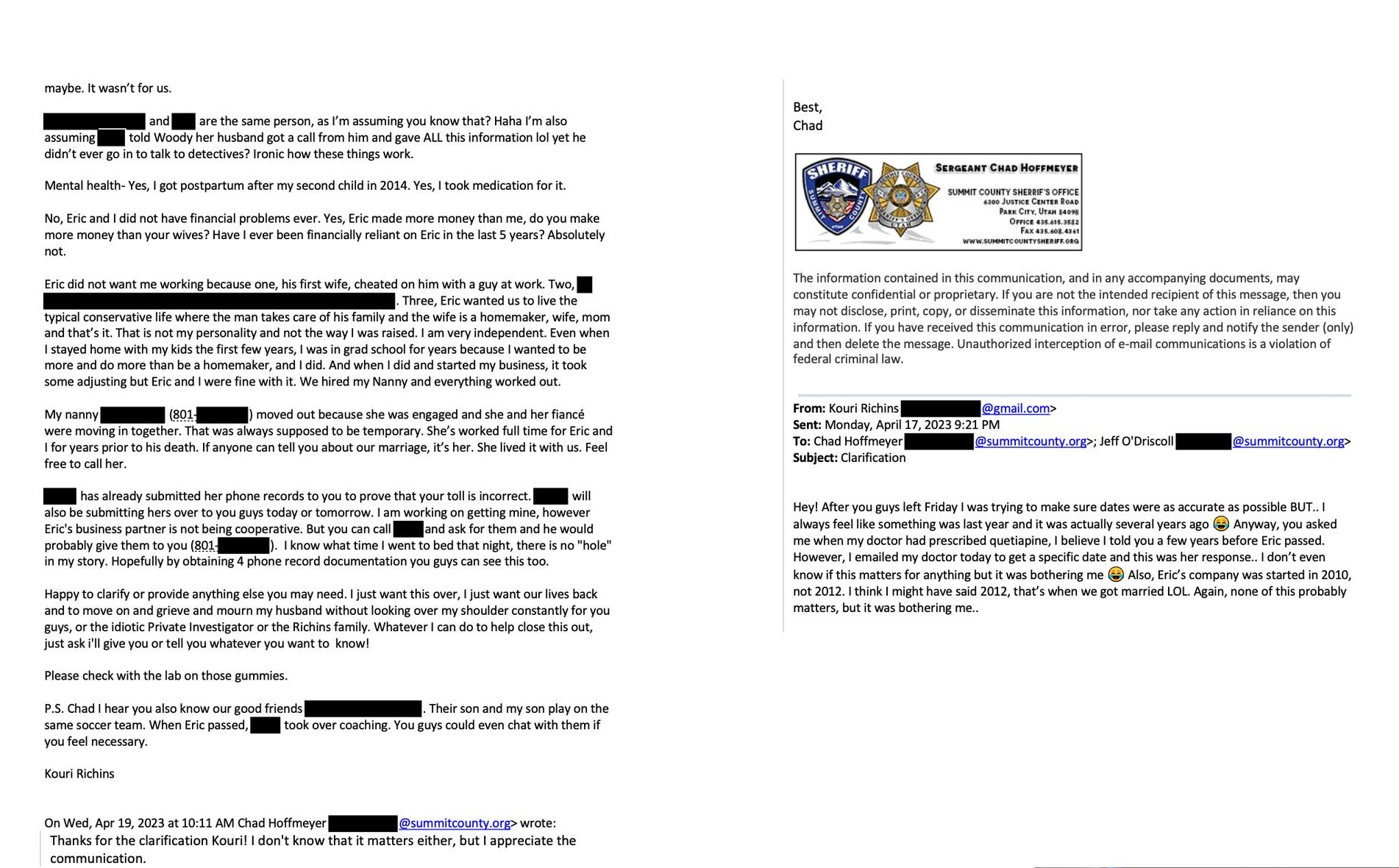
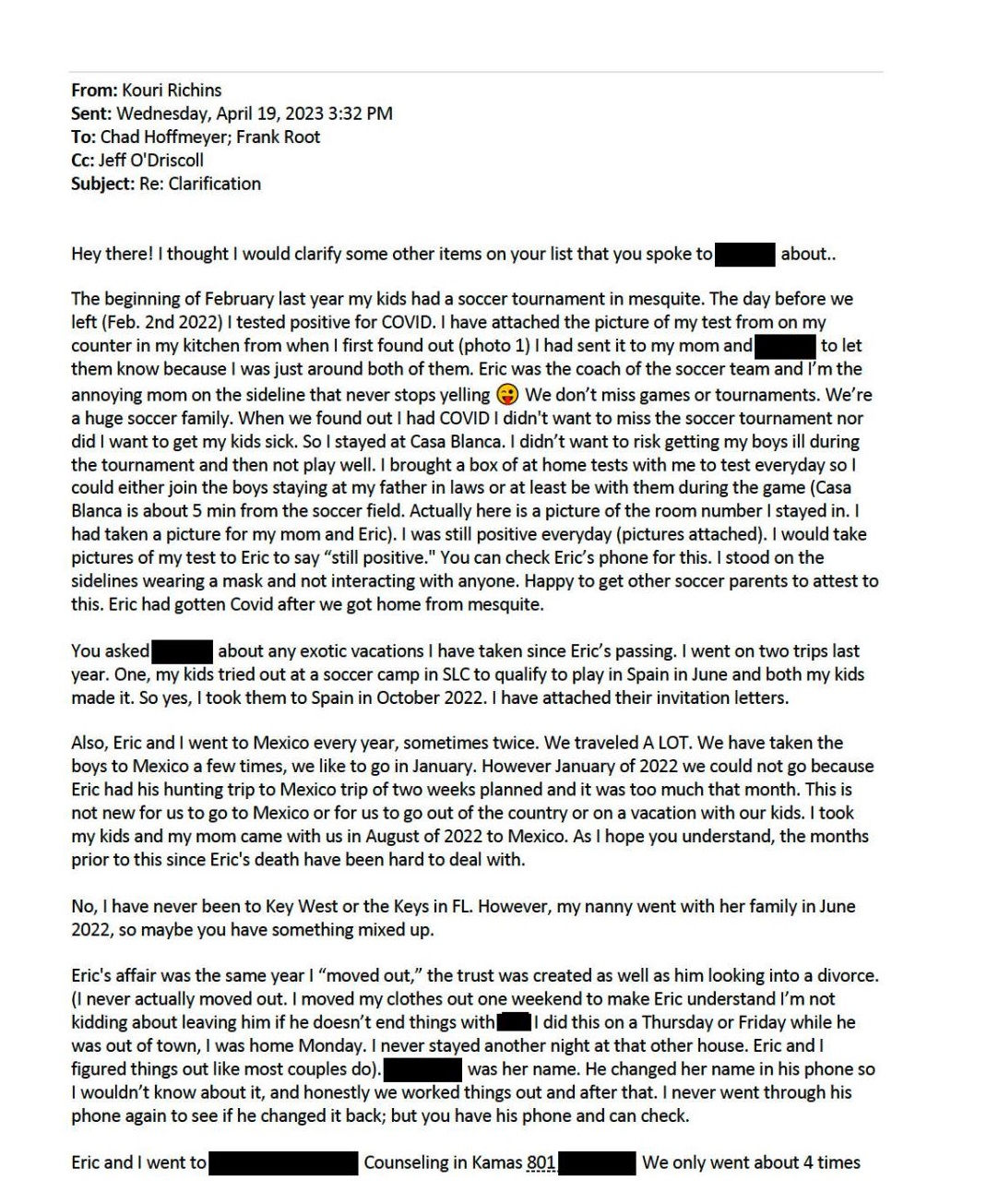
The story of Kouri and Eric began in 2009 at a Home Depot where Kouri, then only 19, worked as a cashier. Their relationship progressed into marriage in 2013 and the birth of three sons. To the outside world, they were a successful couple living the American dream in Summit County, Utah. Eric was a successful businessman in the masonry industry, and Kouri was a burgeoning real estate agent. Yet, as the prosecution meticulously detailed during the trial, the marriage was a battlefield of financial infidelity and deep-seated resentment. Kouri’s own words, captured in an April 2023 email to detectives, revealed a fundamental disconnect. She described Eric’s desire for a “typical conservative life” where the man provided and the wife was a homemaker—a life she claimed did not fit her “very independent” personality. She spoke of a past affair of Eric’s and his pursuit of a divorce as early as 2020, suggesting a relationship that had been fractured long before the final, fatal night.
The prosecution argued that Kouri’s motive was not just a desire for “independence,” but a desperate need for financial salvation. Evidence presented at trial showed that Kouri was drowning in debt from her real estate ventures and house-flipping projects. Her financial desperation led her to engage in what prosecutors termed “financial infidelity” against her husband. In 2019, she used a power of attorney—without Eric’s knowledge—to obtain a $250,000 Home Equity Line of Credit (HELOC) on his premarital home. By 2020, Eric discovered that Kouri had withdrawn at least $100,000 from his bank accounts and misdirected $23,000 intended for his business taxes. This betrayal prompted Eric to take drastic measures. In late 2020, he consulted an estate-planning attorney to protect his assets and his children. He created a living trust, removed Kouri as the beneficiary of his $500,000 life insurance policy, and appointed his sister, Katie Richins-Benson, as the trustee—specifically and intentionally excluding Kouri. Crucially, Kouri was unaware of these changes until after Eric’s death.
The trial highlighted that the fatal dose of fentanyl Eric ingested on March 4, 2022, was likely not the first time Kouri had tried to kill him. Eric’s family testified to his growing suspicion and fear. During a trip to Greece, Eric became violently ill after Kouri gave him a drink. He called his sister, terrified, stating he believed his wife had tried to kill him. On Valentine’s Day in 2022, only weeks before his death, Eric suffered a severe allergic reaction after eating a sandwich Kouri had prepared. He broke into hives, couldn’t breathe, and had to use his son’s EpiPen and Benadryl before losing consciousness for several hours. These incidents painted a picture of a man who knew he was being hunted within his own home. He told multiple friends and family members that if anything happened to him, “she was to blame.”
The forensic evidence regarding the night of the murder was equally damning. Kouri told investigators she had prepared a “celebratory” Moscow Mule for Eric to toast a successful real estate closing, then left him in bed to go sleep in one of their children’s rooms. When she returned, she claimed she found him cold and unresponsive. However, her narrative of frantic CPR and inconsolable grief was debunked by first responders and digital evidence. While Kouri claimed she “pumped so damn hard” during CPR, paramedics noted that Eric was foaming at the mouth and expelling blood—indicators that actual CPR had not been performed prior to their arrival. Her calm demeanor on bodycam footage stood in sharp contrast to the “distraught” persona she described in her journals, where she wrote of throwing up in the bathroom and rocking back and forth in prayer.
The state’s case was bolstered by the testimony of Carmen Lauber, a housekeeper and acquaintance who admitted to selling Kouri the fentanyl that killed Eric. Lauber testified that Kouri had requested “the Michael Jackson stuff” or something “stronger” for an alleged investor with back pain. The prosecution also highlighted Kouri’s incriminating digital footprint. Her Google searches included inquiries such as “can cops force you to do a lie detector test” and “if someone is poisoned what does it go down on the death certificate as.” Furthermore, it was revealed that Kouri had booked a romantic getaway with a boyfriend for April 2022—a trip she scheduled in December 2021, long before Eric’s “unexpected” death.
Even after her arrest in May 2023, Kouri continued to attempt to manipulate the situation. Prosecutors discovered the “Walk the Dog” letter in her jail cell—a six-page handwritten document where she instructed her mother to have her brother, Ronald Darden, provide false testimony. She wanted him to claim that Eric had obtained drugs from Mexico, an attempt to blame the victim for his own overdose. This desperate move only added to the mountain of evidence against her. The prosecution also pointed to a disturbing family history; Kouri’s mother, Lisa Darden, had been investigated in 2006 for the drug-overdose death of a romantic partner who had named her as his beneficiary shortly before his passing.
During closing arguments, the defense attempted to focus on the lack of direct evidence, noting that no fentanyl was found in the Moscow Mule mugs or the house. This led to the trial’s most cinematic moment. When Kouri’s attorney, Kathryn Nester, pointed out that no fentanyl was found in the home, Detective Jeff O’Driscoll retorted, “There was a boatload of fentanyl in his stomach that came out of the house with him.” It was a “mic drop” moment that encapsulated the undeniable reality of the crime. The jury of six men and two women agreed, finding that while there might not be a “smoking gun” video of the administration of the poison, the circumstantial evidence was overwhelming and pointed to only one conclusion.
The consequences of Kouri Richins’ actions are profound. Her three sons have lost their father and, effectively, their mother. The Richins family has endured years of legal battles and public scrutiny while mourning a man who spent his final months in fear. Kouri’s conviction on five counts brings a measure of justice, though the scars on the community and the family remain. She will face sentencing on May 13, 2026. In a tragic and poignant twist of fate, this date marks what would have been Eric Richins’ 44th birthday. On the day the family should have been celebrating his life, they will instead watch his murderer be sentenced to what is expected to be a very long term in prison.
The case of Utah v. Kouri Richins serves as a harrowing reminder of the darkness that can hide behind a mask of normalcy. Kouri believed she was smarter than the investigators, smarter than the “idiotic Private Investigator,” and smarter than the law. She trusted in her own “wisdom and knowledge,” as the prosecution quoted from the Bible, believing that no one saw her crimes. But the truth, pieced together through bank records, text messages, and the testimony of those who truly knew the couple, finally caught up with her. The author of a book on grief will now have a lifetime in a prison cell to reflect on the immense, irreparable grief she authored for her own family.