PURE OUTRAGE: Brian Hooker’s nonchalant attitude regarding Lynette Hooker’s disappearance is sparking a public outcry; he looks disturbingly comfortable, showing zero trace of worry or panic
THE EIGHT-HOUR SILENCE: Public Scrutiny Mounts Over Husband’s Demeanor in Bahamas Disappearance of Lynette Hooker
ABACO, THE BAHAMAS – As the sun rises over the jagged coastline of the Abaco Islands for another day of high-stakes searching, the mystery surrounding the disappearance of 55-year-old Lynette Hooker has shifted from a maritime rescue to a psychological puzzle. While the U.S. Coast Guard and the Royal Bahamas Defence Force scour the dark, unforgiving Atlantic, the spotlight has fixed firmly on the man who was the last to see her alive: her husband, 58-year-old Brian Hooker.
Since the moment he drifted into the Marsh Harbour Boat Yard at 4:00 a.m. on Sunday, April 5, Brian Hooker’s actions, his words, and—perhaps most notably—his silence have become the focal point of an international debate. While he has not been accused of any wrongdoing, his refusal to engage with the media and the mechanical nature of his testimony have left both investigators and the public asking: What really happened in the eight hours between the fall and the first cry for help?
A Night of Calculated Silence
The official timeline provided by the Royal Bahamas Police Force (RBPF) is as harrowing as it is perplexing. According to Brian Hooker, the couple departed Hope Town for Elbow Cay at approximately 7:30 p.m. Saturday. During the transit in their 8-foot hard-bottom dinghy, Lynette reportedly “bounced” out of the vessel. Brian claims she was holding the ignition keys at the time, causing the engine to kill instantly and leaving him stranded in total darkness.
What followed was an eight-hour gap that has become the “black hole” of the investigation. Brian told police he spent the entire night paddling the disabled dinghy toward shore, eventually arriving nearly nine hours later.

However, it is his demeanor upon arrival that has raised eyebrows. Witnesses at the boat yard described a man who appeared “physically destroyed” but “emotionally vacant.” Rather than screaming for immediate rescue or collapsing in a frantic plea for his wife’s life, Brian’s first reported words focused on the mechanical failure of the boat: “She has the keys… I couldn’t start the boat to go back for her.”
The “Stonewall” Strategy: Declining to Speak
In the days following the disappearance, as the search for Lynette reached a fever pitch, the public expected a grieving husband to plead for help on camera. Instead, Brian Hooker has retreated into a wall of silence.
When approached by CBS News and other major U.S. outlets for insight into his wife’s final moments, Brian Hooker formally declined to answer any questions. This “stonewall” approach, while legally protected, has ignited a firestorm of speculation online.
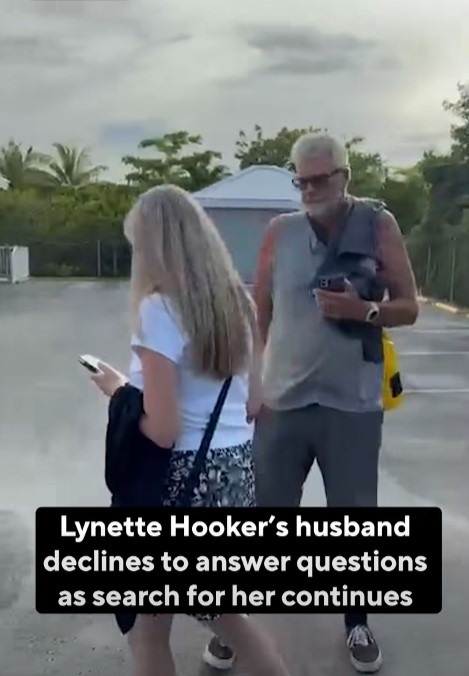
“In cases of a missing loved one, the instinct is usually to use every microphone available to keep the story alive,” says maritime legal analyst Robert Vance. “When a witness—especially a spouse—declines to speak to the media, the public often interprets that silence as a lack of desperation. In the court of public opinion, silence is often misread as guilt, even when it’s a valid reaction to trauma.”
The RBPF has confirmed that Brian has been interviewed, but they have not released any statements regarding his emotional state or the consistency of his story. For now, he remains a witness, not a suspect, but the pressure is mounting.
The Technical Inconsistencies
The maritime community in the Abacos, many of whom are seasoned sailors familiar with the exact “cut” where Lynette vanished, have been vocal about the technical gaps in Brian’s account.
The 8-foot dinghy used by the couple is a small vessel. Critics argue that even in “strong currents,” an experienced boater should have been able to keep a visual on a person in the water for more than a few minutes, even without an engine. “If she fell, she would have been right there,” noted one local fisherman who joined the search. “To paddle for eight hours toward Marsh Harbour instead of the much closer Elbow Cay or their own yacht, the Soulmate, is a decision that defies nautical logic. You paddle to the nearest light, the nearest help. You don’t paddle away from the last place you saw her for half a day.”
Furthermore, the detail about the keys continues to haunt the probe. Social media users have pointed out that in most dinghies, the “key” is a kill-switch lanyard. It is almost unheard of for a passenger to be holding the engine’s primary safety tether while the vessel is in motion.
Social Media and the “Husband Theory”
The vacuum created by Brian Hooker’s refusal to speak has been filled by a torrent of internet sleuths. On platforms like Facebook and Reddit, thousands of users have deconstructed the case, often drawing parallels to high-profile domestic tragedies.
“This is giving me major ‘Double Jeopardy’ vibes,” wrote one user, referencing the 1999 film about a husband who fakes a disappearance. Others have pointed out that the decision to travel in “rough” conditions at night without life jackets—all while the wife is holding the only set of keys—seems like a sequence of events too perfect to be accidental.
The most “terrifying” aspect for many is the lack of immediate searching. If Brian spent the entire night paddling toward a distant boat yard, he was, by definition, moving away from the “Point Last Seen.” In a search-and-rescue operation, every minute the witness spends moving away from the scene without calling for help is a minute that likely seals the victim’s fate.
A Daughter’s Anguish vs. A Father’s Silence
The contrast between Brian’s silence and the family’s public heartbreak is stark. Karli Aylesworth, Lynette’s daughter, has been the primary voice for the family, releasing statements of profound “anguish and uncertainty.”
“I have been privy to very little information,” Aylesworth told reporters, a statement that many have interpreted as a subtle nod to the lack of clarity coming from her father’s side of the ordeal. While Karli and the Michigan community hold vigils and pray for a “miracle,” Brian remains shielded from the public eye, reportedly staying in the Bahamas to “assist” with the official probe, though the extent of that assistance remains private.
The Search Efforts Continue
Despite the clouds of suspicion, the Royal Bahamas Defence Force and U.S. Coast Guard Miami Sector are not letting the drama distract from the mission. Aerial searches using thermal imaging have covered hundreds of square miles. Divers have been deployed to check the “blue holes” and underwater caves common in the Abaco region, in case Lynette’s body became trapped by the tides.
“We are racing against time,” the RBPF stated in a press release. “Dangerous waters and strong currents are our primary adversaries. We are examining every detail of the vessel and the reported timeline.”
The “Golden Hour” has Passed
As the investigation enters its fourth day, the transition from “Search and Rescue” to “Search and Recovery” feels inevitable to those on the ground. The water temperature and the presence of predatory marine life in the deeper Atlantic cuts make survival beyond 72 hours without a life jacket statistically improbable.
For Brian Hooker, the search for his wife may soon become a different kind of struggle—a struggle to explain the “unexplainable” gaps in his story to federal investigators who will eventually take over the case upon his return to the United States.
Whether his silence is the result of overwhelming grief and “survivor’s guilt” or something more calculated is a question that may only be answered if the ocean gives up its secrets. For now, the people of the Abacos, the Onsted community, and the daughter left in the dark are left with only the haunting image of a man paddling into the night, leaving his wife behind in the black abyss.