The final message sent from the phone of Professor Monica Montefalcone shocked all of Italy: Did she foresee her own death, yet chose to dive into the cave of terror for an unexpected purpose?
By: International Affairs Investigative Team
“It is fundamental to observe the underwater environment, which remains far too unknown to the general public.”
Those were the final words sent from the phone of the renowned Italian marine biologist, Professor Monica Montefalcone, at 10:15 p.m. on the night of May 14, 2026. The text, sent to a colleague, read like a quiet, lifelong mission statement. Just a few hours later, the 51-year-old professor, along with her daughter and three companions, dove into a cave 160 feet (approximately 50 meters) below the surface of the Indian Ocean.
They never returned.
The horrific tragedy that unfolded in the waters of the Maldives not only claimed the lives of five Italian citizens but also sent shockwaves through the global scientific community. Regarded as the single worst diving accident in the history of the archipelago, it has ignited fierce debates over the boundaries of exploratory passion, scientific research, and the unpredictable perils of nature.
Part I: A Breathtaking Recovery Mission Amidst the Monsoon
For days, the waters near the Vaavu Atoll were battered by tropical depressions and active monsoon warnings. Violent downcurrents and near-zero underwater visibility repeatedly forced rescue teams to halt operations for their own safety.
However, the moment tidal currents briefly stabilized, an elite dive rescue team from the Maldives military immediately entered the cave mouth at a depth of 160 feet. According to reports from the scene, the cave structure was exceptionally narrow and heavily blanketed by thick layers of silt and fine sand, which could be instantly disturbed by the slightest movement.
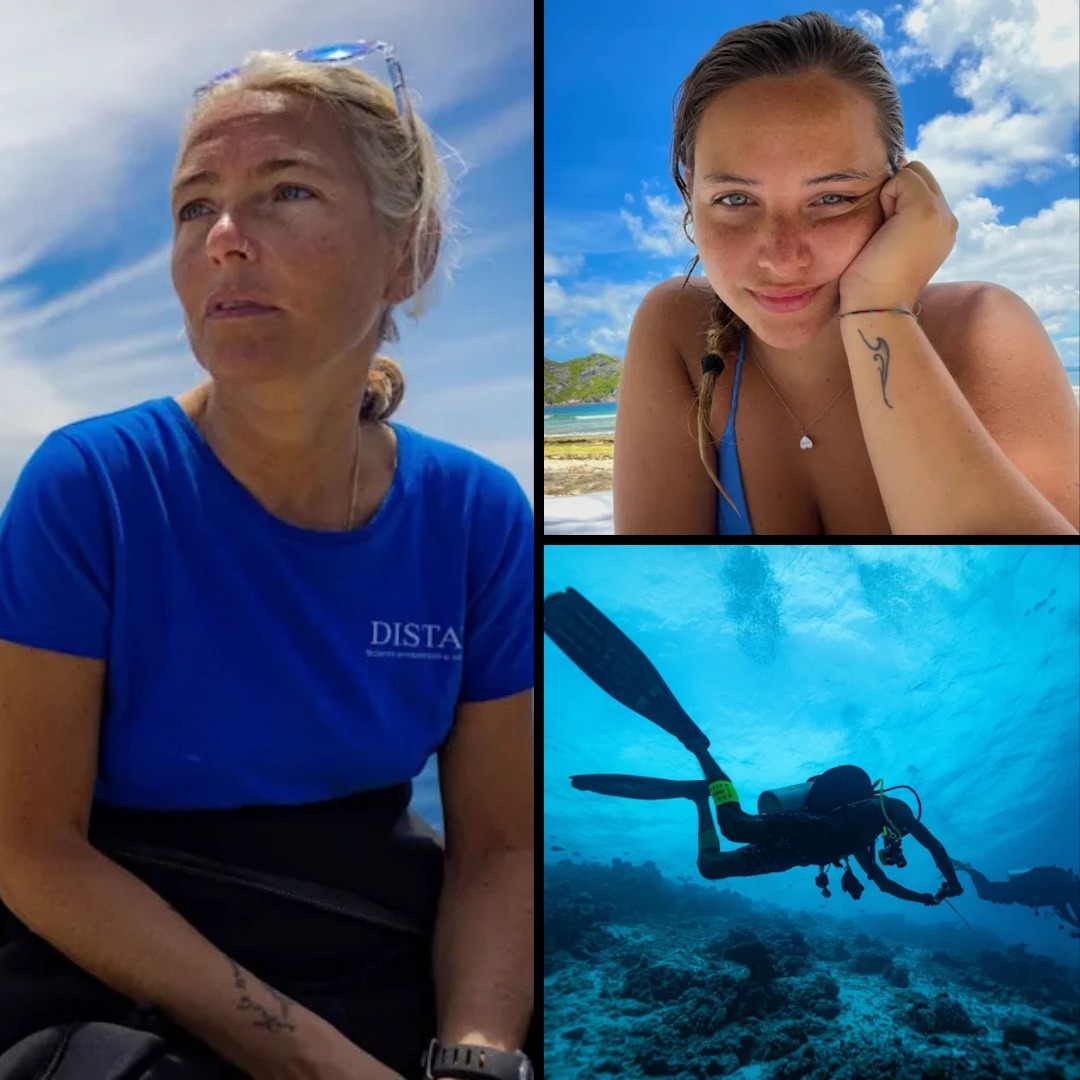
Utilizing specialized tracking equipment and an advanced guide-line system, the rescue team successfully reached the inner chamber of the vault—the exact location where Professor Monica Montefalcone and Master of Marine Biology Federico Gualtieri (31) were found, having tragically exhausted their oxygen supply. The delicate process of bringing the two bodies to the surface required strict adherence to technical decompression protocols to preserve forensic integrity for the upcoming autopsy.
To date, three of the five victims of this historic tragedy have been recovered. Two young victims remain missing inside the deep recesses of the cave: 22-year-old Giorgia Sommacal (Professor Monica’s daughter) and 31-year-old research fellow Muriel Oddenino.
Part II: A Heartbroken Father’s Cry and the Defiant Stance on “Iron Discipline”
In Italy, news of the partial recovery immediately dominated major headlines, including La Repubblica. The grief is unimaginable for Carlo Sommacal, the husband of Professor Monica and father of young Giorgia. His heartbreak was torn open anew; though his wife has been found, their beloved daughter remains left behind in the cold, dark depths of the ocean.
Speaking to the press through a choked voice, Mr. Sommacal maintained the razor-sharp clarity of someone who deeply understood the mechanics of diving, fiercely defending his wife’s professional reputation:
“The only certainty I have is that my wife is among the best divers on the face of the earth. She was an incredibly disciplined, cautious, and responsible person. Monica would have never, absolutely never, jeopardized the life of our daughter or any other young people.”
His convictions are grounded in objective reality. Professor Montefalcone was no amateur. With over 5,000 dives spanning two decades, she knew the marine topography of the Maldives like the back of her hand. Furthermore, she was a survivor of the catastrophic 2004 Indian Ocean tsunami, a feat she achieved through sheer composure and her profound understanding of oceanic currents.
Consequently, both the family and close colleagues have firmly rejected any hypotheses suggesting the divers panicked or made rudimentary errors. Instead, Mr. Sommacal points toward a “systemic failure”—an unforeseen environmental trap or a fatal technical malfunction in the equipment or nitrox-blending process that simultaneously incapacitated an entire team of experts. The recovery of Professor Monica’s body and her dive computer will serve as the crucial “black box” needed to unravel this tragedy.
Part III: Hidden Complications and Legal Friction
As authorities pivot into a deep technical investigation, complex details surrounding the trip have surfaced, sparking polarizing debates among the public and diving professionals.
1. The Secrets Enclosed in the Dive Computer and Gas Cylinders
The local Prosecutor’s Office immediately sealed the diving gear recovered with Professor Monica and Federico. Forensic engineering experts are now focusing heavily on two areas:
- The Dive Logs: To establish the precise timeline, depth profile, and ascent/descent rates of the victims.
- Gas Analysis: Testing the residual air in the cylinders to determine if carbon monoxide (CO) poisoning occurred due to a faulty filtration process at the local dive center.
2. The University of Genoa Distances Itself
Shortly after the tragedy, the University of Genoa—where Professor Monica was a long-standing faculty member—issued an official statement clarifying the nature of the expedition. The university explicitly stated that the fatal dive on May 15 was conducted in a personal capacity, entirely separate from any official, university-sanctioned scientific missions.
This statement drew mixed reactions. While it legally insulated the academic institution from liability and insurance disputes, it left the public feeling a profound sense of sorrow. It painted a picture of scientists left entirely isolated in their pursuit of passion, even though the core purpose of Professor Monica’s journey to the Maldives remained unchanged: documenting the devastating impacts of climate change on tropical biodiversity.
Part IV: The “Cave Trap” and a Desperate Attempt to Save One Another
Based on the tight proximity in which the bodies were discovered, international cave-rescue experts have begun reconstructing the terrifying scenario that took place 50 meters below the surface:
[Silt-out Phenomenon] ➔ Sediments disturbed ➔ Zero visibility, total disorientation
               ⬇
[Monsoon Downcurrents] ➔ Strong currents pull the divers deeper into narrow crevices
               ⬇
[Internal Rescue Attempt] ➔ Team members perish while trying to share air and save one another
The fact that the bodies of the professor and her colleague were found close together strongly supports the theory of a domino effect. It is highly probable that one of the younger team members encountered an initial crisis—such as becoming wedged in a rock crevice or suffering a sudden gas depletion. Bound by maternal instinct and fierce professional camaraderie, Professor Monica and the others chose not to execute an emergency ascent alone. They stayed behind, fighting until the very last breath of oxygen to save one another.
Part V: Victim Status and Search Progress
| Name | Age | Role | Search Status |
| Gianluca Benedetti | 44 | Diving Instructor | Recovered (First) |
| Monica Montefalcone | 51 | Professor of Marine Biology | Successfully Recovered |
| Federico Gualtieri | 31 | Master of Marine Biology | Successfully Recovered |
| Giorgia Sommacal | 22 | Daughter of Prof. Montefalcone | Missing inside the cave |
| Muriel Oddenino | 31 | Research Fellow | Missing inside the cave |
Conclusion: Brought Back From the Deepest Love of Her Life
Professor Monica Montefalcone spent her entire life loving, studying, and defending the sea. Cruelly, the very ocean she gave everything to became the place that held her captive.
The successful recovery of her body, alongside her colleague Federico Gualtieri, offers a painful sliver of closure for the family, allowing her to leave the dark abyss and return home. Yet, this somber journey remains incomplete. As long as young Giorgia Sommacal and her dedicated student Muriel Oddenino remain beneath the waves, the waters of Vaavu Atoll will remain an unhealing wound.
The professor’s final words regarding the “fundamental need to observe the underwater environment” will forever endure as a guiding beacon for those left behind. The ocean may guard its secrets fiercely, but the systemic errors made by humans above the surface must be brought to light—if only to preserve the ultimate dignity and honor of a true scientist.