The first two bodies have been recovered from the third chamber of death deep inside the Maldives cave—female professor Monica Montefalcone and scientist Federico Gualtieri. The images of them being brought to the surface have left the global media completely stunned: What happens at the bottom of the ocean can truly never be underestimated.
TRAGEDY BENEATH THE OCEAN: BODIES OF TWO ITALIAN SCIENTISTS RECOVERED FROM UNDERWATER CAVE IN THE MALDIVES
PART 1: THE GRUELING SEARCH IN THE DEPTHS OF VAAVU ATOLL
After days filled with anxiety, tension, and fading hope, the perilous search and rescue operation at the Vaavu Atoll ring reef in the island nation of the Maldives has come to a tragic end. Urgent reports from the scene have finally confirmed a grim reality: the bodies of two of the divers who went missing inside the mysterious underwater cave system have been recovered and brought to the surface.
According to initial preliminary reports from local coast guard and rescue forces, the two bodies brought to the surface included one male and one female. Shortly thereafter, the identities of the victims were swiftly clarified. Italy’s leading business journal, Il Sole 24 Ore, officially reported that the bodies found belong to two renowned scientists from the University of Genoa: Professor Monica Montefalcone and research fellow Federico Gualtieri. They were top experts conducting a vital marine biology research project in these waters.
This heartbreaking confirmation was also delivered to the international media by the legal representative of a victim’s family. Antonello Riccio, a legal representative of Gualtieri’s parents, spoke to the Italian press agency, ANSA, to confirm the news:
‘One of the bodies is Federico’s, the other is the teacher Montefalcone,’
Despite facing an overwhelmingly sudden loss, the family of the young researcher expressed deep appreciation for the tireless efforts of all parties involved throughout the high-risk search operation. Speaking on behalf of the family, lawyer Riccio stated:
‘We were contacted by the [Italian] embassy to give us the news. Federico Gualtieri’s family, although absolutely devastated, wish to express their gratitude for the work of both the local authorities and [DAN Europe’s] team of experts. ‘We also thank the Italian embassy, which has always been very cooperative.
PART 2: RECOVERY FROM THE DEATH DEPTHS AND FORENSIC PROCEDURES
To reach the location of the victims, Maldivian authorities had to enlist the help of some of the world’s finest underwater cave diving specialists. Mohamed Hussain Shareef, spokesman for the Maldivian government, confirmed specific details regarding where the victims were located. He stated that the two bodies were found in the deepest third chamber of the cave, at a depth of approximately 60m.
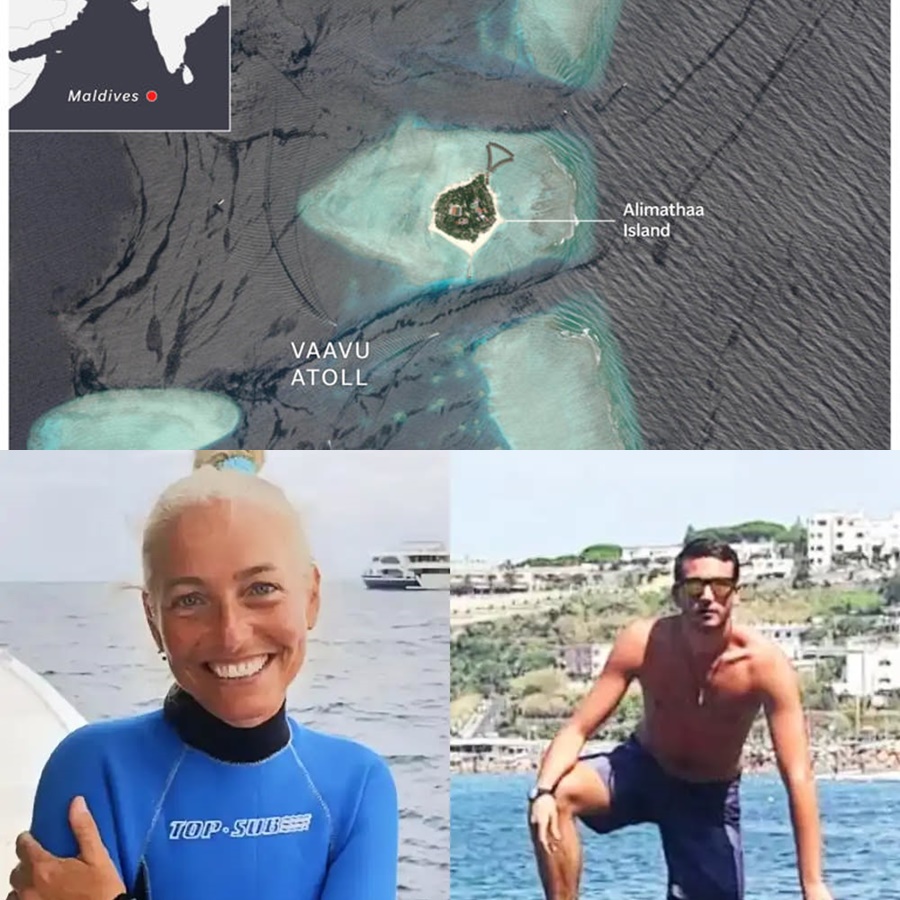
The bodies of two of the missing divers, reported by the Italian media Professor Monica Montefalcone and research fellow Federico Gualtieri, have been recovered. Numerous reports have surfaced that the team had an offical permit to dive to 50m for research purposes.
The feat of bravery in locating and recovering the bodies belongs to an elite, specialized team of Finnish divers consisting of three experts: Sami Paakkarinen, Patrik Grönqvist, and Jenni Westerlund. These are highly seasoned specialists in the harshest cave diving environments on the planet, where a minor error in navigation or gas management can cost a diver their life.
Immediately after being safely brought to the surface, the bodies of Professor Montefalcone and researcher Gualtieri were transported to a mortuary in the Maldives capital Malé. Currently, diplomatic and legal procedures are being urgently processed to return them to Italy within the next few days. In Italy, medical and forensic authorities will conduct full autopsies to determine the exact cause of death, deciphering whether it was due to gas depletion, nitrogen narcosis, or another sudden technical failure.
Reflecting on this complex logistical process, lawyer Antonello Riccio noted:
‘We know that it will take a few days for the authorisations to return to Italy,’ said Riccio. ‘If it took three or four days for [Gianluca Benedetti, who was found on the same day the incident occurred], I imagine it will take the same time for the others. ‘It seems that an autopsy will not be performed there in the Maldives, we have to see if they will do it here’.
Riccio’s mention of Gianluca Benedetti – the Italian dive guide who was found deceased on the very day the incident occurred – further underscores the severity and heartbreaking scale of this diving tragedy.
PART 3: THE 50-METER DIVE PERMIT AND THE TRUTH BEHIND THE RUMORS
Immediately after news of the accident spread, a wave of speculation, theories, and unfounded rumors erupted across mainstream media and international Internet dive forums. Many were quick to criticize the dive team, raising major questions about why a high-level academic research team would severely violate the standard 30m depth limit for recreational diving in the Maldives – a strict rule designed to ensure tourist safety.
However, legal truths that gradually emerged over the following days shattered those baseless speculations. Over the last two days, several media outlets, including Italy’s Il Sole 24 Ore and the BBC, have reported that Professor Montefalcone and her team actually held a specific, legal permit issued by the local government, allowing them to dive to a depth of 50m for the purposes of scientific research.
The reason for this special privilege is that Professor Montefalcone was no ordinary tourist; she has been reported as one of the foremost experts on Maldives coral as part of her research at the University of Genoa. Her years of research play a vital role in understanding and conserving coral reefs against climate change. Although the specific necessity for the permit (such as searching for or surveying a rare endemic coral species living in deep waters) has not yet been officially disclosed by authorities, a reporter from Corriere Della Sera – one of Italy’s most notable newspapers – interviewed Mohamed Hussain Shareef about the document.
PART 4: DETAILS OF THE PERMIT AND THE CRUCIAL AMBIGUITIES
Based on the Corriere interview with Mr. Shareef, the specific legal details of the dive permit were brought to light. The document was approved and issued in February, valid specifically from May 3 to 17, and permitted diving operations within a depth range of 0 to 50m. Notably, this permit did not cover all members present at the scene on that fateful day. Only three of the five divers involved are named in the permit: Professor Montefalcone, and two subordinate researchers, Muriel Oddenino and Federico Gualtieri.
Conversely, Montefalcone’s daughter, Giorgia Sommacal, and their Italian guide, Gianluca Benedetti, are not.
Explaining this academic research collaboration in greater detail, Shareef stated in the interview:
‘The University of Genoa team has been conducting annual research in the Maldives for at least four years,’ said Shareef in the interview. ‘They had submitted a specific research proposal on soft corals and the composition of the Maldives’ reef systems to the Department of Marine Research, which gave the green light. They had the necessary permits.’
When the reporter questioned further regarding the application process for the permit and the legality of the standard 30m limit in the country, Shareef clarified the fundamental difference between recreational sports and specialized scientific research:
‘The 30-meter limit applies to recreational diving. ‘Researchers can propose diving deeper, and there’s no second specific law in the Maldives that prevents it. The main problem is that it was a cave dive, and their research proposal, as far as I know, didn’t mention it. ‘They specified the atolls, but not the specific dive sites.’
This fine line lies at the very heart of the matter. While the existence of the legal 50m permit refutes allegations that the research team acted undisciplined or recklessly without cause, it does not directly explain the root cause of their disappearance, nor does it prove that they entered the cave deliberately. However, the document does lend some credence to a plausible theory: the divers had planned to descend to that depth with a clear purpose. The problem is that they faced a dangerous cave geological structure that may not have been part of their initial safety scenario.
PART 5: A PERILOUS THRESHOLD AND THE GRIEF OF AN ISLAND NATION
The underwater cave system where the bodies were found is an incredibly complex and treacherous natural structure. Remarkably, the entrance to the caves in which their bodies have since been found is at a depth of 47m – a boundary extremely close to the maximum 10% tolerance threshold of their 50m permit. When a diver reaches this threshold, they are very near the human body’s limit of endurance against massive water pressure and severe physiological risks.
The Maldivian government is currently continuing to cooperate with international investigative agencies to collect data from the victims’ dive computers in order to accurately reconstruct their final moments underwater. Mr. Shareef expressed the deep sorrow and grief of the entire government and people of the Maldives over this immense loss:
‘We’re still investigating how deep they went,’ said Shareef. ‘The cave entrance is 47 meters. In all of this, I can tell you that it was a very hard blow for us too. ‘We have a special bond with Italy, and the professor was a very special person because she dedicated so many years of her professional life to research in this country.’
This catastrophic accident is not only an irreparable loss for the families, friends, and students of the victims, but also leaves a massive void within the international marine science community. Professor Monica Montefalcone and her young colleague Federico Gualtieri fell right on their scientific “battlefield,” where they dedicated their entire passion to discovering and protecting the mystical beauty of the ocean. The investigation remains ongoing, but their scientific legacy and love for the coral reefs of the Maldives will undoubtedly be remembered forever.