THE TRAGIC CAUSE REVEALED: How 5 expert divers perished in the Maldives, overtaking even the most experienced professor. ‘Once they were underwater and this hit, their only fate was a painful death in the abyssal deep
Painful Oxygen Toxicity and Disorientation May Be Primary Causes of the Maldives Diving Tragedy That Killed 5 Italian Tourists
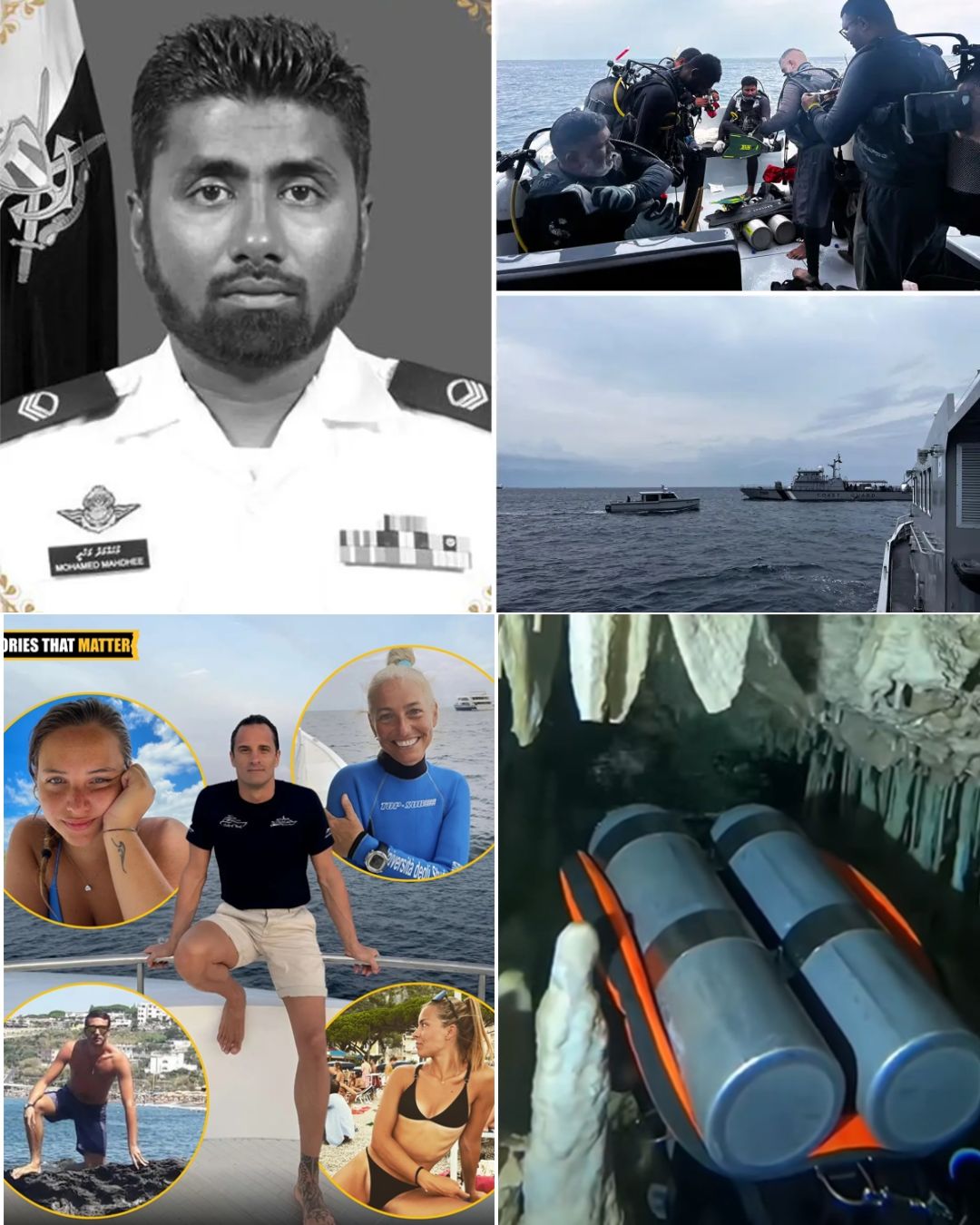
The diving tragedy occurred on May 14 inside an underwater cave system at Vaavu Atoll, Maldives, claiming the lives of five Italian tourists. The victims were scientists and students from the University of Genoa (Italy). The group, led by 51-year-old Professor Monica Montefalcone, was conducting a dive to research an undocumented coral species. Among the deceased was Giorgia Sommacal, 22, the daughter of Professor Montefalcone.
By the morning of May 19, rescue teams had recovered three bodies. The remaining two are expected to be brought to the surface on May 20.
According to reports from Italian media, the diving group held a permit to descend to a depth of 50 meters for scientific research, meaning they did not violate the 30-meter depth limit typically applied to recreational diving. However, the permit was only registered under the names of Professor Montefalcone and two other individuals. The remaining two members, including her daughter, were not on the official list.
No final conclusion has been reached regarding what transpired inside the cave system, as there are no survivors. Based on the locations where the bodies were discovered and the underwater topography, experts have outlined the primary scenarios that led to the tragedy.
The Treacherous Topography of the Cave
The dive team entered a highly complex underwater cave system at Vaavu Atoll at a depth of approximately 50 meters, though the actual depth of the cave reaches around 60 meters. The cave consists of three large chambers connected by narrow passages, protruding ledges, open vertical walls, and several tunnels cutting through the reef structure—all carrying a high risk of powerful currents. Visibility here is low, particularly during inclement weather, and the environment features a heavily silted bottom and extremely confined spaces.
The divers transmitted a distress signal around 1:45 p.m. and were officially reported missing after failing to resurface at their scheduled time.
The Threat of “Oxygen Toxicity”
Diving expert Maurizio Uras suggested that “oxygen toxicity” inside the cave could have been a contributing factor to the accident. This phenomenon can occur during deep dives; if the oxygen blend is incorrect, it can become highly toxic at certain depths.
During a standard dive, divers breathe compressed air containing 21% oxygen and 79% nitrogen. However, some divers utilize a specialized gas mixture called nitrox (oxygen-enriched air), which contains a higher percentage of oxygen and less nitrogen than regular compressed air.
If oxygen is inhaled at excessively high partial pressures, it becomes toxic to the human body. When this occurs, divers experience symptoms such as dizziness, acute pain, cognitive impairment, and severe disorientation, rendering them unable to ascend to the surface.
Respiratory specialist Claudio Micheletto, Director of the Respiratory Department at the Verona University Hospital, noted that it is highly probable “an issue occurred with the gas cylinders” during the dive. Dr. Micheletto emphasized that oxygen toxicity is one of the most perilous complications of deep diving.
“Death resulting from oxygen toxicity or hyperoxia is one of the most catastrophic ways to die during a dive—a truly horrific outcome,” he stated.
Severe Weather and Cross-Currents
“Weather conditions were also a critical factor, and the Indian Ocean is nothing like the relatively calm Mediterranean. The Indian Ocean features powerful currents that can violently toss a diver from one side to another. That presents a very real danger,” Mr. Uras added.
On the day of the accident, a yellow alert had been issued for passenger vessels and fishermen. The advisories warned of hazardous weather and strong currents capable of disorienting divers, stirring up fine silt to reduce visibility to zero, and making navigation or escape immensely difficult.
The “Venturi Effect” Vacuum Theory
Alfonso Bolognini, President of the Italian Society of Underwater and Hyperbaric Medicine, suggested that the group may have met with disaster while surveying the cave in preparation for future dives.
The dive team might have been sucked inside by a fierce current generated by the unique structure of the cave’s entrance. The cave’s narrow conduit could have triggered a “Venturi effect”—a phenomenon where water accelerates to maintain a continuous flow rate, causing a sharp drop in pressure and creating a powerful vacuum force that pulls objects deep into the cave.
Mr. Bolognini proposed this hypothesis after receiving data on the underwater conditions from diving specialists at DAN Europe (Divers Alert Network). According to him, the team initially deployed a Remotely Operated Vehicle (ROV) to the mouth of the cave. When the violent currents prevented the device from entering, the team chose to dive down themselves.
“Two scenarios could have unfolded following this suction hypothesis,” Mr. Bolognini explained. “Either everyone was sucked inward simultaneously, or one individual was pulled in and the rest perished while attempting a rescue.” Additionally, sudden panic could have severely exacerbated the tragedy.
This hypothesis offers an explanation for how a group of such highly qualified and competent divers could go missing.
Search and Recovery Efforts
According to local officials, each diving operation to locate and retrieve a body takes approximately three hours. The mission is immediately aborted if conditions become too hazardous.
Earlier over the weekend, search efforts were heavily hampered by severe weather. Tragically, a Maldives military rescue diver, Mohamed Mahudhee, died from decompression sickness on May 16 while searching for the victims, bringing the total death toll of the incident to six.
The Maldives is a low-lying archipelago characterized by sprawling white sandbanks and coral reefs with an exceptionally high density of marine life. Scuba diving is incredibly popular here, often taking the form of drift diving powered by the Indian Ocean’s monsoon currents. These currents flow along the islands, bringing vital nutrients that sustain the rich ecosystem.
With its expansive geography and sparse population, Vaavu Atoll—alongside Meemu Atoll—has become a world-renowned diving destination in the Maldives. The secluded nature of its beaches and dive sites makes it a preferred choice for experienced divers seeking uninterrupted exploration.