“HAUNTED BY THE THROAT OF DEATH”
The first rescue diver to descend to the scene where 5 diving experts perished in the deadly Maldives cave is still shocked and haunted by the terrifying ‘choke point’ inside the cavern: 4 people lay in the cave, covered in sediment silt, hands still trying to cling to rock crevices in their final struggle.
FROM THE DARKNESS OF THE MALDIVIAN CAVE: A RESCUER’S HAUNTING MEMORY AND THE TEAR-STAINED WARNING FROM DAN EUROPE
MALÉ, MALDIVES — “The scene was absolutely horrific…” — The voice of the international recovery team diver choked over the radio, leaving a freezing silence across the deck of the Maldives National Defence Force (MNDF) vessel. After days of grueling labor cutting through jagged underwater structures, the rescue crew finally breached the deepest, narrowest section of the Vaavu Atoll cave system—where all five doomed Italian divers had drawn their final breath.
Exclusive disclosures from firsthand witnesses of the recovery mission, combined with official technical breakdowns from the Divers Alert Network Europe (DAN Europe), have painted an unprecedented, chilling picture of the worst cave diving disaster in the history of the archipelago. This is no longer just a tragic accident; it is a brutal lesson written in blood about the razor-thin margin between life, death, and catastrophic panic beneath the surface of the ocean.
1. Journey Through the “Throat of Death”
The underwater cavern network at Vaavu Atoll is notorious within the technical diving community for its deceptive geomorphology and unpredictable undercurrents. To reach the fateful third chamber—a dead-end trap sitting at a depth of nearly 165 feet (50 meters)—the Finnish recovery team coordinated by DAN Europe had to endure an incredibly suffocating experience.
“We had to fight through a layer of darkness so dense, so absolute, that even the high-output beams of our specialized dive lights were swallowed whole within a few feet,” the recovery diver vividly recalled.
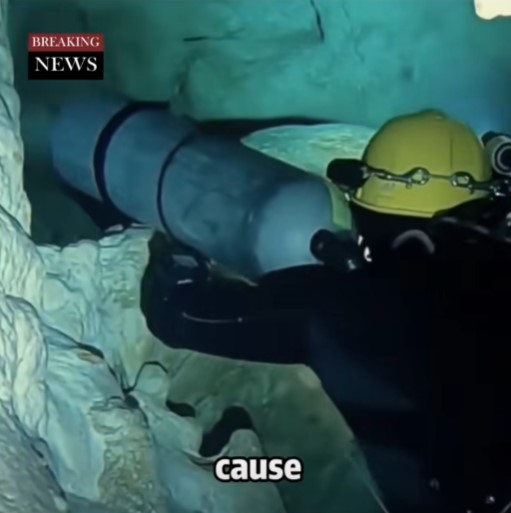
The passage leading into the final chamber was not an open conduit, but a series of dangerously tight restrictions. At these extreme choke points, the clearance between the razor-sharp limestone ceiling and the fine silt floor was so narrow that a diver could only wiggle through sideways, occasionally being forced to unclip sidemount cylinders just to squeeze through.
The hazard escalated exponentially because the fine sediment and silt, which had accumulated undisturbed for thousands of years, were continuously stirred up by fin kicks. Within seconds, visibility plummeted to absolute zero. Moving entirely by touch, the recovery crew had to cling blindly to their guidelines in an atmosphere of intense psychological pressure, acutely aware that a single snag could leave them permanently entombed within the “throat of death.”
2. A Scene “Beyond Horrific” Inside the Third Chamber
After more than an hour of navigating blindly through the stone labyrinth, the recovery team finally breached the threshold of the third chamber—the blind alley with no exit. As their dive lights cut through the milky, disturbed water, they were confronted by a sight that the witness described as “beyond horrifying,” a visual memory that he stated would haunt him for the rest of his days.
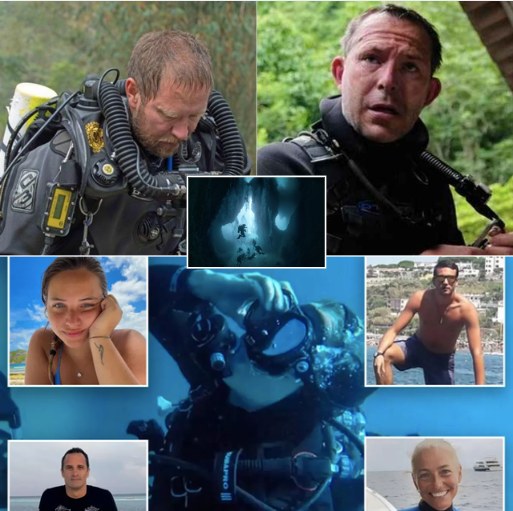
The four bodies of the research group—Professor Monica Montefalcone (52), her daughter Giorgia Sommacal (20), and young researchers Muriel Oddenino and Federico Gualtieri—were discovered huddled tightly together against the terminal limestone wall of the cave.
- The Posture of Despair: Contrary to early assumptions of a swift, peaceful passing, the physical positioning of the victims told a grim tale of a violent struggle against asphyxiation. They were discovered piled over one another, the fingers of some victims still desperately clawing at rock crevices or tightly gripping the gear of their colleagues in their final, convulsive moments.
- Signs of Cascade Panic: The dive masks of several team members were displaced or flooded, pointing to a severe cascade panic that gripped the group the moment they realized the breathing gas in their standard 12-liter cylinders was completely exhausted.
A short distance from the cluster of four lay the body of their instructor, Gianluca Benedetti (44). He was prone near the narrow entrance of the chamber, both arms stretched out in front of him as if he had been straining to relocate the guideline or seeking a sliver of light to save his students before ambient pressure and hypoxia struck him down. The atmosphere within the vault was heavy with the grim finality of the deep sea, shrouded in a dead silence that chilled the rescuers to the bone.
3. DAN Europe Steps In: Technical Analysis and Expert Insights
Shortly after the recovery team’s harrowing accounts shook the public, Laura Marroni, CEO of DAN Europe, stepped forward on behalf of the organization to provide profound professional insight into the mechanics of the tragedy. DAN Europe asserted that the horrific scene encountered by the divers was the inevitable result of a series of severe technical miscalculations colliding with a textbook psychological trap.
[Equipment Failure: Standard 12L Tanks] -> [Navigation Error: Blind Chamber] -> [Gas Depletion + Silt Out] -> [Cascade Panic] -> [Asphyxiation]
The Trap of the Standard 12-Liter Cylinder
Laura Marroni heavily emphasized that utilizing standard 12-liter aluminum or steel cylinders for an overhead cave profile extending to 165 feet was a fatal decision. At this depth, under an ambient pressure of 6 atmospheres (6 ATA), a diver consumes gas six times faster than at the surface.
“When you take a wrong turn and realize you are trapped inside a dead-end chamber, the needle on your pressure gauge drops with terrifying velocity. The window of time they had to realize their mistake and reverse their tracks was incredibly short—under 10 minutes, perhaps even less,” the DAN Europe CEO analyzed.
The Anatomy of Lethal Panic
DAN Europe further explained the physiological and psychological unraveling that occurred within the minds and bodies of the five Italian divers during those fateful minutes. When the group realized their exit was obscured by the sandbank and visibility was obliterated by the silt out, adrenaline levels spiked into an uncontrollable “fight or flight” response.
The victims began to hyperventilate, breathing rapidly and shallowly, which caused the meager gas supply remaining in the 12-liter tanks to dump out within a few frantic gasps. The sudden surge of carbon dioxide ($CO_2$) in their bloodstreams due to irregular respiration hyper-stimulated the brain’s panic center, stripping even a seasoned veteran like Professor Monica of basic logical reasoning. This disorientation inevitably led to the victims unconsciously grasping at each other’s gear before succumbing to nitrogen/oxygen toxicity and final asphyxiation.
4. Absolute Respect and the Decommissioning Mission
Although the main recovery phase—fraught with immense physical and emotional strain—was successfully concluded by Wednesday, May 20, 2026, with all five Italian nationals and the fallen local military diver brought ashore, DAN Europe declared that the mission is not yet over.
In accordance with the highest ethical standards and best practices established within the international cave diving community, the Finnish team consisting of Sami Paakkarinen, Patrik Grönqvist, and Jenni Westerlund will return to the core of the cave for a final operational dive. Their objective is to systematically remove all guidelines, auxiliary tanks, and staging equipment deployed inside the system during the multi-day recovery effort.
Laura Marroni stated:
“Throughout the entire mission, DAN Europe’s choices have been guided by two unwavering priorities: the absolute safety of the recovery team and the utmost respect for the victims and their families. We must restore the natural, pristine environment of the cavern and remove all traces of human intervention so that their souls may rest in peace.”
Furthermore, because a transnational criminal investigation between the Italian and Maldivian governments remains active, the technical team will attempt to further document and map the third chamber using advanced 3D modeling. This will provide legislative authorities with the most precise structural data possible, assisting in confirming whether any external factors or anomalies were present prior to the dive.
Conclusion: A Costly Lesson Echoing from the Deep
The tragedy at Vaavu Atoll will be analyzed for decades to come within dive safety manuals worldwide. The haunting firsthand account of a scene “beyond horrifying” detailed by the recovery diver, the gallant sacrifice of the Maldivian military sergeant, and the clinical yet necessary analysis from DAN Europe stand as a fierce warning to anyone who seeks to challenge the strict parameters of nature.
The oceans of the Maldives carry the breathtaking beauty of a paradise, but a single wrong turn combined with a casual oversight regarding life-support equipment can instantly transform a dream dive into an eternal tomb. As the five Italian divers begin their final journey back to the warmth of their homeland, closing a devastating chapter beneath the sea, the lesson regarding absolute discipline in overhead environments remains behind—unyielding and forever etched in stone.