NO GUIDELINE: Trapped in a dead end by a lethal sand wall, 5 Italian divers perish in Maldives shark cave; rescuers uncover a HORRIFIC SECRET on the rock fissures during the recovery of 4 bodies: Their final moments were truly a nightmare of absolute despair
THE VISUAL TRAP AND A DEATH SENTENCE AT 60 METERS: THE FULL EXCLUSIVE INTERVIEW WITH DAN EUROPE ON THE MALDIVES SUBMERGED CAVE TRAGEDY
MALE, MALDIVES — On May 20, 2026, the deeply sorrowful search and recovery operation within the submerged cave network of Vaavu Atoll, Maldives, officially came to a close. The bodies of five Italian tourists and one local military rescue diver have all been successfully returned to the surface, marking the single most catastrophic scuba diving accident in the history of the island nation.
Immediately following the conclusion of the mission, Laura Marroni, CEO of DAN Europe—the organization responsible for directly coordinating and managing the elite rescue diving squad—hosted a stunning international press conference. The newly released on-scene data not only decodes the exact mechanics of this subterranean “death trap” but also lays bare a horrifying sequence of human errors committed by the University of Genoa research team, leading to an agonizing and heartbreaking end.
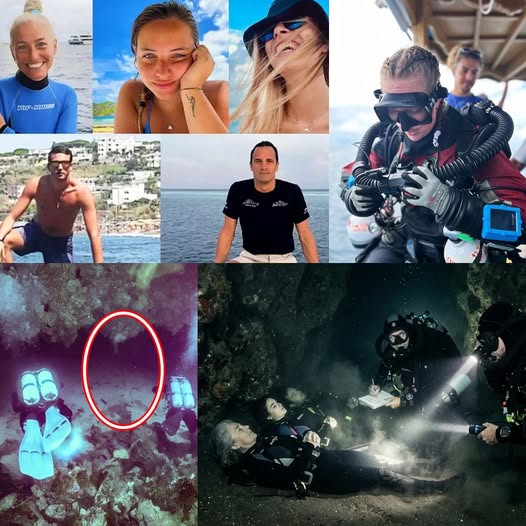
1. The Finnish Rescue Squad and the Suffocating Recovery Process
According to the official brief from DAN Europe, the extreme hazards present within the Vaavu Atoll cave network required the deployment of a three-man team consisting of the most elite, elite technical cave divers from Finland. Facing a freezing, overhead environment at a depth of nearly 60 meters, the rescue team operated under strict technical protocols, with each diver assigned a highly specialized role to recover the remains of the victims:
- The First Diver (Recovery Specialist): Tasked with the primary responsibility of penetrating the tightest restrictions, freeing the victims, and directly transporting each body out of the rocky fissures.
- The Second Diver (Safety/Support Specialist): Stationed nearby to constantly monitor environmental safety, track gas management, oversee equipment risks, and remain fully prepared to initiate an emergency rescue for the primary diver.
- The Third Diver (Documentarian): Utilized a specialized underwater documentation camera system to film and photograph the entire scene layout to assist forensic investigators and technical analysts.
Sami Paakkarinen, one of the three Finnish technical specialists, disclosed that while this was not mathematically the most technical dive of his career, it was unequivocally one of the most tragic and haunting experiences he had ever endured.
2. Mapping the Vaavu Cave Morphology: The Illusion of the Deceptive “Sand Wall”
The detailed brief compiled by the recovery team has reconstructed a terrifying three-dimensional diagram of the interior cave system, exposing the true nature of the ocean’s predatory visual trap.
[SEA SURFACE]
       │
       ▼ (Descent to 50m - 60m)
[FIRST CHAMBER: Immense cavern dome, flooded with ambient sunlight, pristine white sand floor]
       │
       ▼
[MAIN PASSAGE: 30m long, 3m wide, flawless visibility under high-powered technical torches]
       │
       ▼
[SUBMERGED SANDBANK: Effortlessly crossed on penetration] ──► [SECOND CHAMBER: Permanent Blackout]
       │                                                         │
       ▼ (On retreat: Blinded by sand camouflage)                 ▼
[FALSE LEFT CORRIDOR: Dozens of meters long] ◄─────────────────── (Wrong turn taken in panic)
       │
       ▼
[DEAD-END ALLEY: The final location where all bodies were recovered]
The cave system opens with the First Chamber—an immense cavern dome flooded with ambient daylight reflecting from the open sea across a pristine white sand floor. Advancing further, the team traveled through a main passage measuring roughly 30 meters long and 3 meters wide. Utilizing high-output technical torches, the visibility here remained flawless, allowing them to clearly observe the surrounding limestone walls. This passage led straight into the Second Chamber—a colossal, circular vault carved into the coral bedrock, completely isolated from any natural solar light.
The fatal catalyst resided precisely at the boundary separating the main passage from the pitch-black second chamber: a dynamic underwater sandbank. Laura Marroni explained that as the Italian team swam down the gradient into the secondary room, this sandbank sloped downward smoothly, allowing them to pass over it with absolute ease.
However, the trap sprung when they turned around to exit. Looking out from the absolute darkness of the second chamber, the sandbank—due to the geometrical layout of the stone and the reflection angles of their dive lights—suddenly underwent a visual metamorphosis. It appeared to the human eye as a solid, impenetrable stone wall, completely masking the entrance to the correct exit corridor.
Even more menacingly, to the left of this sandbank lay a secondary opening—a false corridor dozens of meters long that appeared wide open but was, in reality, a blind alley (dead-end). Stripped of any physical navigational line, the divers succumbed to the optical illusion and turned into this false passage in their desperate bid to escape.
3. A Death Sentence Presided by 12-Liter Cylinders and the Absence of a Guideline
The on-scene investigation overseen by DAN Europe confirmed a devastating fact: the five Italian divers failed to deploy any form of guideline or safety reel as they penetrated the cave system. In technical cave diving, this line serves as the absolute umbilical cord of life support, ensuring that a diver can close their eyes and safely navigate back to open water purely through tactile contact. The Finnish recovery team noted that they could only trace the victims’ final movements by following physical disturbance marks left on the silt floor.
This operational complacency, paired with extreme gas limitations, sealed their deaths:
- Using Non-Compliant Gas Supplies: The research group carried only standard aluminum 12-liter cylinders (single tanks engineered strictly for recreational open water diving). At a depth of nearly 60 meters, under a hydrostatic ambient pressure of 7 atmospheres ($7\text{ ATA}$), the compressed air is heavily compacted and consumed seven times faster than at sea level.
- The Searing Depletion of Safe Bottom Time: Under standard No-Decompression Limits (NDL), the safe bottom time for a diver at this extreme depth is a mere 3 to 4 minutes. To explore deep into the secondary chamber under a 3-to-4-minute profile is a mathematical impossibility. Laura Marroni noted that even under a theoretical best-case scenario, the group possessed less than 10 minutes of total gas volume before facing total depletion or severe, life-threatening decompression sickness.
In a fatal bid to save a few minutes out of that tight 10-minute clock, the divers made a catastrophic compromise: they bypassed driving tie-offs and running a continuous guideline. Placing full faith in their personal diving capabilities, they falsely believed that a wide, 3-meter corridor would be impossible to lose.
4. 10 Minutes in Hell: The Final Hours and the Silt-Out Trap
By systematically correlating the positions of the recovered bodies and on-scene physical evidence, DAN Europe has reconstructed the terrifying final moments of the Italian dive team within the eternal dark.
The moment the group swam into the false left corridor and realized they were facing the blank stone wall of a dead end, the submersible pressure gauges (SPGs) on their chests were already hovering deep inside the critical red zone. Cascade panic instantly erupted across the team. In a state of overwhelming terror, their heart rates spiked, inducing violent hyperventilation that drained the remaining fractions of air from their standard 12-liter cylinders at an exponential rate.
This terror triggered frantic, uncoordinated fin kicks as the victims clashed into one another in a chaotic attempt to turn back and flee. This precise mechanical motion awoke the single most feared hazard in overhead environments: the Silt-out.
The ultra-fine sediment and loose mud that had rested undisturbed for thousands of years on the floor of the blind alley exploded into suspension. In less than 5 seconds, the spatial visibility surrounding the five divers dropped to absolute zero ($0\%$). A thick, blinding fog encased the group. Their technical torches were rendered totally obsolete as the high-output light beams merely reflected off the suspended particles, creating a blinding white wall of light that was entirely opaque.
[ENTER BLIND DEAD END]
          │
          ▼
[SYSTEMIC CASCADE PANIC / HYPERVENTILATION]
          │
          ▼
[FRANTIC FIN KICKING] ──► [SEDIMENT BLOWOUT (SILT-OUT)] ──► [VISIBILITY DROPS TO 0%]
                                                                   │
                                                                   ▼
[FATALITIES OCCUR IN UTTER BLINDNESS WITHIN MINUTES] ◄─────────────┘
Blinded and disoriented in a fluid vacuum, without a physical guideline to grasp, the five divers completely lost their spatial orientation. They clawed blindly, colliding with each other and crashing against the raw stone walls in a suffocating nightmare.
The Finnish rescue team discovered three of the bodies piled closely together on the silt-covered floor. More tragically, the fourth body was found suspended, wedged tightly near the stone ceiling of the vault, separated from the others by a mere 2 to 3 meters. The physical posturing of the deceased indicated they were desperately clawing at minute rock fissures in their final, convulsive struggle before succumbing to total asphyxiation.
5. Legal Investigation Targets Strict Regional Environmental Limits
Beyond the technical forensic analysis of the gear and the terrain, the disaster has prompted a rigorous criminal and administrative inquiry by Maldivian authorities.
Under current maritime and tourism laws in the Maldives, which are strictly enacted to protect human life, the absolute depth limit for recreational tourist diving is capped at 30 meters. However, the University of Genoa scientific expedition group—comprising marine ecology Professor Monica Montefalcone (51), her daughter Giorgia Sommacal (22), researchers Federico Gualtieri and Muriel Oddenino, along with instructor Gianluca Benedetti—had pushed their dive profile to nearly 60 meters.
Spokespersons from the University of Genoa confirmed that the team was executing an official scientific mission to evaluate marine environmental health and the local impacts of climate change, specifically targeting the documentation of an unclassified coral species. Nevertheless, the decision to execute a highly complex technical diving profile inside a hazardous overhead cave system utilizing substandard recreational gear while profoundly violating regional depth boundaries remains a core legal question that state prosecutors are actively pursuing.
Conclusion: A Costly Reminder Echoing from the Dark Vaults
All digital media devices recovered from the site, including the GoPro action cameras mounted to the helmets of the deceased, have been legally sealed and transferred to the Maldives Police Service for advanced forensic data extraction. Authorities and grieving family members remain hopeful that the final footage stored within the memory cards—if not structurally crushed by hydrostatic pressure—will soon shed definitive light on the final seconds of the scientists’ lives.
The tragedy at Vaavu Atoll stands as a somber, deeply sorrowful chapter for the global marine science community. It leaves behind a classic, textbook lesson written in blood: the ocean is utterly merciless, offering no quarter for overconfidence or safety compromises. When crossing the threshold into a submerged cave where a direct vertical escape route to the surface simply does not exist, turning your back on life-saving technical rules like guideline management will immediately convert a mission of scientific discovery into a tragic journey of no return.