THE MYSTERY SUNK IN THE DARKNESS OF VAAVU ATOLL: WHY THE 5 ITALIAN DIVERS FAILED TO LAY A GUIDELINE – THE FATAL SAFETY VIOLATION THAT CLAIMED 6 LIVES
VAAVU ATOLL, MALDIVES — In the technical cave diving community, there is a famous maxim that has become an unwritten law, written in the blood of hundreds of casualties who came before: “Follow the guideline as if your life depends on it, because it does.” The guideline or reel is the absolute umbilical cord connecting a diver to survival—the definitive life support asset ensuring they can navigate back to open water when the surrounding environment is engulfed in eternal darkness and blinding sediment clouds that reduce visibility to absolute zero.
Yet, in the worst scuba diving disaster in the history of the Maldives, which occurred on May 14, 2026, within the Vaavu Atoll submerged cave network, a shocking detail from the Finnish recovery team and DAN Europe has been brought to light: the group of five Italian divers completely failed to deploy a permanent guideline as they advanced deep into the secondary cavern chamber. Why did an expedition team consisting of elite specialists from the University of Genoa, led by veteran marine ecology Professor Monica Montefalcone and accompanied by professional instructor Gianluca Benedetti, bypass the most fundamental survival protocol in overhead environments? This exclusive structural analysis breaks down the systemic human errors, overconfidence, and the predatory optical illusion that drove them into a corner.
1. The Anatomy of the “Umbilical Cord” Rule in Technical Cave Diving
Before diving into the underlying causes of the tragedy, it is imperative to establish why entering an overhead cave network at a depth of 50 meters (165 feet) without laying a guideline is a suicidal act. Unlike standard open water reef diving, where a diver can simply perform a direct vertical ascent to the surface when faced with an emergency, cave diving takes place within a strict overhead environment.
In this space, the only exit is the exact point of entry. When a technical diver penetrates a cave system, they must utilize a dedicated reel, anchoring the primary tie-off securely at the cavern opening (where natural ambient light or an open-water exit is available) and continuously letting out the line as they swim inward. This line acts as a critical failsafe to:
- Maintain absolute orientation, preventing the diver from being deceived by symmetrical geological structures or identical limestone walls.
- Ensure a physical exit route during a Silt-out (a phenomenon where fine, loose sediment deposits on the cave floor are disturbed, instantly dropping visibility to $0\%$ and rendering high-output dive lights entirely useless). In that dense, milky fog, divers cannot even see their own hands; they must rely entirely on their fingers gripping the guideline to blindly navigate back to safety.
By abandoning this tool, the Italian dive group effectively cut their own lifeline, gambling their survival entirely on visual memory and spatial intuition inside an uncharted subterranean vault.
2. The Optical Illusion of the First Chamber: Deceptive Ambient Light
Utilizing the detailed geological descriptions of the Vaavu Atoll cave system provided by the DAN Europe recovery squad, experts have reconstructed the psychological landscape that fostered such fatal complacency. This cavern network possesses a highly deceptive morphology.
[Wide Cavern Entrance / Bright Natural Ambient Light]
                        │
                        ▼
[Passage: 3m Wide, 30m Long (Flawless Visibility with Specialized Torches)]
                        │
                        ▼
[Innocent-Looking Sandbank (Passed Across with Absolute Ease)]
                        │
                        ▼
[SECOND CHAMBER: TOTAL BLACKOUT / THE OPTICAL TRAP IS TRIGGERED]
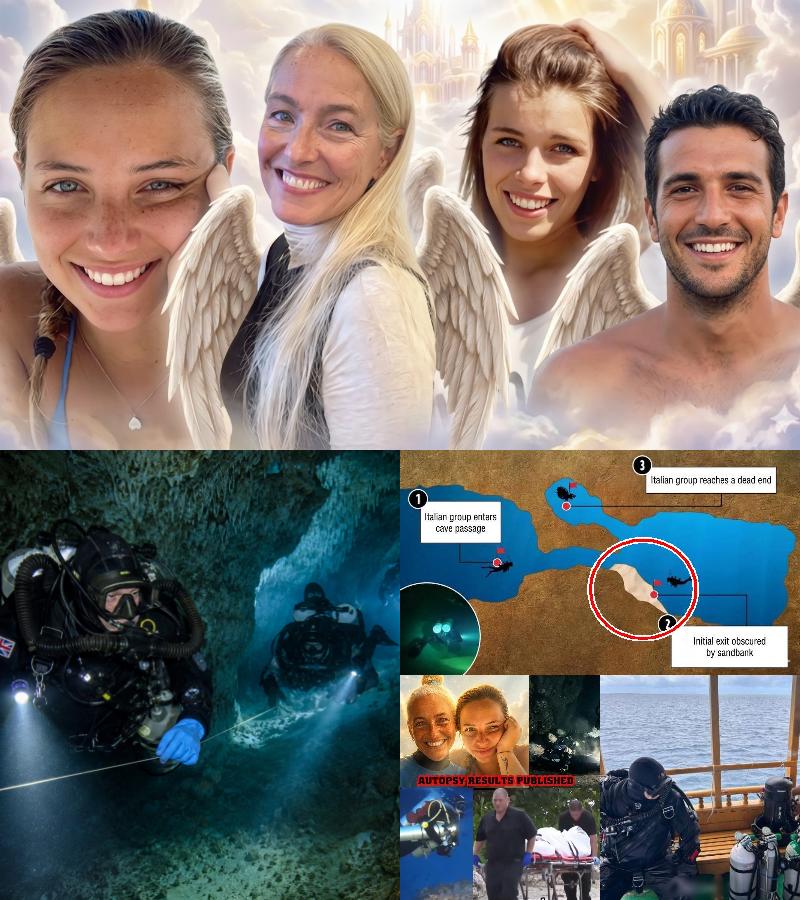
When Professor Monica’s team descended to the 50-meter threshold, the initial zone they encountered was a massive cavern dome illuminated by natural light reflecting off a pristine white sand floor. The environment did not present the forbidding aura of a “death cave”; instead, it mirrored a vibrant underwater sanctuary. Moving past this dome, they entered a corridor approximately 30 meters long and 3 meters wide. Although ambient daylight faded, their high-powered technical dive lights maintained flawless visibility.
This seamless progression, combined with wide-open clearance and excellent visibility across the first 30 meters, created an immediate psychological trap: overconfidence. The team misjudged the system as a straightforward, linear tunnel, assuming that reversing their tracks would be as simple as swimming in a straight line. Instructor Gianluca Benedetti likely concluded that deploying a guideline within a spacious, 3-meter-wide corridor with clear visibility was an unnecessary expenditure of time—a fatal mistake common among veteran divers who grow complacent in the face of familiar underwater geometry.
3. The “Short Research Dive” Mentality and the 12-Liter Cylinder Clock
Another core element explaining the decision not to lay a line resides in the specific objective of the dive and extreme time constraints. Representatives from the University of Genoa confirmed that the group was not executing a deep cave exploration mission; rather, they were conducting a short scientific deployment to monitor the marine environment and document an unclassified coral species.
Because their initial operational profile was limited to sampling the cavern periphery or shallow openings, the five Italians equipped themselves with standard 12-liter cylinders (recreational scuba tanks) instead of the high-capacity technical twinsets or sidemount configurations utilized by deep cave exploration teams.
At a depth of 50 meters, under an ambient hydrostatic pressure of 6 atmospheres (6 ATA), a diver’s gas consumption rate accelerates by a factor of six compared to the surface. Technical calculations reveal that they possessed less than 10 minutes of safe bottom time at that depth to conduct their research and initiate a retreat.
This brutal time pressure forced a fatal compromise: bypassing the guideline installation to conserve minutes. Driving anchors, securing primary tie-offs, and managing line wraps require precise mechanics that consume between 3 to 5 minutes of precious gas. The research team chose to swim rapidly inward to capture their photographs and data on the new coral, betting on their collective experience that they could not possibly lose their way within a brief 10-minute window.
4. The Sudden “Sand Wall” and the Metamorphosis of the Cave
The structural errors committed by the Italian team met a devastating end the moment they crossed the submerged sandbank separating the primary corridor from the secondary chamber. This second room was a massive, circular vault completely devoid of natural light.
As their brief survey window expired, the group turned around to return to the exit corridor. At this exact moment, the tragedy unfolded. From the vantage point inside the pitch-black second chamber looking back out, the sandbank they had effortlessly crossed minutes earlier completely “metamorphosed” due to the shifting angle of their dive lights and the sloping angle of the floor. It appeared visually as a solid rock wall, entirely obscuring their line of sight to the actual exit passage.
If a guideline had been laid across that sandbank, the divers would have simply maintained contact with the line and swum directly through the camouflaged barrier. Without it, they were completely stripped of visual orientation. Ahead of them lay two potential paths: the true exit masked by the sandbank, and a false, dead-end corridor branching to the left, which extended for several dozen meters and appeared deceptively clear.
As panic began to mount while looking at their rapidly falling submersible pressure gauges (SPGs), the team made their final fatal choice: they swam down the left corridor, believing it to be the way home.
5. The Silt-Out Phenomenon – The Final Seal on the Vault
Laura Marroni, CEO of DAN Europe, emphasized that wandering into the dead-end corridor triggered a textbook cascade panic. After swimming dozens of meters into the restriction only to realize they were trapped in a blind alley, the oxygen levels in their cylinders hit critical redlines.
Searing fear caused the victims’ respiratory rates to spike to three to four times their normal volume. Frantic, disorganized fin kicks during their chaotic attempt to reverse direction inside the narrow space disturbed the most dangerous hazard in cave diving: the sediment cloud.
The ultra-fine silt and loose dust accumulated undisturbed for millennia on the floor of the Vaavu Atoll cave exploded into the water column. Within less than 5 seconds, the entire environment surrounding the five divers was choked by a dense, muddy suspension, obliterating visibility to absolute zero ($0\%$). Their high-powered dive lights were rendered completely useless, merely reflecting off the dense suspension and creating a blinding white wall of light that was impossible to see through.
[Enter Dead-End Corridor] -> [Panic & Hyperventilation] -> [Aggressive Fin Kicks] -> [Silt Explodes into Water] -> [Visibility Drops to 0%] -> [No Guideline to Navigate Exit] -> [Fatalities]
At this juncture, the full, merciless weight of failing to deploy a guideline was realized. Had a line been present, they could have simply closed their eyes, managed their breathing, and pulled themselves along the cord to safety regardless of the blackout. But lost in a liquid void with zero visibility and zero reference lines, the five divers clawed at the dark in absolute futility. Their bodies were ultimately discovered submerged within the deep silt layer, the fingers of several victims still locked onto small vach rock crevices in their final, convulsive struggle against asphyxiation.
Conclusion: A Costly Lesson Carved in Stone at Vaavu Atoll
The disaster in the Maldives, which claimed the lives of five Italian nationals and cost the life of a local military rescue diver during the multi-day search operation, was not an unavoidable act of God. It stands as the tragic consequence of a sequence of subjective human errors: diving well beyond recreational safety parameters (50m), utilizing inadequate gas volumes (12L standard tanks), operating with improper exposure suits that compromised buoyancy control, and above all, violating the core technical protocol of laying a guideline.
The passing of Professor Monica Montefalcone and her young research colleagues is a profound loss to the marine biology discipline. However, their final operational oversight will forever endure as a stark, solemn textbook case—an unyielding warning echoing to the global diving community that inside the sunless vaults of the deep ocean, the smallest compromise on safety protocols will cost nothing less than your life.