UNDENIABLE TRUTH about the cause of death of 5 professional Italian divers in the Maldives: There is no such thing as the death cave sucking 5 victims inside, they went in there for an unimaginable REASON, ultimately paying with their entire lives; condolences to the families
FORENSIC AND DIGITAL DOSSIER ON THE MALDIVES SUBMERGED CAVE TRAGEDY: DECODING THE CRITICAL NAVIGATIONAL ERROR OF THE FIVE ITALIAN DIVERS
MALE, MALDIVES — The investigation surrounding the deaths of five Italian divers inside a submerged cave network in Vaavu Atoll, Maldives, on May 14, is entering a pivotal stage as it expands into an international inquiry. Currently, authorities from both nations are moving swiftly to seize and seal electronic devices, while synthesizing testimonies from professional rescue personnel and local experts to clarify the core catalyst of this catastrophic accident.
The cave system where the accident occurred—referred to in local reports as Devana Kandu or Dhekunu Kandu—has become the focal point of a widening culpable homicide (manslaughter) investigation initiated by prosecutors in Rome and executed directly by the Genoa Flying Squad.
1. Seizure of Electronic Devices and the Legal Investigation Progress
To facilitate the digital forensic investigation, police investigators have seized a large volume of the victims’ personal equipment, including mobile phones, personal computers, tablets, USB drives, and a portable hard drive. According to the Italian daily Corriere Della Sera, this entire cache of equipment was safely transported and returned to Italy by Stefano Vanin, an associate professor of zoology at the University of Genoa.
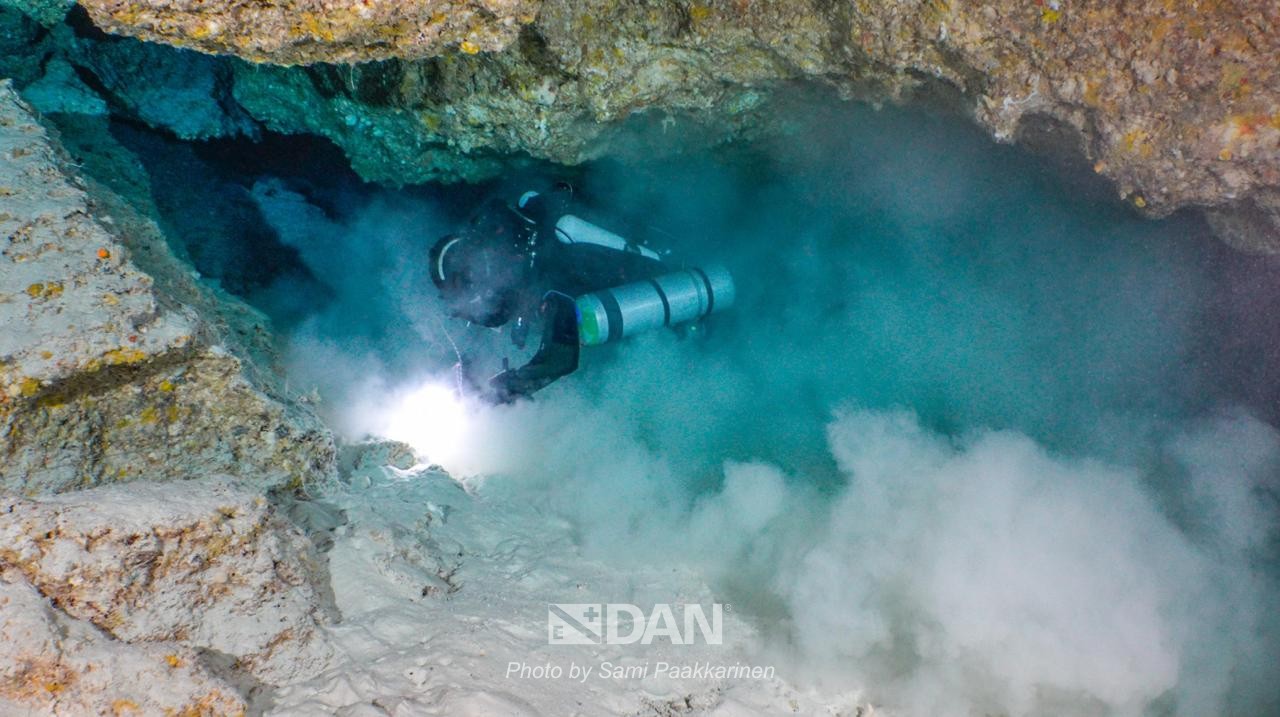
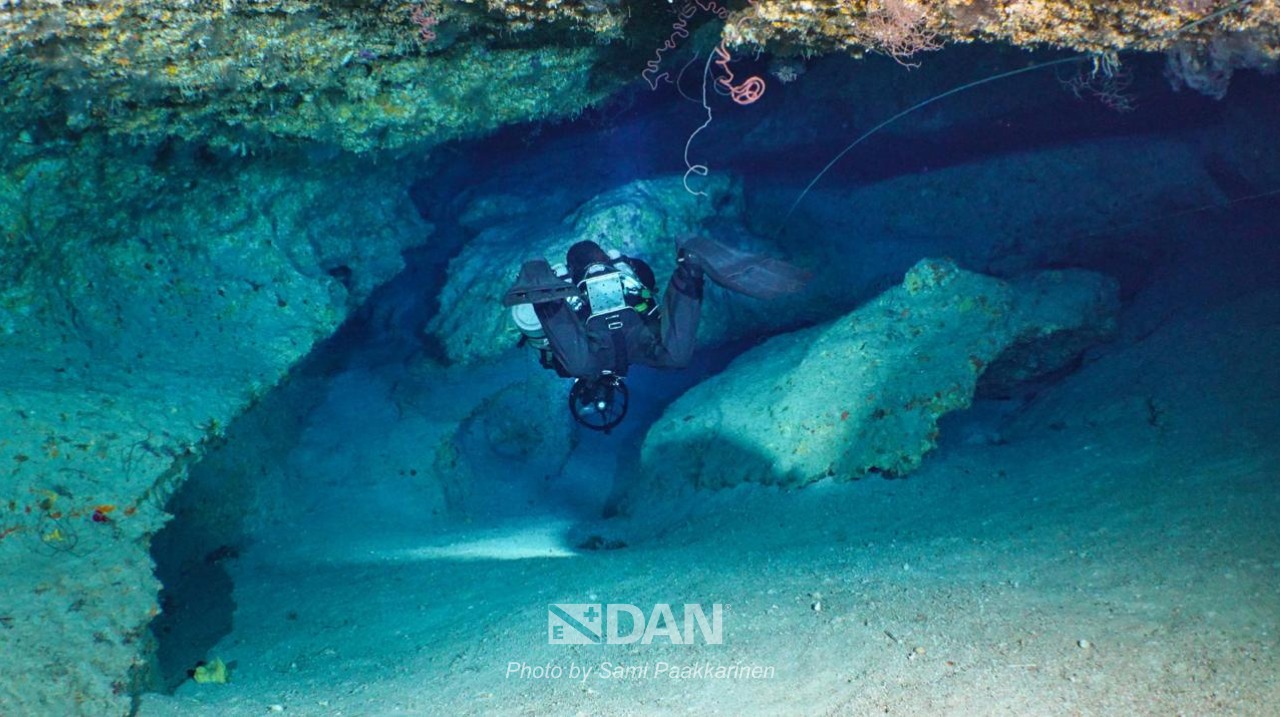
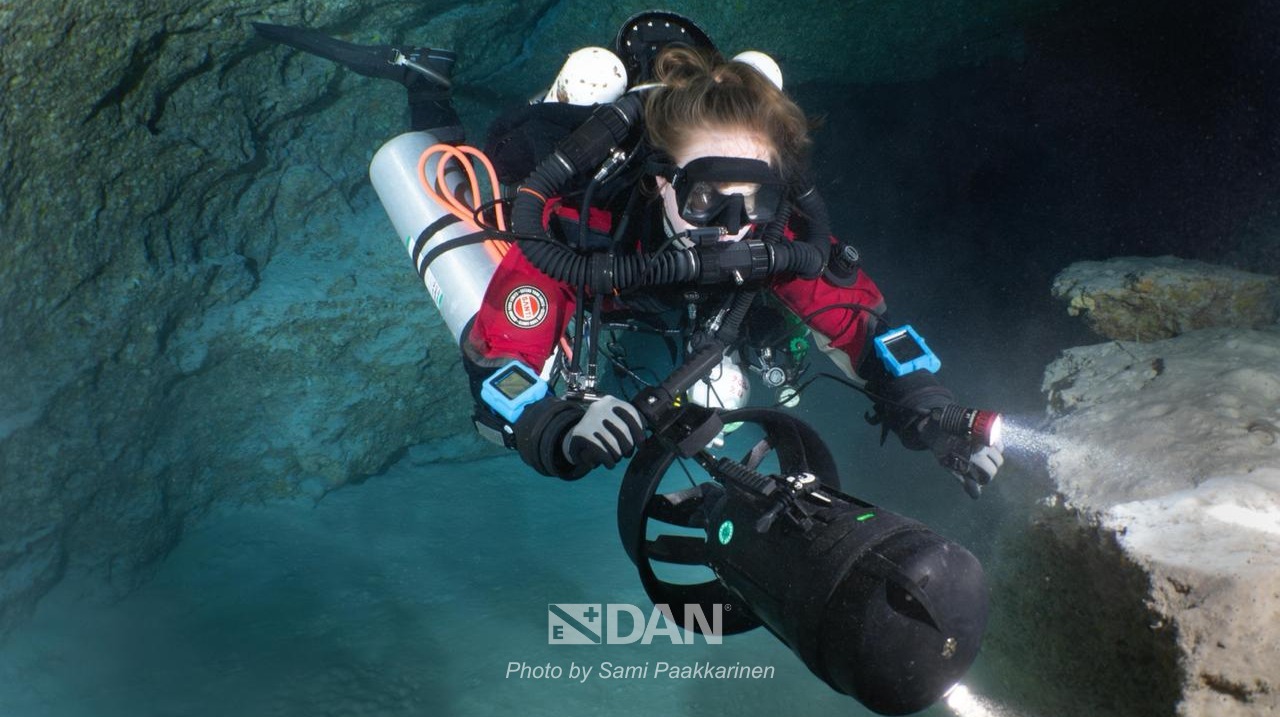
First pictures from the cave rescue as one of the team passes through the entrance (Photo: Sami Paakkarinen/DAN Europe)
Mr. Vanin was a passenger on the same liveaboard vessel, the Duke of York, as Professor Monica Montefalcone—a professor of ecology at the University of Genoa and one of the five divers who perished inside the cave.
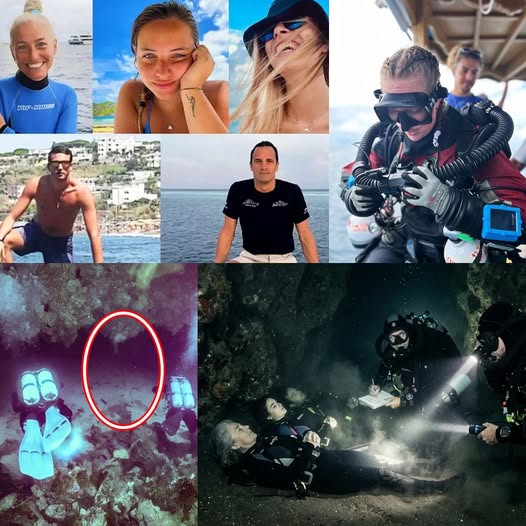
The identities of the dive team members reported missing and subsequently confirmed deceased after the fateful dive on May 14 include:
- Professor Monica Montefalcone (Professor at the University of Genoa)
- Giorgia Sommacal (22, daughter of Professor Montefalcone)
- Muriel Oddenino (Researcher)
- Federico Gualtieri (Research Assistant)
- Gianluca Benedetti (Dive Instructor/Guide)
Tragically, the disaster also claimed the life of a local first responder. Staff Sergeant Mohamed Mahudhee, a rescue diver with the Maldives National Defence Force (MNDF), heroically died from air depletion during the initial search operation shortly after the dive team was reported missing.
Regarding the recovery timeline, instructor and guide Gianluca Benedetti’s body was the first to be located and brought to the surface on the exact day of the incident (May 14). The remaining four victims from the research team were located on May 18 by a team of Finnish technical cave specialists consisting of Sami Paakkarinen, Patrik Grönqvist, and Jenni Westerlund. Deployed by DAN Europe, this specialist squad completed the recovery of the rest of the missing team over the next two days.
2. Digital Devices in Malé and the Tidal Current Debate
In tandem with the devices returned to Italy, Italian authorities have filed official requests with the Maldivian government for access to the GoPro action cameras, dive computers, and other equipment recovered from the bodies by the Finnish team. These items are currently being held by investigators in Malé.
Industry experts note that data extraction from these devices is vital to reconstructing the exact sequence of the tragedy. They provide precise telemetry including absolute depths, detailed timelines, gas consumption rates, and potentially, video footage capturing the disaster as it unfolded. These data streams will help confirm or lay to rest theories regarding whether the team entered the cave voluntarily or were forcefully pushed inside by a violent current.
Based on in-depth interviews with the Finnish rescue team and reporting across Italian media, the most plausible scenario established so far is that the divers deliberately entered the cave and became trapped when they mistook a dead-end tunnel for the exit.
3. A Death Sentence Formed by a ‘Fatal Navigational Error’
In an exclusive interview with Corriere della Sera, cave rescue specialist Sami Paakkarinen firmly challenged the theory that the divers drifted into the cave accidentally or involuntarily:
“It’s a huge cave,” Paakkarinen analyzed. “And besides, in the Maldives, the sun shines up to, I think, 100 metres deep. So at 60 metres it’s still daylight, and when you enter a cave, you know it because it gets dark. You don’t risk accidentally entering a cave.”
Previously, one of the most prevalent theories regarding the cause of death was that the divers were pulled into the cave mouth by heavy currents, generating a Venturi effect that they were physically unable to swim against. The Venturi effect occurs when a fluid or gas flows through a narrow choke point, causing its velocity to increase rapidly while simultaneously dropping the surrounding pressure, creating a severe mechanical suction effect.
This Venturi theory was proposed by Alfonso Bolognini, president of the Italian Society of Underwater and Hyperbaric Medicine, based on architectural sketches of the cave’s entrance. However, Paakkarinen directly refuted this premise based on his real-world field experience at the site:
“I can only comment based on my experience. We experienced these so-called tidal currents. The water moves in this direction for 12 hours and then in the opposite direction for another 12. Continuous currents. So it’s true that there is a current going in and out of the cave. The cave, so to speak, is breathing. But it’s really not very strong. It’s not possible that it sucked anyone in.”
While this does not completely rule out the possibility of the divers being influenced by a current to some degree, the cave’s physical morphology and the terminal location of the bodies strongly indicate that the group voluntarily swam into the deeper second chamber of the system.
4. The Visual Trap of the “Deceptive Sand Wall”
The geometric layout of the Devana Kandu cave has been detailed by the Finnish rescue team and other technical divers who have previously explored it, including Shafraz Naeem, a Maldivian technical diver who has logged dives at this specific site more than 30 times. The cave features a massive, highly visible opening at a depth of 47 meters ($154\text{ ft}$), opening into a spacious and wide First Chamber.
This initial room connects to a deeper Second Chamber via a narrow, S-shaped tunnel measuring roughly 30 meters in length. Laura Marroni, CEO of DAN Europe, stated that the critical hazard materializes precisely at the exit boundary of this S-tunnel as it empties into the second chamber: a dynamic underwater sandbank. This sandbank creates a powerful optical illusion, completely obscuring the true location of the exit corridor when a diver looks back from inside the chamber.
Compounding this hazard, to the left of the true exit corridor sits a secondary opening. This false corridor leads to a smaller Third Chamber, which is actually a complete dead end. This is the exact pocket where the bodies of the four research team members—Monica Montefalcone, Giorgia Sommacal, Muriel Oddenino, and Federico Gualtieri—were ultimately recovered.
Investigators believe that the optical illusion generated by the sandbank, likely exacerbated by a silt blowout of stirred-up sand and fine sediment that choked out visibility, led the divers to mistake this false left corridor for the way out.
“The divers, unable to find the exit corridor, found themselves in a corridor to the left of what would have been the exit, which, however, was a dead end,” explained Laura Marroni. “The bodies of the divers were found all together inside there, as if they had mistaken it for the right one, but there was no way out.”
                    [CAVE MOUTH / ENTRANCE (47m Depth)]
                                    │
                                    ▼
                     [FIRST CHAMBER: Massive, wide clearing]
                                    │
                    (Location of Gianluca Benedetti's body)
                                    ▼
                     [S-SHAPED TUNNEL: 30 Meters Long]
                                    │
                                    ▼
             ┌──────────────────────┴──────────────────────┐
             ▼ (True Exit Route)                           ▼ (Mistaken Turn Due to Illusion)
    [OPTICAL ILLUSION SANDBANK]                   [FALSE LEFT CORRIDOR]
             │                                             │
             ▼                                             ▼
    [DEEPER SECOND CHAMBER]                       [THIRD CHAMBER / DEAD END]
                                                           │
                                                           ▼
                                        (Location of 4 research team bodies)
In stark contrast to the group of four, the body of instructor Gianluca Benedetti was recovered from a completely distinct location: right within the First Chamber of the cave, at the immediate entrance of the narrow tunnel leading to the second chamber. At this time, investigators cannot definitively state whether he was waiting at the mouth of the tunnel for the others to return, or if he was the solitary diver to successfully navigate the true exit corridor before running out of breathing gas just before breaking into open water.
5. Severe Questions Regarding Gas Management and Equipment Profiles
While current reports outline the most mathematically plausible scenario based on preliminary physical evidence, global diving authorities and analysts are raising serious criticisms regarding the gas mixtures and equipment configurations utilized by the team.
Permit logs indicate that three of the five divers held official authorization from Maldivian regulators to dive to 50 meters strictly for marine research purposes. However, according to an investigative report published by La Repubblica, the entire group was diving exclusively on standard 12-liter single cylinders (the baseline standard tank used for shallow recreational sport diving).
Diving safety experts stress that while descending to depths between 50 and 60 meters on standard compressed air ($21\%\text{ O}_2, 79\%\text{ N}_2$) is technically achievable, the psychological and physical impairments of gas narcosis—more accurately termed because oxygen becomes highly narcotic under extreme partial pressures alongside nitrogen—are severely magnified.
To dive safely for any duration beyond the globally accepted recreational threshold of 40 meters—and absolutely anywhere past 50 meters—a diver must utilize Trimix (a specialized breathing gas blending oxygen, nitrogen, and helium) to offset the narcotic depth effects and maintain cognitive clarity for real-time problem-solving.
Furthermore, even if they had been breathing an optimized gas profile, executing a 50-to-60-meter profile on a single 12-liter tank meant that their available bottom time was measured in mere single-digit minutes.
“We’re talking about ten minutes, perhaps even less,” Laura Marroni emphasized. She added that if cascade panic was triggered, this survival window would shrink exponentially. “Realising that the way is not right, and having little remaining air, maybe after going back and forth, terrifies you—then you breathe more quickly and your air supply drops.”
Another systemic safety failure underscored by international technical cave divers is that the research group failed to deploy a guideline of any kind. Running a continuous safety line is an absolute, non-negotiable protocol when entering any overhead or trần kín environment. Had a physical guideline been present at the scene, it almost certainly would have saved their lives.
Conclusion
Official documentation and forensic autopsies are scheduled to take place in Italy as soon as the victims’ remains complete international repatriation protocols. Concurrently, the physical data recovered from the team’s dive computers and GoPro units—should the internal flash memory prove intact and readable—will hopefully allow investigators to stitch together the final missing pieces, providing a definitive, step-by-step reconstruction of this deeply sorrowful tragedy in the Maldives.