THE “SAND WALL” ILLUSION AND THE MOST HORRIFYING DIVING TRAGEDY IN MALDIVES HISTORY
May 14, 2026, will forever be etched into the history of international tourism and scuba diving as one of its darkest milestones. A promising scientific research expedition by leading experts from the University of Genoa (Italy) ended in a horrific tragedy 50 meters beneath the ocean’s surface. Five lives were lost forever in the cold, pitch-black darkness of an underwater cave system in Vaavu Atoll. As international rescue teams gradually unraveled the mystery, the world was left stunned by the terrifying power of nature and the razor-thin line between life and death in a deep watery grave.
Part 1: The Fateful Expedition of the Marine Scientists
The Maldives has long been dubbed a paradise on Earth, home to vibrant coral reefs and crystal-clear turquoise waters. For marine biologists, it is not just a dream holiday destination but an invaluable “natural laboratory” to study the impacts of climate change on marine ecosystems.
In mid-May 2026, a research team consisting of top experts and students from the University of Genoa arrived here aboard the luxury liveaboard Duke of York. Led by Professor Monica Montefalcone (51) — a prominent figure in tropical marine ecology with over 5,000 hours of diving experience — the group planned to survey a rare and threatened coral species. Accompanying her was her 22-year-old daughter, Giorgia Sommacal, alongside two brilliant young marine biologists: Federico Gualtieri (31) and Muriel Oddenino (31). To ensure safety, they hired Gianluca Benedetti (44), a highly experienced local dive instructor well-versed in the challenging waters of the Maldives.
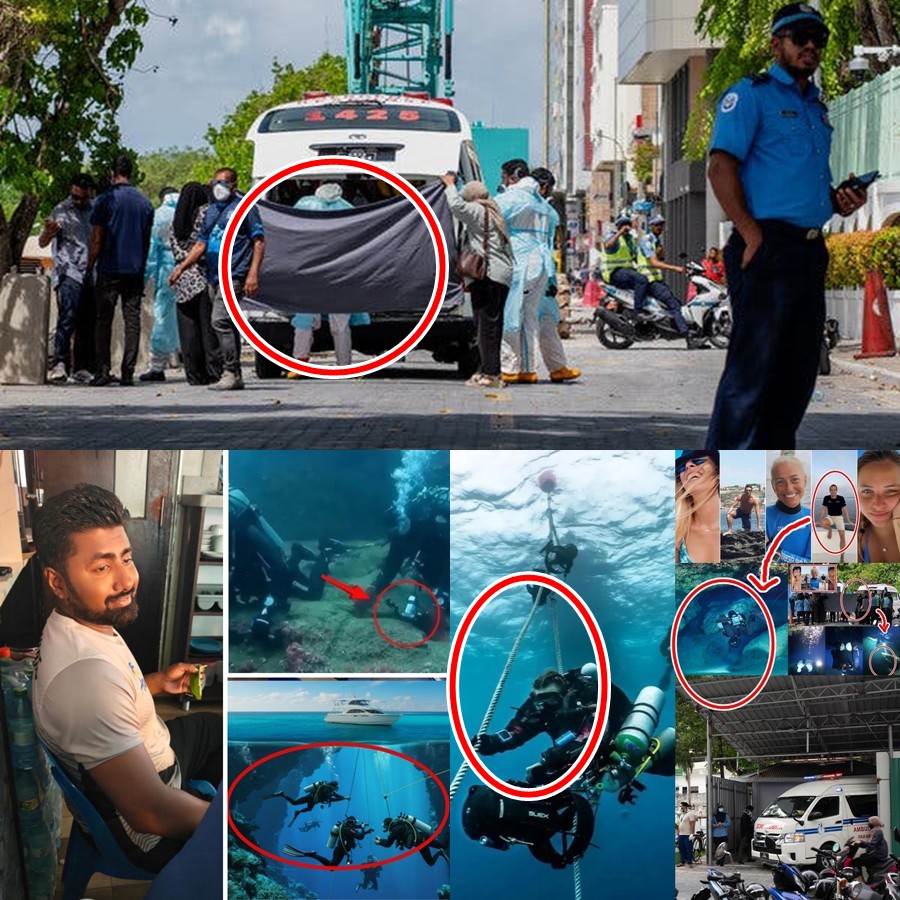
On the morning of May 14, the weather at Vaavu Atoll was eerily perfect. The sea was as flat as a mirror, hiding the deadly traps of the coral reef’s complex cave geography beneath. None of the five members could have anticipated that their decision to dive into the underwater cave system that day would be a one-way ticket to one of the most terrifying scenarios in the diving world.
Part 2: Hell at 50 Meters and the “Sand Wall” Illusion
The cave system where the accident occurred was located roughly 50 meters (164 feet) below the surface — a depth that far exceeds the strict 30-meter limit enforced for recreational diving in the Maldives.
According to technical reports from the recovery teams, the structure of this underwater cave was like a natural labyrinth perfectly designed to trap any creature that entered:
- The Entrance Chamber: Located right at the opening, this was a large, spacious area illuminated by natural sunlight filtering down from the surface, its floor carpeted with fine sand. At this stage, everything was smooth and straightforward.
- The Corridor: Venturing deeper, a dimly lit tunnel stretched nearly 30 meters long and 3 meters wide. Visibility here began to drop but remained manageable with powerful dive lights.
- The Second Chamber: At the end of the corridor sat a massive, circular cavern completely cut off from natural light. The critical hazard lay in between: a massive, submerged sandbank sat directly between the corridor and this second chamber.
On May 21, Laura Marroni, CEO of DAN Europe (Divers Alert Network) — the organization overseeing and coordinating the recovery operation — announced a shocking discovery that explained why the divers became trapped.
Rescue divers revealed that entering the second chamber over the sandbank was relatively easy because the team was moving downward. However, when the group turned around to find their way out, a terrifying optical illusion occurred. Due to the complete absence of light and the angle of the underwater topography, when looking from inside the dark cavern toward the exit, the sandbank appeared exactly like a solid, impenetrable stone wall completely blocking the original passageway.
In near-total darkness, under the faint beam of their dive torches, this “sand wall illusion” completely distorted the divers’ perception. Believing their original path had collapsed or that they had taken a wrong turn, they scrambled for an alternative. To the immediate left of the sandbank lay a second side corridor extending several dozen meters. Mistaking this for the actual exit route, the five divers made a fatal decision: they swam deeper into the side passage. Tragically, it was a dead-end.
[Chamber 1: Bright] ──> [30m Corridor] ──> [SUBMERGED SANDBANK] ──> [Chamber 2: Pitch Black]
                                                                          │
                                               (Mistaken for the exit) └──> [DEAD-END PASSAGE]
                                                                            (5 bodies recovered)
Part 3: Moments of Pure Panic in the Deep Darkness
To comprehend the sheer terror of the victims’ final moments, one must look at the physics of air consumption at a depth of 50 meters.
The Italian group was reportedly using standard single 12-liter aluminum tanks meant for basic recreational diving. At 50 meters deep, under an atmospheric pressure of 6 ATM, a standard tank drains six times faster than it does at the surface. The safe exploration time at this extreme depth is a mere 10 minutes or less. They were not equipped with redundant double tanks, they were not breathing Trimix gas blends, and most crucially, they had not deployed a guideline — the absolute golden rule of cave diving used to navigate back to safety.
Laura Marroni explained heartrendingly:
“If they realized they had gone the wrong way while already running low on air, the situation would have become terrifying very quickly. At that depth, panic triggers a biological response that causes the heart rate to skyrocket and breathing to accelerate. You will drain your remaining oxygen in just a few short minutes.”
Imagine the nightmare scenario: five divers packed into a tight rock crevice, watching their pressure gauges rapidly plummet toward zero. As they scrambled in confusion, their fin kicks and exhaled exhaust bubbles disturbed the delicate silt and sediment on the cave floor. Within seconds, visibility dropped to absolute zero. The space became a soup of blinding black mud. Even the most powerful dive lights were rendered useless against the “mud wall.” In the eerie silence of the deep ocean, the only sounds were the frantic pounding of their own hearts and the dry rasp of regulators starving for air. They huddled together in desperation. All five bodies were later recovered clustered in the same spot inside the dead-end passage — a haunting testament that they stayed together, sharing their final breaths until the very end.
Part 4: Expert Debate and the Heavy Price Paid
Immediately following the tragedy, several theories emerged. Dr. Alfonso Bolognini, President of the Italian Association of Underwater and Hyperbaric Medicine, initially speculated that the group might have been pulled deeper into the cave by the “Venturi effect” — a physical phenomenon where water accelerates violently through narrow spaces, creating intense suction forces that could overpower a diver.
However, this theory was firmly rejected by Sami Paakkarinen, a veteran Finnish rescue diver who was part of the technical team that retrieved the bodies. Paakkarinen stated that the current inside the cave was mild, predictable, and reversed direction every 12 hours with the tide. “It wasn’t strong enough to pull anyone in. This was purely a tragic accident caused by disorientation, topography, and panic,” he stated bluntly.
The tragedy did not stop with the deaths of the five Italian nationals. The ocean claimed yet another life: Mohamed Mahudhee, a Maldivian military diver. In a desperate bid to search for the missing tourists in the initial days of the operation, Mahudhee suffered severe decompression sickness (the bends) after ascending too rapidly from the dangerous depths and tragically died in the line of duty.
Currently, the Maldivian government has indefinitely suspended the operating license of the luxury vessel Duke of York to facilitate a comprehensive investigation into whether there was negligence on the part of the dive operators. GoPro cameras recovered from the victims’ bodies have been sent to forensic specialists for data recovery, with the hope of reconstructing the exact timeline of their final moments in the dark.
Part 5: A Grim Wake-Up Call from “Tourist Paradise”
Cave diving is universally categorized by international sports organizations as one of the most dangerous disciplines on the planet. Unlike open-water diving, cave diving completely removes a diver’s ability to make an emergency swimming ascent to the surface. Above their heads sit tons of solid rock. The only way out is the way they came in.
Statistics over the past six years in the Maldives — an island nation comprised of 1,192 coral islands — have recorded at least 112 tourist deaths linked to marine activities. Among these, 42 cases involved scuba diving or snorkeling accidents. These chilling numbers serve as a massive red flag regarding the oversight and regulation of adventure tourism in tropical hotspots.
Maldives Marine Tourism Fatalities (Past 6 Years):
┌─────────────────────────────────────────────────────────┐
│ Total Casualties: 112 deaths                            │
├──────────────────────────────┬──────────────────────────┤
│ Scuba/Snorkeling Accidents   │ Other Marine Activities  │
│ 42 Cases (37.5%)             │ 70 Cases (62.5%)         │
└──────────────────────────────┴──────────────────────────┘
The deaths of Professor Monica Montefalcone, her daughter, and their colleagues are an irreplaceable loss for their families and a profound blow to the scientific community at the University of Genoa. Above all, the disaster at Vaavu Atoll stands as a stark, bloody lesson for anyone exploring the underwater world: complacency, overconfidence, or violating safety limits in the face of nature will cost you your life.
Fifty meters beneath the Maldivian waves, that “sand wall” remains, silent and cold — a stern reminder from the ocean to mankind: respect the deep, before it is too late.