LATEST UPDATE: DEFENSE RESTS, JURY PREPARES TO DELIBERATE IN THE FATAL STABBING OF A 17-YEAR-OLD AT A TEXAS TRACK MEET
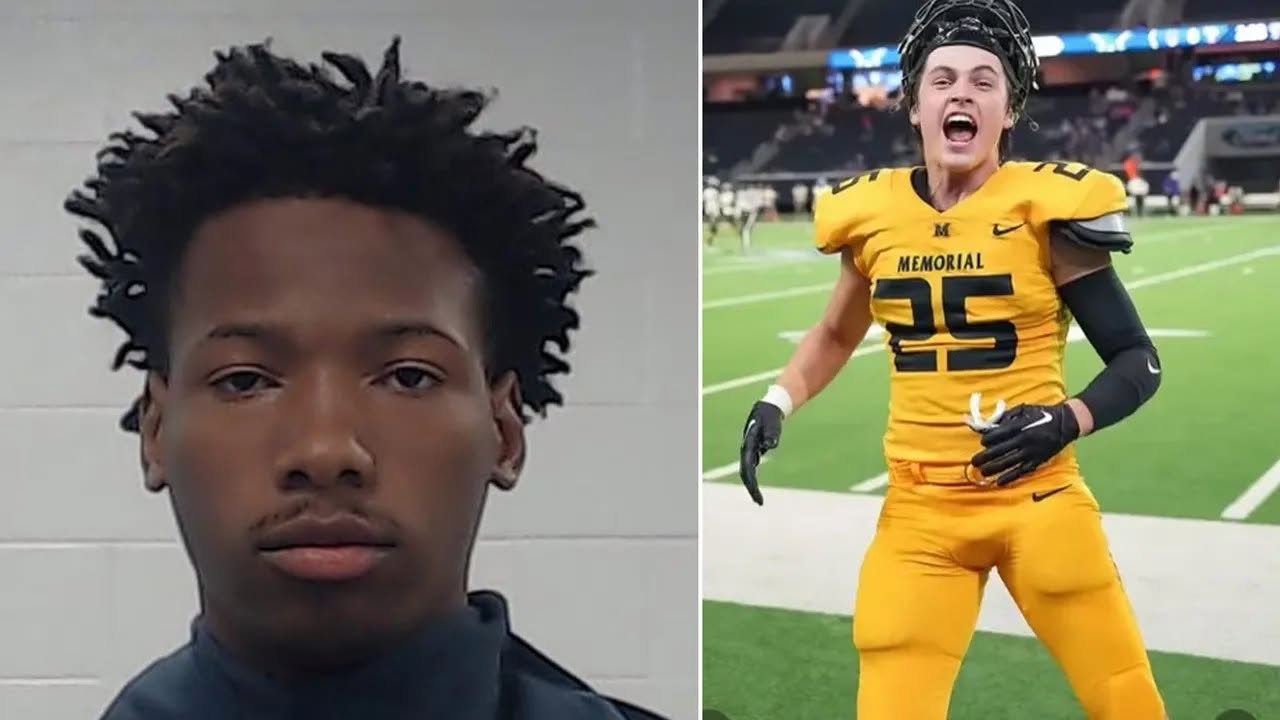
FRISCO, Texas – The highly publicized murder trial of Karmelo Anthony, accused in the fatal stabbing of 17-year-old Austin Metcalf at a high school track meet, has reached a critical turning point.
Following days of intense testimony, Anthony’s defense team has officially rested its case. The presiding judge dismissed the jury for the day to prepare for closing arguments, which are scheduled to begin on Tuesday morning.
The tragedy occurred last year at Kuykendall Stadium when Anthony, who was 17 at the time, allegedly stabbed and killed 17-year-old Austin Metcalf. Investigators say the fatal confrontation began under a team tent where athletes had gathered to seek shelter during inclement weather and ended when Metcalf was stabbed in the chest. Although Anthony was a juvenile at the time of the incident, he is being charged and tried as an adult.
The Legal Battle Over “Self-Defense”
Throughout the trial, Karmelo Anthony and his defense team have firmly maintained that he acted in self-defense. The defense sought to prove that Anthony panicked and felt threatened when a physical altercation erupted within the cramped confines of the team tent.
However, prosecutors have aggressively pushed back, portraying Anthony as the primary aggressor. According to investigators, Anthony refused to leave the rival team’s area despite multiple warnings, escalating the tension before pulling out a knife and stabbing Metcalf in the chest, causing fatal injuries.
A Strategic Move: Defense Requests Jury to Determine Sentencing
If found guilty by the jury, Anthony faces a severe sentencing range of five years to life in prison.
In a notable legal development just before resting their case, Anthony’s defense attorneys filed a specific request: They have asked that the jury, rather than the judge, determine the actual sentence in the event of a conviction.
Legal experts view this as a tactical calculation by the defense, hoping that a panel of ordinary citizens might offer a more lenient or sympathetic sentence compared to the strict statutory applications typically handed down by a judge.
Critical Hours Ahead
With the judge dismissing the jury for the day, all eyes are now on Tuesday morning’s proceedings.
- Closing Arguments: Both the prosecution and the defense will deliver their final, compelling summaries, tying together all evidence to make their ultimate case to the jury.
- Deliberation: Immediately following closing arguments, the 12-member jury will be sequestered to deliberate. They must reach a unanimous decision to deliver a final verdict of either guilty or acquitted.
allas, Texas, opened up into a torrential downpour. For the hundreds of high school students participating in the inter-school track meet that day, the rain was a major inconvenience, forcing them to huddle together under mobile team tents for shelter. But no one could have anticipated that the cramped space beneath one of those pop-up tents would become the scene of a horrific homicide—one that would claim the life of a 17-year-old boy and land an 18-year-old in the dock facing first-degree murder charges.
More than a year after the tragedy, the murder trial of Karmelo Anthony (now 19) at the Collin County Courthouse is heading into its tense final stages. The case has not only sent shockwaves through this peaceful suburban community but has also ignited fierce debates over the razor-thin line between “justifiable self-defense” and “intentional murder,” while exposing chilling loopholes in Texas weapon laws.
1. The Fateful Rain and the Tension Under the Tent
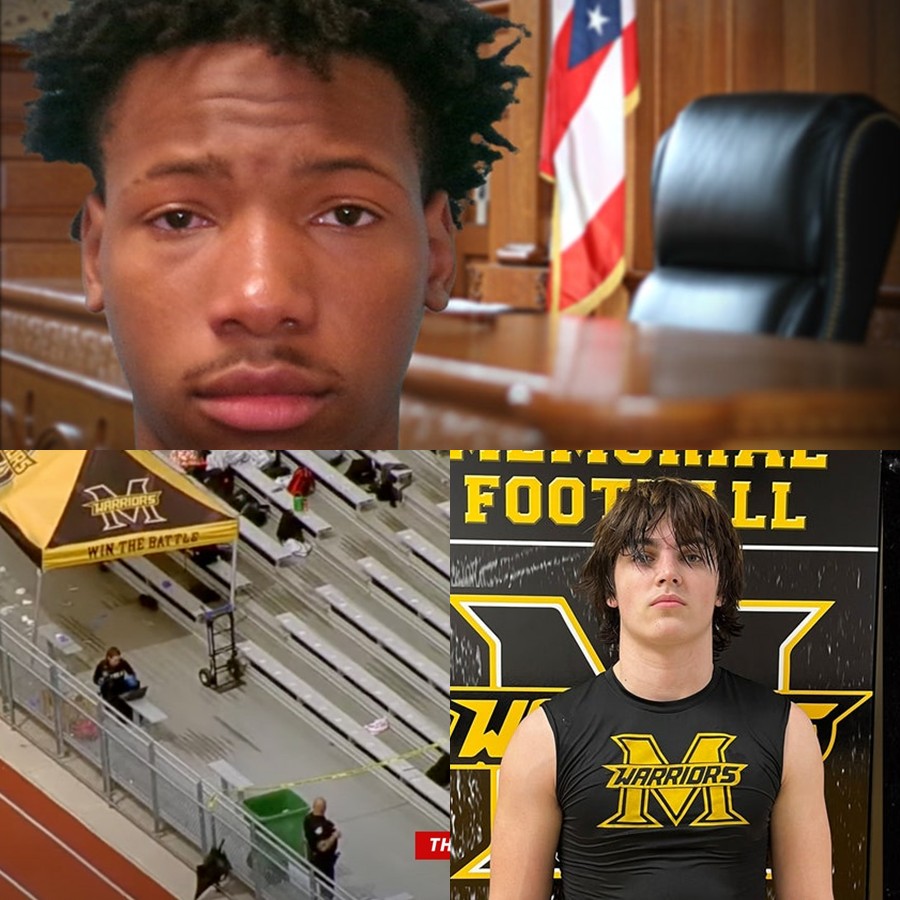
To understand the core of the case, investigators had to dissect every single second of the afternoon of April 2, 2025. The victim was Austin Metcalf, 17, a promising track star at Frisco Memorial High School. The defendant was Karmelo Anthony, 18, a student from rival school Frisco Centennial High School. The two schools sit just a few miles apart, and their students frequently crossed paths in scholastic sporting events.
As the heavy rain battered the stadium, Anthony walked across the field to meet a friend. He stepped underneath the team tent belonging to Frisco Memorial High School. It was this single action that triggered an irreversible chain of events.
According to prosecutors, the appearance of a rival school student in their technical area made the Memorial athletes uncomfortable. Austin Metcalf, along with his twin brother Hunter Metcalf, approached Anthony and asked him to leave. Prosecutors assert that Anthony was not only uncooperative but also hurled taunts and insults at the other students. The space beneath the tent grew increasingly suffocating as the verbal altercation escalated into physical shoving and jostling.
Within a few brief seconds, a trivial dispute between teenagers spiraled into a bloody catastrophe. Anthony abruptly reached into his backpack, pulled out a pocketknife, and delivered a fatal, single stab wound directly into Austin Metcalf’s chest.
Stunned witnesses testified that after being stabbed, Austin could only lift his rain-soaked shirt, uttering his final words, “I got stabbed,” before collapsing onto the muddy ground. Despite receiving immediate first aid from stadium medical staff and being rushed to the nearest hospital, Austin Metcalf succumbed to the wound that pierced his heart. Anthony was apprehended by police at the scene in a state of panic.
2. The Courtroom Battle: “Self-Defense” or “Aggression”?
The trial unfolding in Collin County in June 2026 has become a breathtaking battle of wits between the prosecution and the defense, offering two diametrically opposed perspectives on the exact same event.
The Defense’s Argument: Fear and the Right to Self-Defense
Karmelo Anthony’s defense team built their entire strategy around the concept of “Self-defense.” They sought to portray Anthony as an isolated young man, surrounded and threatened by a large group of hostile students from a rival school.
According to the defense’s argument, it is entirely normal for athletes to mingle and move between team tents during a track meet, meaning Anthony’s presence could not be construed as “criminal trespass.” When Anthony entered the tent, he was approached by the Metcalf brothers and other boys with an aggressive attitude. The defense argued that Anthony was shoved, cornered in a confined space, and fell into a state of panic, fearing for his life. The knife was drawn not to attack, but as a natural reflex of a teenager who felt he had no way out.
The Critical Turning Point: A “Legal” Knife
One of the most notable moments of the trial occurred when the defense called Detective Beau Riley, a member of the Frisco Police Department’s Crimes Against Children unit and one of the first responders to the scene.
Before the jury, Anthony’s attorney had Detective Riley confirm a startling legal reality: The knife Anthony carried and used to fatally stab Austin Metcalf was completely legal to possess in the state of Texas. Furthermore, under current state law, bringing this knife inside a public stadium at that time did not constitute a criminal offense.
This is because Texas remains one of the states with some of the most relaxed weapon laws—covering both knives and firearms—in the United States. The defense fully leveraged this detail to convince the jury that Anthony harbored no “malice aforethought.” He did not intentionally smuggle a banned weapon into a school event with the intent to kill; the knife was simply a legal, personal item he routinely carried in his backpack every day.
The Prosecution’s Argument: The Initial Aggressor
Conversely, Collin County prosecutors painted a completely different picture. They rejected the self-defense narrative, asserting that Anthony was the aggressor from start to finish.
The prosecution emphasized that Anthony had been asked to leave the Memorial team tent area not just once, but multiple times by the students who rightfully occupied that space for the competition. Instead of leaving peacefully, Anthony chose to stay, using provocative language to escalate tensions. The prosecutor argued: “You cannot walk into someone else’s house, refuse to leave, provoke a fight, and then pull out a knife to stab an unarmed child to death and call it self-defense.”
To reinforce this point, the prosecution presented medical evidence showing that the stab wound was delivered with immense, decisive force directly into the victim’s vital organ, demonstrating a calculated outburst of violence rather than a panicked swipe meant to intimidate.
3. The Shift in Witness Testimony and the Defendant’s Silence
During the intense cross-examinations in the first week of June 2026, the defense’s strategy suffered severe blows from digital evidence presented by law enforcement.
The Collapse of Defense Witnesses
The defense called a 17-year-old track athlete to the stand. The witness testified that from his position near the stadium gates, he saw a chaotic scene unfolding in the bleachers and team tent area: “Everybody was standing up and I saw somebody get pushed or get punched, I don’t know which.” This testimony was intended to bolster the theory that Anthony was subjected to physical violence before deploying his knife.
However, during cross-examination, prosecutors spectacularly turned the tables. They introduced high-definition surveillance footage retrieved from the stadium’s security system. The video proved that at the moment the stabbing occurred, the 17-year-old witness was actually standing on an entirely different part of the field warming up, his line of sight completely blocked by barricades and crowds. Faced with irrefutable evidence, the witness was forced to admit to the court that he did not remember the details accurately and was partially “guessing” based on subsequent rumors.
Similarly, Detective Beau Riley had previously testified that he conducted a thorough digital forensic review of the phone, camera roll, text messages, and Snapchat account of another student who had spoken to Anthony before the incident. The data analysis yielded absolutely no evidence of any pre-planned bullying or threats targeting Anthony. This completely dismantled the defense’s narrative that Anthony was the victim of a coordinated, mob-style ambush.
Karmelo Anthony’s Right to Remain Silent
On Monday, June 8, 2026, the trial reached a crescendo of drama when it came time for the defendant to exercise his right to take the stand and tell his story directly to the jury. This was Anthony’s sole opportunity to explain the “fear” he felt on that fateful day.
However, after a lengthy private consultation with his attorneys, Karmelo Anthony invoked his right to remain silent. Under the U.S. Constitution, a defendant has the right against self-incrimination, and this silence cannot be interpreted as an admission of guilt. Nonetheless, legal analysts noted that Anthony’s decision not to face sharp cross-examination from prosecutors indicated the defense knew they were on shaky ground, and letting Anthony speak posed too many risks. The defense officially rested their case without putting the defendant on the stand.
4. The Social Media Storm and a Stern Warning from the Bench
The murder case in Frisco did not stop at the courtroom doors. Over the past year, it has been swiftly swept into a toxic vortex of social and political debates online.
Due to the sensitive racial dynamics involved—the defendant, Karmelo Anthony, is Black, while the victim, Austin Metcalf, was white—the case has been weaponized by extremist groups on the internet to incite racial animosity. Various right-wing and left-wing online factions have continuously pushed curated, false information to manipulate public opinion.
The social media hysteria reached an alarming peak in early June 2026, when a social media influencer named Jake Lang was arrested by Frisco police. Lang had intentionally trespassed into David Kuykendall Stadium—which remains partially cordoned off for legal proceedings—to film sensationalized videos, searching for fabricated bloodstains to drive engagement on his personal accounts.
Faced with severe information chaos that could compromise the objectivity of justice, Presiding Judge John Roach Jr. issued an unprecedentedly stern warning to the members of the jury before dismissing them:
“For your virtue and your dedication to justice, I direct you explicitly that no one is permitted to go on social media, read articles, or watch video commentaries about this case. The only things you are to listen to and rely upon are the legal evidences presented right here inside this courtroom.”
5. Awaiting the Final Verdict
On Tuesday, June 9, 2026, the trial will move into closing arguments. This will be the final opportunity for prosecutors to summarize Anthony’s alleged crime and for defense attorneys to make a final plea based on a citizen’s right to self-defense. Following that, Karmelo Anthony’s fate will rest entirely in the hands of a 12-member jury. They will be sequestered in the deliberation room until they reach a unanimous verdict.
If convicted of first-degree murder, Anthony faces up to life in prison, with a minimum of 30 years before becoming eligible for parole, or a maximum sentence of up to 99 years.
Regardless of the court’s verdict in the coming days, this case leaves behind profound grief and a sobering lesson for society. One family has permanently lost a 17-year-old son right on the precipice of adulthood; another family must watch their child’s future vanish behind prison bars. The tragedy in Frisco serves as a costly reminder of the devastating consequences when the ego and impulsivity of youth are backed by the availability of lethal weapons under the guise of being “legal.” Behind the torrential rain that day in Texas, there are no winners—only lives that have been shattered forever.