BEHIND THE VIRAL PHOTO AND KARMELO ANTHONY’S 35-YEAR PRISON SENTENCE: WHEN MEDIA BIAS COLLIDES WITH LEGAL REALITY
The case of Karmelo Anthony, a Black high school student who fatally stabbed White student Austin Metcalf during a school track meet in Frisco, Texas, in 2025, once became a flashpoint that shocked the United States.
Most recently, a major legal turning point unfolded in a Collin County courtroom, where a jury officially sentenced Anthony to 35 years in prison.
At the same time, while decisive courtroom proceedings were taking place, social media once again erupted in fierce controversy over an old photograph that resurfaced online: a picture showing Karmelo Anthony holding a black firearm in one hand while raising his middle finger defiantly with the other.
The image quickly became a powerful weapon in the court of public opinion, dividing internet users into two deeply opposing camps.
What is the truth behind this provocative photograph? And what does the newly imposed 35-year sentence reveal about the legal boundary between self-defense and intentional homicide?
This article examines the case in depth and unpacks the layers of facts behind the controversy.
Part 1: The “Gun-and-Middle-Finger” Photo — The Spark That Sent Social Media Into Overdrive
As Karmelo Anthony’s trial entered its most critical stage, a close-up image of the teenager posing with what appeared to be a weapon while making an obscene gesture spread rapidly across platforms including X (formerly Twitter), TikTok, and Facebook.
Because the image surfaced at such a sensitive moment, it immediately became the center of two sharply opposing narratives.
Viewpoint One: “A Clear Reflection of a Violent Character”
For critics of Anthony, the photograph seemed to provide the clearest explanation for what happened at the Frisco track meet in April 2025.
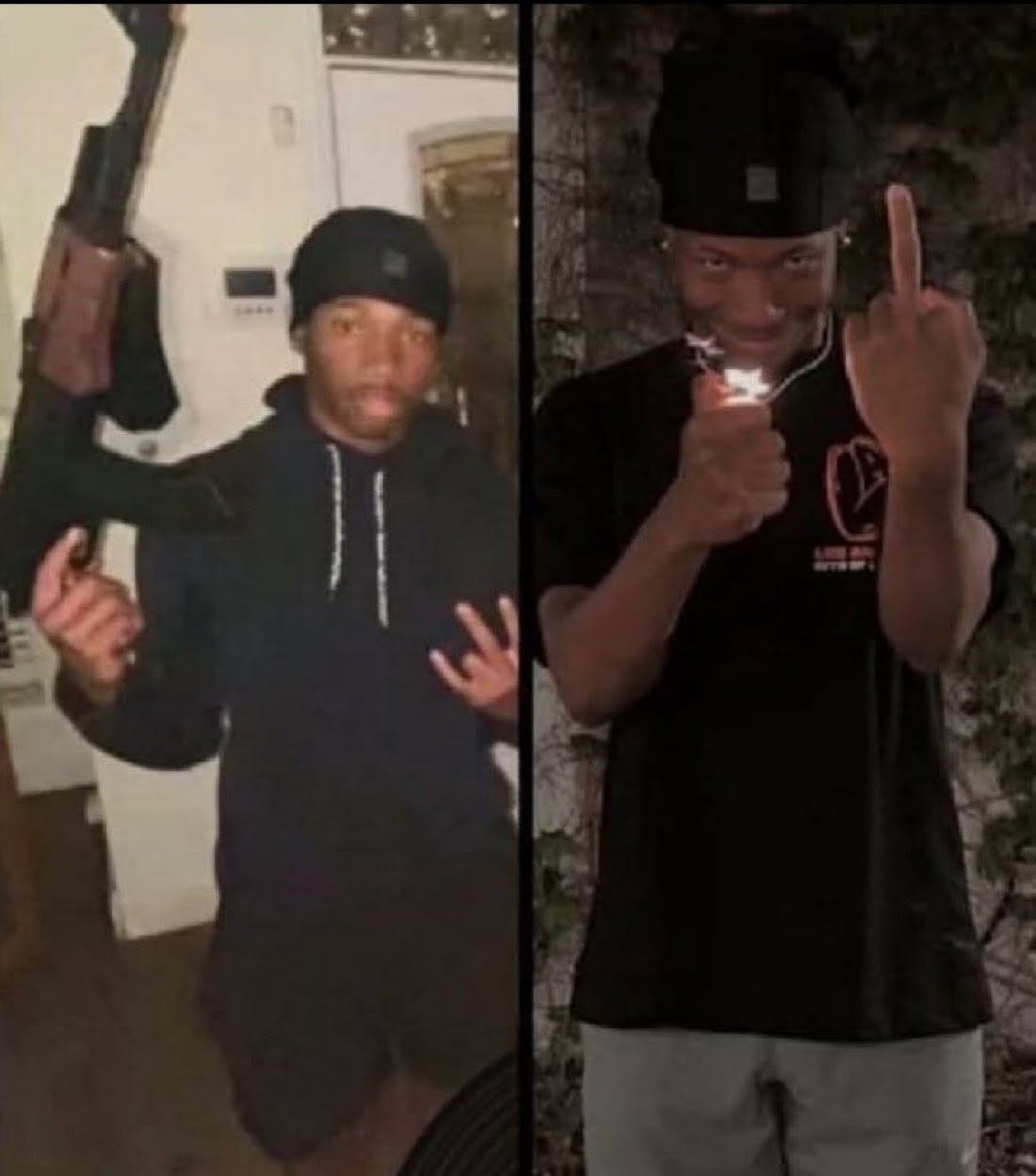
They argued that the image of a teenager posing with a gun and displaying an offensive gesture demonstrated that Anthony was not the innocent victim or well-behaved young man that his family and attorneys attempted to portray in court.
Many believed that the apparent glorification of weapons, fascination with violence, and reckless attitude displayed in the image reflected the same mindset that ultimately led him to pull out a knife during a confrontation and fatally stab another student.
To these observers, the photograph served as indirect evidence of Anthony’s character.
Viewpoint Two: “A Smear Campaign Driven by Racial Bias”
On the other hand, Anthony’s supporters and various social justice advocates strongly objected to the use of the image as a tool for shaping public opinion.
They argued that the photograph was simply an example of “clout-chasing” behavior that has become common among American teenagers, many of whom imitate the aggressive styles of rap artists and social media personalities to project a certain image.
Supporters accused extremist online groups of deliberately digging up an old photograph without providing proper context in order to portray Anthony as a violent Black gangster rather than a teenager involved in a complex criminal case involving claims of self-defense.
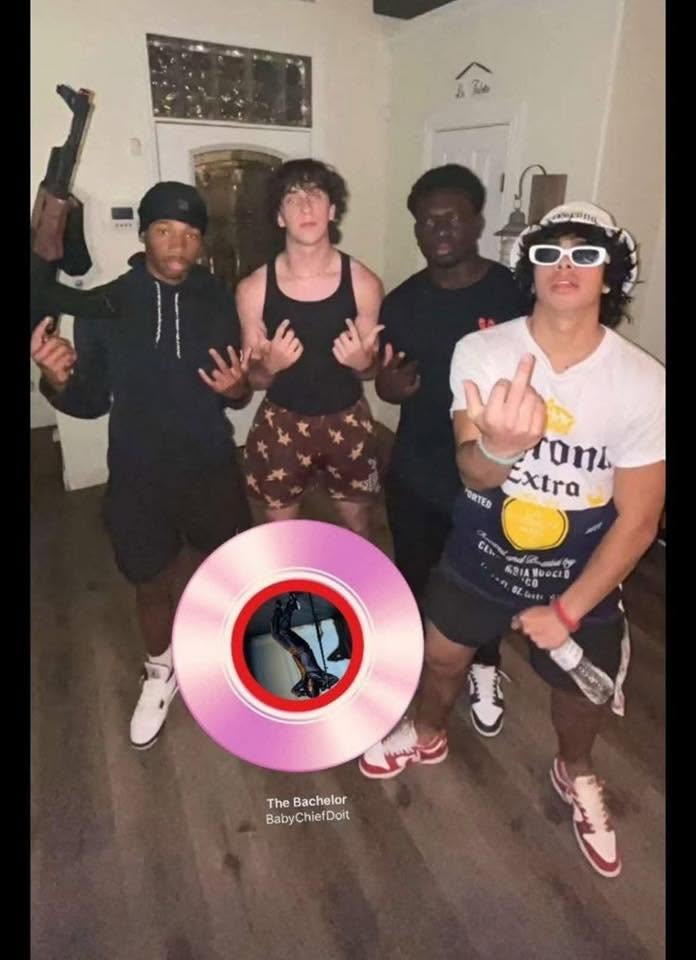
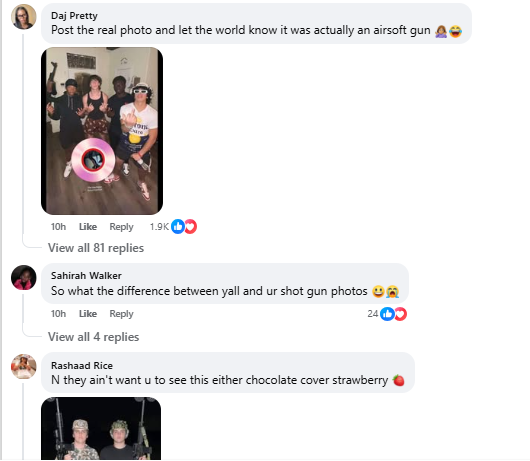
Post the real photo and let the world know it was actually an airsoft gun
According to this perspective, the image was being weaponized to influence public sentiment and place pressure on the jury.
Part 2: Uncovering the Truth About the Weapon in the Photo and the Missing Context
As criticism surrounding the photograph intensified and concerns grew that Anthony’s right to a fair trial could be compromised, sources close to the case and legal-defense fundraising groups for his family offered a more detailed explanation.
The Key Fact: The Weapon Was Not a Real Firearm
According to those sources, the weapon seen in the photograph was not a real firearm at all. It was reportedly an Airsoft gun, a replica weapon that fires plastic pellets and is commonly used in recreational shooting games.
In Texas, it is generally legal for teenagers to own, purchase, and pose with Airsoft guns. Such items are not classified as deadly firearms under the law.
Supporters argued that many social media accounts intentionally omitted this context, labeling the object as a “real gun” and creating a misleading narrative that dramatically altered public perception.
While the act of raising a middle finger may be viewed as offensive or immature, supporters contended that it carries no legal significance and cannot be used to establish that someone is capable of committing murder.
In their view, social media stripped the image of its original context and transformed what may have been a reckless teenage photo into a highly damaging piece of pseudo-evidence in the eyes of the public.
Part 3: The Latest 35-Year Sentence — A Firm Verdict from the Courtroom
While online debates raged across social media, the justice system proceeded on the basis of legal evidence rather than public opinion.
The trial of Karmelo Anthony, now 19 years old, officially concluded in Collin County with a sentence that sent shockwaves through the nation: 35 years in prison for murder.
Dramatic Court Proceedings: The Self-Defense Argument Fails
The incident occurred on April 2, 2025, inside the Memorial High School team’s tent during a track-and-field event in Frisco, Texas.
According to witness testimony and prosecutors’ evidence, Anthony, who was not a student at Memorial High School, entered and remained inside the team’s tent.
Austin Metcalf, 17, along with several other students, repeatedly asked Anthony to leave.
What began as a verbal confrontation quickly escalated into a physical altercation.
Prosecutors argued that Anthony then reached into his bag, pulled out a folding knife, and stabbed Metcalf, causing fatal injuries.
During the trial, defense attorney Mike Howard vigorously argued that Anthony acted in self-defense.
The defense maintained that Anthony was forced to react in a split second of fear and confusion after being shoved to the ground by Metcalf, who was physically larger than him, inside the confined space of the tent.
The jury, however, ultimately rejected that argument.
Prosecutors successfully persuaded jurors that Anthony’s act of drawing a knife and stabbing directly into a vital area demonstrated intent and awareness of the likely consequences.
As a result, jurors concluded that the evidence satisfied the legal elements of murder rather than a lesser offense such as manslaughter.
The Legal Battle Over “Sudden Passion”
Under Texas law, a defendant convicted of murder may receive a significantly reduced sentence if the defense proves that the killing occurred under a state known as “Sudden Passion.”
This legal concept refers to a situation in which a person becomes so emotionally overwhelmed, frightened, or provoked by the victim’s actions that they lose the ability to exercise normal judgment.
If accepted, the punishment range can be reduced dramatically.
The trial judge allowed the jury to consider whether Anthony qualified for this mitigating circumstance.
After approximately two and a half hours of deliberation, jurors rejected the Sudden Passion claim.
They determined that Anthony’s response exceeded what would reasonably be expected in a self-defense situation.
With the statutory punishment range extending from five years to life imprisonment, the jury ultimately imposed a sentence of 35 years, reflecting what they viewed as an appropriate balance between accountability and justice.
Part 4: The Heartbreaking Pain of Two Mothers and the Shadow of Race Over the Case
The sentencing hearing was not merely about determining punishment under the law. It also exposed the devastating human cost left behind by the tragedy.
A Mother’s Tearful Plea for Mercy
During the sentencing phase, the defense called only one witness: Kayla Hayes, Karmelo Anthony’s mother.
Standing before the jury, Hayes broke down in tears as she pleaded for leniency.
“He is my oldest child, my firstborn. He will always be my baby. I love him so much,” she said. “I know my son. He is truly sorry and deeply remorseful for what he has done. Please show mercy to my son.”
Seated at the defense table, Anthony was visibly emotional and reportedly cried as he listened to his mother’s testimony.
A Life Sentence of Grief for the Victim’s Mother
The courtroom then fell silent as Megan Metcalf, the mother of Austin Metcalf, delivered an emotional victim-impact statement.
Addressing the man convicted of killing her son, she spoke through tears:
“You may have received a 35-year prison sentence. You are still fortunate. I have been given a life sentence—a life that I must live without my son. All I have left now are videos, photographs, and memories of his laughter.”
Metcalf recalled the morning of the track meet, describing how she had prepared snacks for her son and hugged him goodbye before he left home.
She never imagined it would be the last time she would see him alive.
For her, the loss is permanent, and no prison sentence can restore what was taken away.
Racial Tensions Beyond the Courtroom
From the very beginning, the case attracted intense national attention because of its racial dimensions.
Anthony is Black, while Austin Metcalf was White.
The composition of the jury also became a subject of public debate. The jury that delivered the verdict reportedly consisted of White, Asian, and Hispanic members, with no Black jurors serving on the panel.
Outside the Collin County courthouse, more than 200 demonstrators from opposing sides gathered under the Texas summer heat.
Supporters and critics exchanged heated arguments as tensions escalated.
One protester expressed frustration, shouting:
“This entire thing is about racism! Tell me why a Black teenager has to stand before a jury with no Black members. Has a White teenager ever had to face an all-Black jury? Never.”
The emotional scenes outside the courthouse illustrated how deeply the case touched broader social and racial wounds within American society.
Part 5: Lessons About Social Media and the Limits of Public Judgment
Looking back at the entire controversy—from the viral photograph to the 35-year prison sentence—several important lessons emerge about justice, media influence, and public perception in the digital age.
Social Media Narratives vs. Courtroom Reality
The photograph showing Anthony holding what appeared to be a gun and making an obscene gesture became a powerful symbol online.
For some, it represented evidence of violent tendencies.
For others, it demonstrated how easily a single image can be removed from its context and used to shape public opinion.
The courtroom, however, focused on a different set of questions.
Rather than judging Anthony based on an old photograph, jurors examined witness testimony, physical evidence, surveillance footage, and the circumstances surrounding the fatal confrontation.
While social media often rewards emotional reactions and simplified narratives, legal proceedings are designed to evaluate evidence according to established standards and procedures.
The Cost of Actions in the Real World
According to the sentence imposed, Anthony faces decades behind bars and may not become eligible for parole until he has served a substantial portion of his sentence.
Regardless of how one interprets the controversial photograph, the court ultimately based its decision on the fatal stabbing itself rather than on social-media images or public speculation.
The photograph may have represented a moment of youthful recklessness, posturing, or poor judgment.
The fatal confrontation, however, involved irreversible consequences.
Conclusion
The Karmelo Anthony case serves as a powerful reminder of how quickly public opinion can form around incomplete information.
A photograph stripped of context can influence perceptions, fuel outrage, and deepen divisions.
Yet courts are tasked with examining facts, evidence, and legal standards rather than viral narratives.
Whether viewed through the lens of criminal justice, race relations, or media influence, the case highlights the dangers of drawing conclusions based solely on appearances.
Public opinion may be swayed by a single image, but the legal system ultimately seeks to determine responsibility through evidence and due process.
For young people especially, the case stands as a sobering lesson about the consequences of decisions made both online and in real life. What may seem like a fleeting moment on social media can shape perceptions for years, while actions taken in moments of conflict can alter lives forever.