FROM BROTHERS TO STRANGERS: The Dark Truth Behind a Three-Year Silent Stand-off
Chapter 1: The Broken Glass in Seattle
The sound of the Seattle rain from that summer night three years ago still seemed to echo in David’s mind whenever he stood under the spotlight of the jazz clubs in Manhattan. But that night, the sharpest sound hadn’t been the rain pouring down on the tin roof, but the shattering of a glass filled with ice cubes that Mark had slammed against the living room wall.
“You’re being selfish as hell, David!” Mark, who was only 22 at the time, stood panting, his eyes red with anger and disappointment. “Dad has been gone for less than a year. Mom needs help managing the apple orchard in the suburbs. And you? You take all your savings, pack your old Fender guitar, and tell me you have to go to New York because of ‘the calling of art’? You’re abandoning this family!”
David looked at the shattered glass on the floor and tightened the strap of his guitar case. He was 25, carrying the typical ambition of a young American—a burning desire to prove himself on the East Coast, where big dreams were nurtured. “This is my only shot, Mark. Verve Records noticed my demo. If I don’t leave now, I’ll grow old and die with regret in this rainy town.”
“Then go,” Mark said, his voice turning dead cold. “But don’t ever call me your brother again.”
David left. New York welcomed him with cold slaps at first, then rewarded him with belated success. Three years later, David had a small studio apartment in Brooklyn, a few well-reviewed jazz albums on Spotify, and a steady gig schedule. However, while American culture teaches people independence and pride, it also inadvertently creates islands of isolation. Amidst the rowdy after-show parties, David always felt an invisible void. He missed Mark. He missed the nights the two brothers would drink Bud Light on the front porch, listening to the crickets and talking about the NFL.
David tried calling Mark. Ten times. Twenty times. On Thanksgiving, Christmas, and Mark’s birthdays. The only response was a series of long rings that eventually forwarded to voicemail. Mark’s silence persisted, rigid and fossilized into a wall of pride that David could not break through. He thought Mark hated him for leaving the family behind.
Chapter 2: The Nor’easter in New York
Three years later, on a brittle Tuesday in January. David had a special gig at a small lounge in upstate New York. Ironically, this was also around the time Mark had just moved to New York a few months prior to take a job as a logistics engineer—information David only knew from his mother’s choked voice during a hasty phone call. Mark had settled into an old brick apartment building in Astoria, Queens. David knew the address, but pride and the fear of rejection always made him choose a detour to avoid that neighborhood.
That night, the universe decided to deny his avoidance.
A Nor’easter blizzard hit the city much earlier than expected. By the time David packed up his instruments and drove his old Ford Mustang back toward the city center, the snow was falling heavily, erasing road lines and turning the pavement into a dangerous sheet of black ice. The windshield wipers worked at full capacity, but the visibility remained a blur.
And then, just as the car crawled past a quiet street, the dashboard lights suddenly flickered. The engine let out a sharp whine and died completely. The car glided a bit before coming to a halt by the curb, directly under a yellow streetlight besieged by swirling white flakes. David tried to restart the engine. It was useless. The battery had died in the sub-zero temperature.
David stepped outside shivering, the biting winter cold of the East Coast instantly seeping through his wool coat. He looked up at the street sign, then at the vintage red-brick building opposite him. His heart skipped a beat.
Mark’s building.
This ironic coincidence felt like a cruel joke of fate. David was isolated in a rapidly cooling cabin, his phone battery down to 12%. He tried calling AAA for roadside assistance, but the operator line was continuously busy due to the sheer volume of stranded vehicles in the storm. The estimated wait time was four hours. In those four hours, David would certainly freeze.
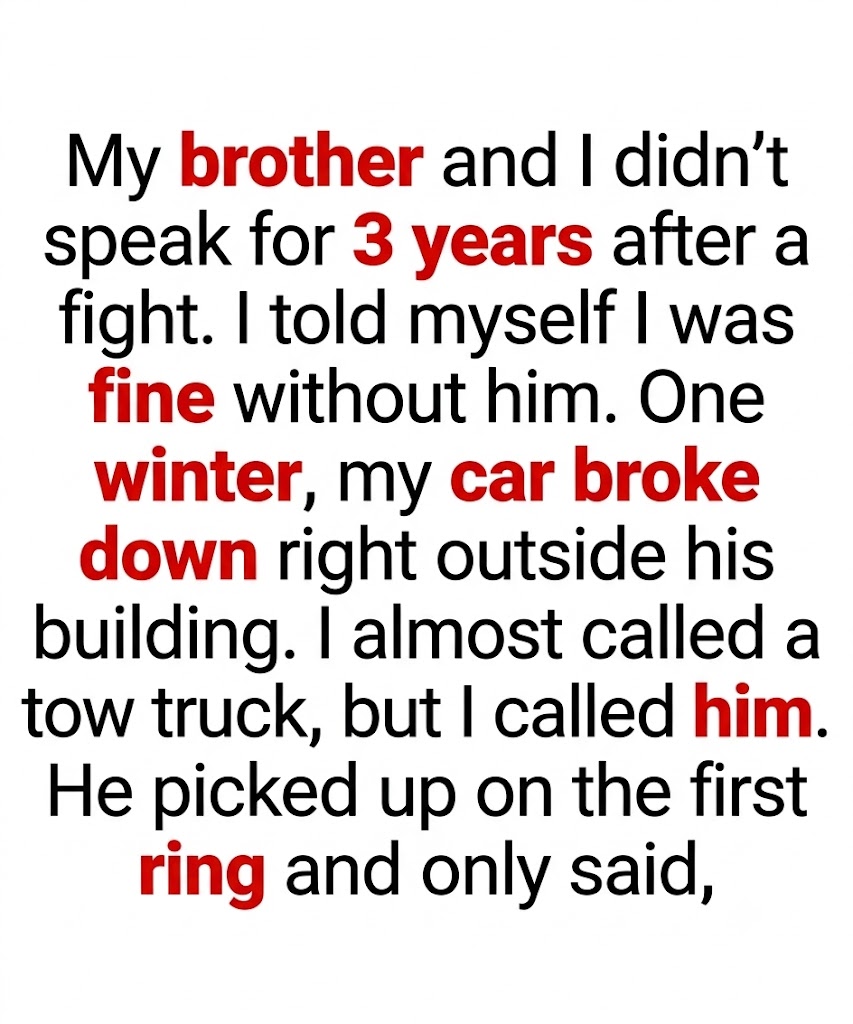
The pride of an American man flared up, tearing at his mind. Knocking on the door or calling the brother he hadn’t spoken to in three years felt like a complete surrender, an admission that said: “Look at me, I left to find glory, and now I’m this pathetic.” But the cold began to numb David’s fingertips. Beneath the layers of polished excuses, he realized that biological death was much closer than the death of his ego.
David took a deep breath, flipped through his contacts, and stopped at the name he had never found the courage to delete: Mark (Bro). He pressed call, bracing himself for a blunt hang-up or a voice full of resentment.
Ring… Ring…
The phone connected. And on the second ring, the other end picked up.
Chapter 3: The Knot Under the Heavy Snow
There was no shouting. There was no prolonged silence.
“David?” Mark’s voice echoed, deeper than it was three years ago, but holding an effortless familiarity that dismantled David’s three years of guarded suspicion in a single heartbeat.
“Mark… My car… it died right in front of your building,” David stammered, partly from the cold, partly from emotion. “The roadside assistance isn’t coming. I really…”
“Stay in the car. Lock the doors. I’m coming down.”
Ten minutes later, the lobby door opened. Mark stepped out in a bulky puffer jacket, holding a set of jumper cables in one hand and a thermos of hot coffee in the other. He didn’t rush in for a hug, nor did he throw any sarcastic remarks. That is the culture of men raised in rural American farmlands—they use action to replace flowery words.
“Pop the hood,” Mark ordered briefly as he approached the car.
David stepped out, and the two brothers stood in the snow, working together to connect the jumper cables from Mark’s pickup truck to David’s car. For an hour of battling frozen bolts and the biting cold, they never mentioned Seattle, the fight, or the three years of silence. They only talked about technical matters, tire pressure, and getting the engine warmed up. Yet, the tension of the lost years was melting away under the weight of logistical hurdles and the shared heat of the coffee cup being passed back and forth.
When the Mustang’s engine finally roared back to life, signaling a return of vitality, Mark unhooked the cables, looked at David, and said, “Come upstairs. You can’t drive back to Brooklyn in this weather. There’s going to be a driving ban in an hour.”
Chapter 4: The Truth in the Cedar Kitchen
Mark’s apartment bore the distinct style of a single American bachelor: a slightly worn leather sofa, a few engineering books, and the faint scent of cedar from a half-burnt scented candle.
Mark handed David a clean sweater and a can of Coors Light. The two brothers sat opposite each other at the kitchen counter. The silence now was no longer terrifying; it was warm and expectant.
“Why did you move to New York?” David spoke first, breaking the ice. “I thought you hated this city. You hated that I left.”
Mark popped open his beer can, watched the bubbles rise, and sighed. This was the moment the knot of the past three years was untied.
“I don’t hate New York, David. And I never hated you for pursuing music,” Mark said, his voice dropping low. “That night, I wasn’t angry because you were selfish. I was angry because I was… terrified.”
David frowned. “Terrified?”
“Dad passed away, and you were the only anchor I had left. When you said you were leaving, it felt like my entire world was collapsing. I used anger to mask my vulnerability. I threw that glass because I wanted you to hold me back, or at least tell me that you would miss me too.” Mark looked up, his gaze direct. “And about the silence for the past three years… Do you know why I never answered your calls?”
“Because you hated me.”
“No,” Mark shook his head, a bittersweet smile appearing on his lips. “Because every time you called, I was staring at the screen, fighting with myself. I got into a prestigious university on the West Coast, but I dropped out halfway through due to depression after Dad died. I had to do manual labor at the orchard to help Mom. At that time, you were shining in New York, appearing in magazines, releasing your own albums. My pride wouldn’t let me pick up the phone and tell my successful older brother: ‘I’m a failure’. I didn’t answer because of my own insecurity, David.”
David was stunned. The beer can in his hand felt frozen. As it turned out, for three years, he had constructed a narrative of hatred, when in reality, it was just two lonely boys trying to protect their bruised egos from each other. They had been pretending that the space between them was an ocean, when in reality, it was just a hallway they were both too afraid to walk down. Mark moving to New York was also his way of proving himself, wanting to stand under the same sky as his brother.
David stood up, walked around the counter, and placed his hand on his brother’s shoulder, squeezing it firmly. “You were never a failure, Mark. You’re the one who kept Mom’s orchard from going under. And tonight, you saved my life.”
Mark looked at his brother, the tears he had held back for three years finally spilling over. He stood up, and this time, the two American brothers embraced tightly—a powerful hug of understanding and forgiveness.
Chapter 5: A Clear Closing – Going Home
The following summer.
Seattle-Tacoma International Airport welcomed two men stepping off a Delta Airlines flight. David carried his guitar case, while Mark pushed the luggage cart.
They had made a clear decision after that winter storm night. David didn’t give up his music, and Mark didn’t quit his job. But they no longer lived in isolation. Every two weeks, Mark would take the train from Queens to Brooklyn to have dinner with David. And this summer, they took time off together to go on a proper American road trip across the country, returning to their hometown of Seattle to visit their mother.
The rented pickup truck rolled down the familiar road leading to the suburban apple orchard. Their mother was already standing on the porch. Her hair had grown grayer, but her radiant smile upon seeing her two sons step out of the car together remained unchanged.
David and Mark looked at each other, then back at the old wooden house. The geographical distance between the East Coast and the West Coast might take five hours by flight, but the distance between the hearts of the two brothers had been permanently closed. They realized that family is not a chain that holds you back, but the safest anchor so that no matter how high or how far you fly, you always know you have a place to return to.