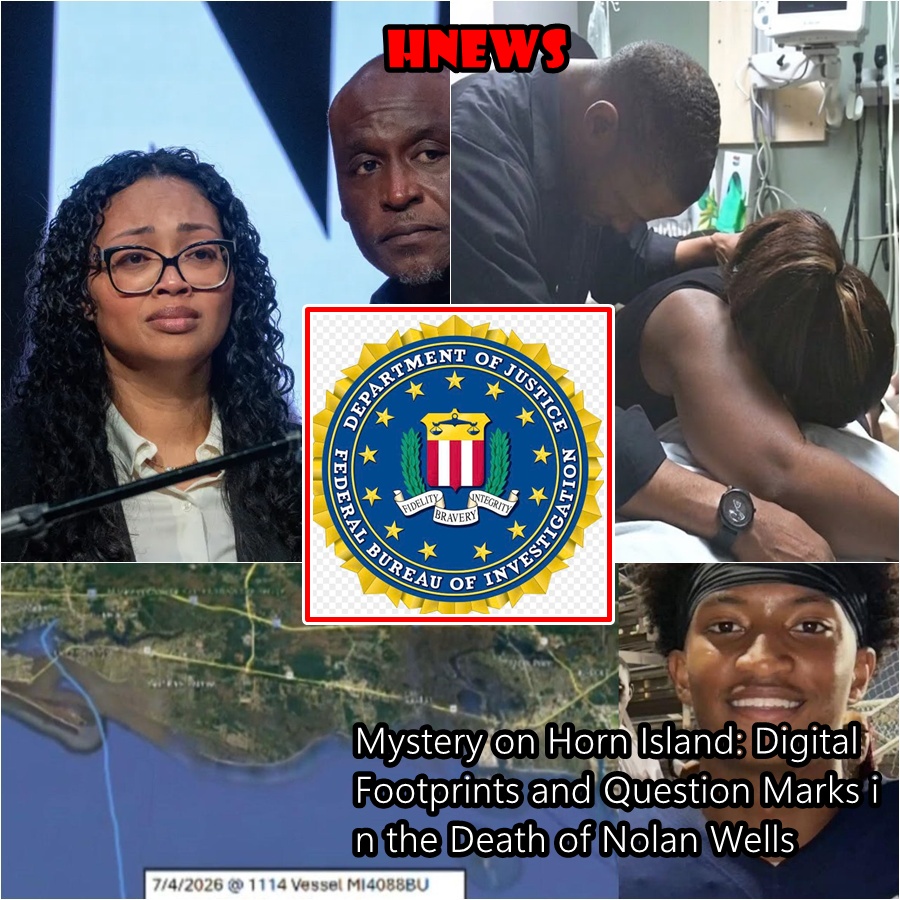
Mystery on Horn Island: Digital Footprints and Question Marks in the Death of Nolan Wells
In the silent graveyard of deleted messages and vanished social media stories, the tragic death of 18-year-old Nolan Wells is slowly transforming into a dark digital thriller of the modern age. It is a haunting case where the facts resist being buried deep underground.
Nolan Wells was once a shining star, a promising football player at a Mississippi community college. However, a fateful trip to Horn Island during the Fourth of July holiday weekend changed everything. The young man was last seen alive on that very day. Just two days later, his lifeless body was recovered from the cold waters near the island.
Although local authorities have not yet issued an official conclusion regarding the cause of death and claim no clear evidence of foul play has been found, the investigation has never cooled down. Both the official autopsy results from the police and the independent examination requested by the victim’s family remain pending.
However, behind the cold and cautious press releases from officials lies a growing nightmare for Nolan’s family. They believe the true answers do not lie in generic, broad statements, but are hidden within “digital breadcrumbs”—invisible traces on the internet that someone deliberately left behind or erased.
The Unusual Silence in the Digital Space
One of the most distressing and suspicious details in the entire case is Nolan’s absolute silence on Snapchat on that fateful day. To those who knew Nolan, this makes no sense at all. He was an extroverted person, always in the habit of constantly updating every moment and activity with his friends on social media. Yet on July 4, his account froze completely: no status updates, no saved photos, and not a single message sent.
It was as if an outside hand had deliberately intervened, actively erasing every trace of the young man’s final hours before disaster struck.
Kieran Ramsey, a former FBI agent and veteran investigator with years of experience hunting America’s most dangerous criminals, noted that the Snapchat platform is far from innocent or “clean” as it appears on the surface. He analyzed:
“In the shadows of disappearing messages, a wealth of evidence often remains. Even when users believe they have permanently deleted content, that data stream still leaves multiple digital layers behind.”
Thanks to emergency data preservation requests sent to Snapchat’s parent tech company, investigators are fully capable of recovering geographic location data (GPS), account activity history, and server records. These fragments of information are like “digital ghosts” that can accurately reconstruct the victim’s final movements while exposing contradictions and lies in the stories of those around him.
Mr. Ramsey emphasized: “I think they’re going to be looking at a lot of that, because you have a timeline that has a lot of contradictions.”
Highly Questionable Accounts and Racial Disparities
Looking back at the events of the night of the incident, the group of friends who accompanied Nolan told police that they had left Horn Island without him. The reason they provided was that Nolan had supposedly met a young woman on the island by chance and decided to split from the group to find his own ride back later.
However, Nolan’s family fiercely rejects this hypothesis. They insist the story is completely fabricated and illogical. For someone with Nolan’s personality, abandoning his friends to go off alone with a stranger in such a remote environment was unprecedented and entirely uncharacteristic.
Suspicion continued to mount when Nolan’s cell phone and personal keys were not actively handed over or returned to the family voluntarily by his friends. Instead, the family and police had to trace and recover them from the hands of others.
Another factor that has drawn significant public attention and pushed the case beyond the boundaries of an ordinary accident is the element of race. Nolan Wells was the only Black member of the group during the trip that day. This disparity has sparked heated and painful debates about underlying racial bias in society.
To seek justice for the young man, prominent civil rights attorney Ben Crump and Reverend Al Sharpton have officially joined the cause, standing shoulder-to-shoulder with the Wells family to demand transparent answers from the authorities. Reverend Sharpton bluntly expressed his skepticism to the media: “This does not smell right.”
The Fight for Truth in Lines of Code
Currently, with the powerful assistance of the FBI in the field of digital forensics, evidence preservation and security requests have been swiftly sent to major tech corporations. If necessary, grand jury subpoenas will be issued to compel parties to hand over deeper secrets hidden behind encryption algorithms.
The most significant step forward this week is that Mississippi authorities and legal representatives for the victim’s family have reached a mutual agreement. Both sides will jointly conduct an extensive and comprehensive examination of Nolan’s personal cell phone.
As investigators begin to meticulously piece together fragments from witness statements, satellite location data, call logs, and the hidden digital footprints left on Snapchat, a terrifying truth is gradually emerging:
The social media app that Nolan once installed on his phone just for fun and to share moments of joy with his friends may now be the only silent witness to his final, fatal moments.
Amidst the silence of the night enveloping Horn Island, messages that seemed to have evaporated into thin air are actually whispering the truth—a truth that someone desperately tried to erase forever. The ghosts of that night are only beginning to speak.