OH MY GOD: My Husband Gave Me a Broom at His Mother’s Birthday Party and Said, “Now You Can Fly Away”—Everyone Laughed Until I Looked at the Cake
My Husband Gave Me a Broom at His Mother’s Birthday Party and Said, “Now You Can Fly Away”—Everyone Laughed Until I Looked at the Cake
PART 1
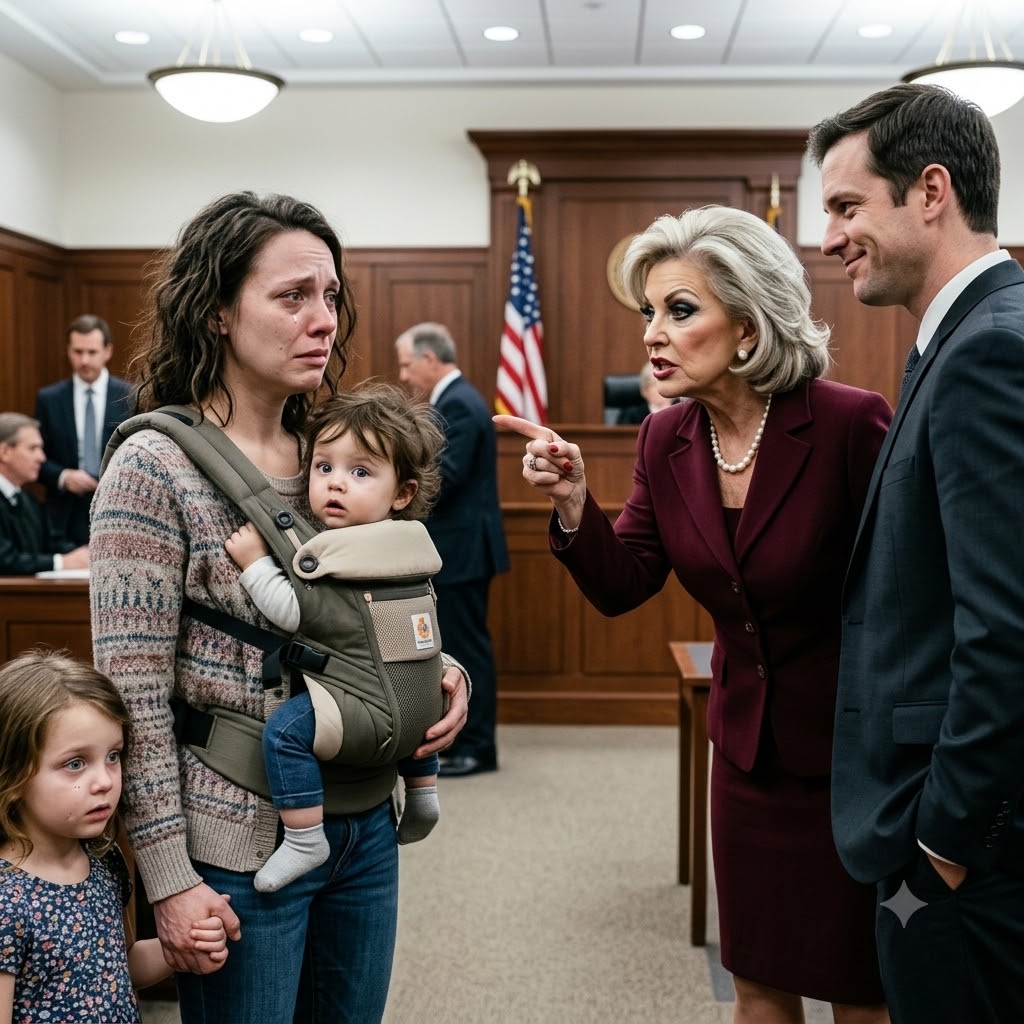
“Here you go, Marisol… your birthday present. A broom. Maybe now you’ll finally learn how to fly away and disappear from my house.”
Roberto laughed like he had just delivered the funniest joke of the night.
The sound exploded across his mother’s living room, sharp and cruel, while his friends, cousins, and neighbors from the gated community in Querétaro looked around with uncomfortable smiles. Some laughed because they thought they had to. Some laughed because silence would have made them guilty. But no one stood up for me.
I stood beside the cake table with my hands still damp from washing glasses in the kitchen, staring at the old broom my husband was holding out like a prize.
It was my birthday too.
But in Doña Raquel’s house, only her birthday mattered.
Roberto’s mother had turned sixty-five, and she had ordered the kind of party meant to remind everyone of her importance: mole, carnitas, norteño music, gold balloons, rented chairs, beer coolers, neighbors in pressed shirts, and a huge cake covered in frosting flowers. I had been awake since before sunrise cooking, sweeping, mopping the patio, arranging chairs, serving drinks, refilling plates, and carrying dirty dishes back to the kitchen.
Nobody hugged me.
Nobody said happy birthday.
Not even Roberto.
At one point, I heard a woman whisper near the hallway, “Is that Roberto’s wife? I thought she was the cleaning lady.”
My face burned, but I lowered my eyes and kept collecting glasses because crying would have pleased them too much.
That was what my marriage had become: a long lesson in swallowing humiliation before anyone noticed it choking me.
I had been married to Roberto for seven years. In the beginning, he was charming in that loud, confident way that makes people mistake arrogance for protection. He opened doors, sent flowers, called me “mi reina” in front of my friends. But little by little, the sweetness disappeared, and the jokes got sharper.
If I gained weight, he called it teasing.
If I cried, he called it drama.
If his mother insulted me, he said, “Don’t be sensitive. That’s just how she talks.”
And every time I forgave him, he learned he could go further.
Doña Raquel had never liked me. She said I was too simple for her son, too quiet for family gatherings, too slow in the kitchen, too plain in photos, too grateful for crumbs. In her house, I was not a daughter-in-law. I was free help with a wedding ring.
That afternoon, I had cooked for guests who did not look at me unless their plates were empty. I had carried ice. I had cleaned spilled salsa. I had watched Roberto drink with his friends while pretending not to see me limping from exhaustion.
Then, near the dessert table, I tripped over the leg of a chair someone had pushed into the walkway.
The tray slipped from my hands.
Glasses crashed across the tile. Agua de jamaica splashed over Doña Raquel’s shoes. For one second, the music seemed to lower by itself, as if the entire house had leaned in to watch me break.
“You useless woman!” Doña Raquel shouted. “You can’t even serve a drink properly.”
I dropped to my knees to gather the broken glass. One sharp piece cut my finger, and red spread across my skin. I pressed my lips together and kept cleaning.
Then Roberto walked toward me.
For one foolish second, I thought he might help.
Instead, he lifted the broom in front of everyone.
“Here’s your ride, my little witch,” he said. “You can fly away whenever you want.”
The laughter came back louder.
Something inside me went very still.
I took the broom from his hand.
Everyone thought I was going to lower my head and clean the floor like I always did. Maybe that was the saddest part. They knew exactly what they had trained me to do.
So first, I swept the broken glass in silence.
I swept slowly. Carefully. I watched the shards gather near my knees, shining under the party lights like tiny pieces of the woman I used to be.
Then I stood.
The room was still laughing.
Roberto wiped his eyes like his own cruelty had entertained him.
Doña Raquel sat near the center of the room, proud and untouched, wearing the gold necklace Roberto had bought with the money I helped save by skipping things I needed.
And then I looked at the cake.
The enormous cake with Doña Raquel’s name written in red frosting. The cake I had picked up from the bakery. The cake I had paid for because Roberto “forgot his wallet.” The cake everyone had gathered around while my own birthday passed like an inconvenience.
“Marisol,” Roberto said, still smiling. “What are you doing?”
I did not answer.
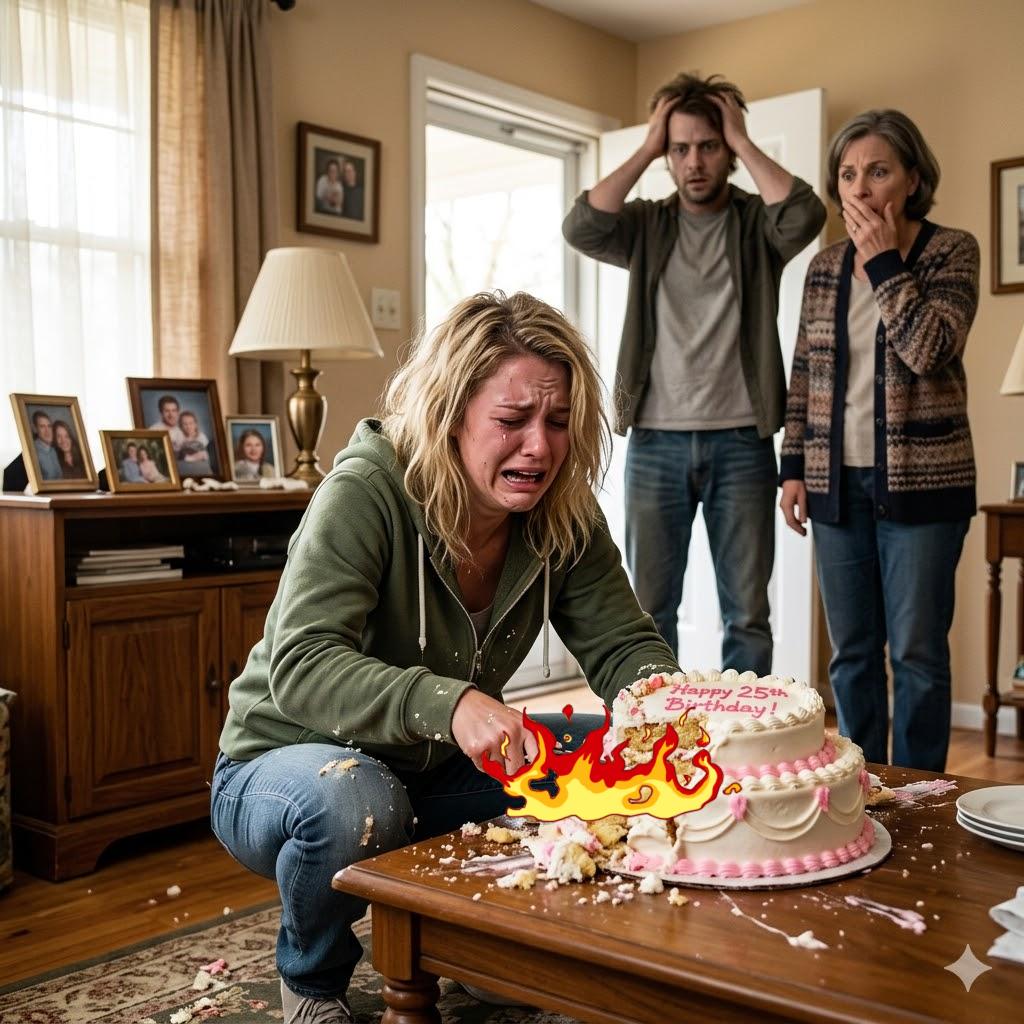
I lifted the broom like a baseball bat and brought it down with every ounce of pain I had swallowed for seven years.
The cake collapsed.
Frosting flew across Doña Raquel’s blouse, the freshly painted wall, the glass coffee table, and the face of one of Roberto’s closest friends. A frosting rose slid slowly down the family portrait above the sofa.
The entire room went silent.
“My cake!” Doña Raquel screamed.
Roberto’s smile disappeared.
For the first time all night, everyone looked at me like I existed.
Roberto stepped forward, his face dark with rage.
“You’re insane,” he snapped. “I’m going to teach you some respect.”
But I was already moving.
I dropped the broom, grabbed my purse from the chair near the door, and ran.
Behind me, people shouted my name. Roberto cursed. Doña Raquel cried about her ruined cake as if that cake had suffered more than I had. I ran down the stairs with my heart pounding so hard I could feel it in my throat.
At the corner, a city bus slowed near the curb.
I got on without asking where it was going.
I sat in the back, clutching my purse, shaking so hard the woman across from me kept glancing over. My dress was wrinkled. My finger was bleeding through a napkin. My cheeks were wet, but I did not make a sound.
The lights of Querétaro passed by the window, blurred and golden.
I had no plan.
I had very little money.
I did not even know which neighborhood the bus was crossing.
But for the first time in years, I was not inside that house.
That alone felt like air.
I took out my phone and called the only friend I still had.
“Lupita,” I whispered. “I left. I couldn’t do it anymore.”
Her voice changed immediately.
“Where are you?”
“I don’t know. Near a plaza, I think. I’m scared.”
“Stay where you are. Send me your location. I’m coming.”
I got off the bus under a tree near a closed pharmacy and waited with my arms wrapped around myself. When Lupita’s car pulled up, I ran to her like a lost child.
She did not ask what happened.
She just held me.
“You’re coming with me,” she said. “Tomorrow we figure out the rest.”
That night, I slept on her sofa under a blanket that smelled like children’s shampoo. My body hurt from the fall, from the running, from the years. Before I closed my eyes, my phone lit up again and again.
Fourteen missed calls from Roberto.
I did not answer.
Then, at 3:07 in the morning, a message arrived.
“You’re going to come back on your knees. And when you do, you’ll wish you had never embarrassed me.”
I stared at the screen until the words blurred.
I thought the worst thing Roberto could do was humiliate me in front of everyone.
I was wrong.
Because the next morning, Lupita would help me check something I had been too afraid to look at for years.
And what we found under Roberto’s name would explain why he was so sure I had nowhere to go.
Part 2 is in the comments… 
ACT I: THE FINANCIAL RECONSTRUCTION
The morning sun through Lupita’s kitchen window was bright, but it felt cold. A plate of untouched chilaquiles sat between us. My hands were still shaking slightly as I held a mug of black coffee, the napkin around my cut finger now replaced by a proper bandage.
Lupita sat across from me, her laptop open, her expression grimmer than I had ever seen it.
“Marisol,” she said softly, typing something into a secure banking portal. “You told me last year that Roberto asked for your signature on some documents to open a joint investment account for your future house. Do you remember that?”
I nodded slowly. “Yes. He said it was a high-yield savings plan. I gave him my tax ID, my identification, and signed the papers he brought home. Every month, forty percent of my earnings from my freelance graphic design work went directly into that account via automatic transfer. He told me he was matching it.”
Lupita didn’t say anything. She just turned the laptop screen around to face me.
On the screen was a public notary registry and a credit monitoring report that Lupita had helped me pull using my digital signature credentials.
My eyes blurred as I read the lines of text:
======================================================================
                 INMUEBLES Y DESARROLLOS QRO, S.A. DE C.V.
======================================================================
[LEGAL STATUS]: ACTIVE
[CHIEF FINANCIAL OFFICER / MAJORITY SHAREHOLDER]: ROBERTO GONZÁLEZ
[CO-SIGNER / FULL LIABILITY GUARANTOR]: MARISOL NIETO
======================================================================
Beneath the corporate registration was a mortgage details page for a luxury penthouse apartment in Jofrito, an upscale, developing district just north of Querétaro.
- Purchase Price: $4,800,000 MXN
- Primary Debtor: Roberto González
- Guarantor / Sole Liable Party: Marisol Nieto
- Account Balance for Joint Savings: $1,200 MXN
The joint savings account where all my hard-earned money had been transferred for three years was virtually empty. Roberto had been systematically draining it to pay the monthly mortgage on a luxury property that was registered solely under his name and his mother’s name as a beneficiary.
Worse, he had used my signature to make me the aval—the sole guarantor of the massive loan. If Roberto stopped paying, or if he decided to disappear, the bank would come after me for millions of pesos. He hadn’t just stolen my money; he had legally shackled me to his debts while ensuring I owned absolutely zero percent of the assets.
“He didn’t want a wife, Marisol,” Lupita said, her voice trembling with anger. “He wanted a financial shield. He kept you exhausted, cooking and cleaning for his mother, tearing down your self-esteem so you would never think to look at the paperwork. He told you that you had nowhere to go because he made sure that, on paper, you were completely ruined.”
I stared at the screen, and for the first time in seven years, the sadness evaporated. The heavy, suffocating weight of humiliation that had crushed me at Doña Raquel’s party turned into something else.
It turned into ice.
He thought I was a helpless witch with a broom. He thought I would come back on my knees because I was financially trapped. But Roberto had made one critical mistake: he forgot that before I married him, I was a top-tier freelance professional who understood how contracts worked once I actually opened my eyes to look at them.
“Lupita,” I said, setting my coffee mug down with a firm click. “Call your brother. He’s a corporate attorney, right?”
Lupita smiled, a fierce, protective glint in her eyes. “The best in the state.”
ACT II: THE AUDIT
Two days later, Roberto’s confidence began to fracture.
I hadn’t returned his calls. I hadn’t replied to his threatening text messages. According to a mutual friend, Doña Raquel had spent twenty-four hours scrubbing red frosting out of her living room carpet, screaming that she was going to have me arrested for property damage.
But they didn’t call the police. Because on Tuesday morning, Roberto received a formal legal notice at his corporate office.
It wasn’t a divorce petition. Not yet. It was a formal demand for an immediate forensic audit of Inmuebles y Desarrollos QRO, initiated by Lupita’s brother, Attorney Carlos Fuentes.
Because Roberto had used my signature as a primary guarantor, I had full legal rights to demand transparency regarding the funds flowing through the accounts tied to that debt. Furthermore, Carlos had discovered a fatal flaw in Roberto’s scheme: to avoid paying high corporate taxes, Roberto had routed several client payments through the joint savings account before transferring them to his personal property loan.
In the eyes of the Servicio de Administración Tributaria (SAT)—the Mexican tax authority—this wasn’t just a marital dispute. This was corporate tax evasion and fraud using a third party’s identity.
The Confrontation at the Café
Roberto sent a panicked, furious text message demanding to meet at a quiet café in the Centro Histórico.
When I walked in, he was already sitting at a corner table, tapping his foot anxiously. He looked tired. His shirt wasn’t as perfectly pressed as usual, and the smug, arrogant grin he wore at the party was completely gone.
As I sat down, he immediately leaned across the table, his voice a harsh, low whisper.
“What the hell is this, Marisol?” he hissed, slamming the legal notice onto the table. “An audit? Are you out of your mind? Do you know what this could do to my reputation? My mother is having palpitations because of the scandal you’re causing!”
“Good morning to you too, Roberto,” I said calmly, crossing my legs. I didn’t lower my eyes. I looked directly into his, and for the first time, he was the one who looked uncomfortable.
“Stop playing games,” he snapped. “You’re angry about the broom. Fine. It was a joke, Marisol. A joke! Everyone at the party knew it was just a bit of fun. You humiliated my mother, you ruined a three-thousand-peso cake, and now you’re trying to ruin my business? Get your things, come back to the house, apologize to my mother, and tell your lawyer to drop this garbage.”
I let out a soft laugh. It was the most liberating sound I had ever made.
“I’m not coming back, Roberto,” I said, my voice steady and clear. “And the audit isn’t a joke. You took my earnings for three years. You used my signature to guarantee a four-and-a-half-million-peso debt for a penthouse I don’t own. You thought I was too stupid to check, because you and your mother spent every single day telling me I was useless.”
Roberto’s face went pale, then flushed with rage. “You signed those papers voluntarily! You can’t prove anything. If you fight me on this, I’ll make sure you don’t get a single cent of alimony. You’ll be living on the street.”
“I don’t want your alimony,” I replied, leaning forward so he could hear every syllable. “But here is what is going to happen. You are going to sign a legal release removing my name entirely as a guarantor from that mortgage. You are going to transfer thirty percent of the corporate shares of your development company to my name to compensate for the stolen earnings, or I will hand over the full forensic audit trail to the SAT by Friday morning.”
Roberto stared at me, his jaw slack. He looked around the café as if hoping someone would step in and defend him, just like his cousins and neighbors had done at the party. But here, in the real world, there was no crowd to laugh at his cruelty. There was only his own fraud staring him in the face.
“You wouldn’t,” he whispered. “It would ruin both of us.”
“I have nothing left to lose, Roberto,” I said, standing up and picking up my purse. “You already took my savings, my dignity, and seven years of my life. I’m perfectly comfortable starting from zero. Are you?”
ACT III: THE CRUMBLES OF AN EMPIRE
By Thursday afternoon, the pressure became unbearable for the González family. Roberto’s primary business partner, terrified of an audit that would expose his own financial irregularities, threatened to pull out of their latest development project unless Roberto settled the matter with me immediately.
The final execution of the settlement took place at Carlos Fuentes’ office.
Roberto arrived accompanied by Doña Raquel. His mother looked withered, her usual gold jewelry missing, her face tight with an expression of pure venom. She refused to look at me, staring instead at the mahogany table.
“This is extortion,” Doña Raquel muttered, her voice shaking. “My son built everything he has. You were just a quiet little thing from a normal neighborhood. We gave you a roof over your head!”
“Ma’am,” Carlos Fuentes interrupted, sliding a thick stack of documents across the table. “If you speak out of turn again, I will add a civil defamation and psychological abuse claim to the criminal fraud filing. Please sign where the yellow flags are.”
Roberto grabbed the pen. His hand was shaking so badly he nearly tore the paper. With three swift, bitter strokes, he signed away his leverage.
- The Mortgage Release: My name was legally expunged from the $4.8 million mortgage, transferring one hundred percent of the financial liability to Roberto and his mother.
- The Restitution: A corporate transfer of assets totaling $1.2 million MXN—the exact amount stolen from my design earnings over three years—plus a ten percent penalty fee, paid out in a certified bank check.
As Carlos gathered the signed documents, Roberto looked up at me, his eyes hollow. The man who had handed me a broom to mock my existence was now completely powerless.
“Are you happy now?” he whispered, his voice cracking. “You took everything I worked for this year.”
I took the certified check from Carlos, placed it neatly inside my purse, and stood up. I looked at Doña Raquel, then at Roberto.
“I didn’t take anything that wasn’t mine,” I said softly. “And unlike your mother’s birthday, Roberto… this gift didn’t cost me my dignity.”
ACT IV: A HIGH-FLYING RETURN
One year later.
The evening air in downtown Querétaro was warm, carrying the scent of roasted coffee and jacaranda blossoms from the plaza below.
The glass doors of the Nieto Digital Design Studio were wide open, reflecting the soft, modern track lighting inside. The walls were decorated with vibrant, high-end branding portfolios, corporate logos, and architectural design layouts.
It was the grand opening of my independent agency.
Over fifty guests filled the room—local business owners, artists, and real friends who valued my work and my presence. Lupita stood near the catering table, raising a glass of champagne toward me with a triumphant grin.
My business had flourished within months of the separation. The restitution money allowed me to lease a beautiful creative space and hire two talented young designers. I was no longer the exhausted woman scrubbing salsa off someone else’s floor; I was a prominent business owner in the city.
As I chatted with a prospective client, my assistant stepped over, holding a large, beautifully wrapped box.
“Marisol, someone just left this at the reception desk,” she said, looking confused. “There’s no card, just a delivery note.”
A few friends gathered around as I placed the box on the central display table. I untied the silk ribbon and lifted the lid.
Inside the box, lying on a bed of black velvet, was a miniature, hand-carved decorative broom made of solid silver and polished obsidian. Attached to the handle was a small, elegant tag written in a familiar, elegant handwriting. It was from Carlos, my attorney.
The tag read:
To Marisol. You didn’t need their permission to leave the ground. Keep flying high.
The room erupted into genuine, warm laughter—not the cruel, mocking laughter of Doña Raquel’s living room, but the shared joy of people who had watched a woman rebuild her life from the ashes of humiliation.
The View from the Clouds
Later that night, after the last guest had left, I stood on the balcony of my studio, looking out over the twinkling lights of the city.
My phone vibrated in my pocket. It was a notification from a local business news portal. I scrolled down and saw a brief article about a real estate foreclosure in the Jofrito district. Inmuebles y Desarrollos QRO had defaulted on a major luxury penthouse loan after a high-profile audit scared away investors. The property was being seized by the bank, and Roberto González was facing a mandatory restructuring of his corporate assets to avoid a prison sentence for tax anomalies.
I closed the article, placed the phone on the railing, and took a deep, clean breath of the night air.
I thought about the night of the party—the broken glass, the red frosting, the burning shame of a woman kneeling on a tile floor while the man she loved treated her like a servant. I remembered the text message telling me I would come back on my knees.
I reached into my bag, pulled out my car keys, and locked the doors of my own studio. As I walked down the stone steps toward the plaza, my heels clicking confidently against the pavement, I realized Roberto had been right about one thing that night.
The broom really had helped me fly away. But I hadn’t disappeared.
I had finally landed exactly where I belonged.