A Cowboy Paid Twelve Dollars for a Pregnant Widow and Her Children
A Cowboy Paid Twelve Dollars for a Pregnant Widow and Her Children—Then the Secret Behind Her Husband’s Death Turned an Entire Western Town Against Them.
A Cowboy Stepped In at the Auction to Save a Pregnant Widow — What He Did Next Shocked the West
Twelve dollars.
That was what they paid for Martha Wheeler and her 3 children.
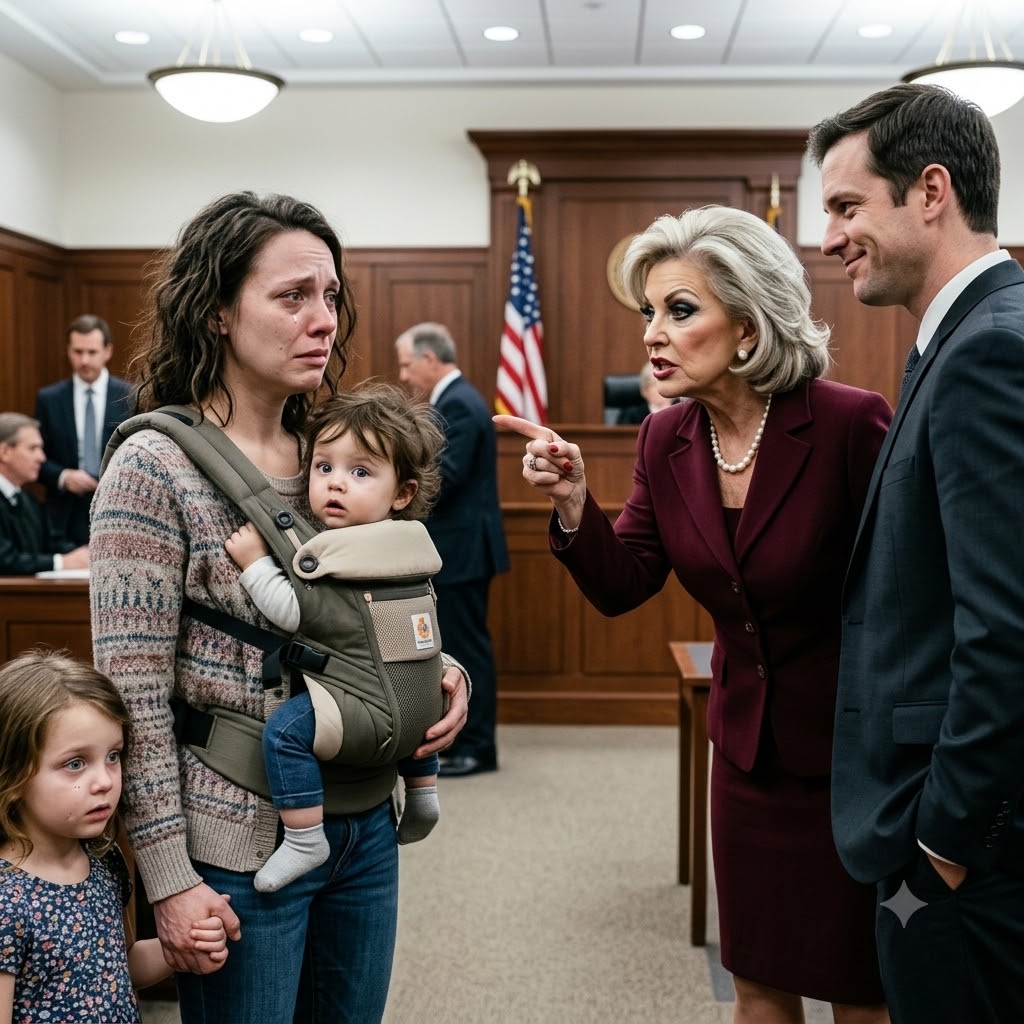
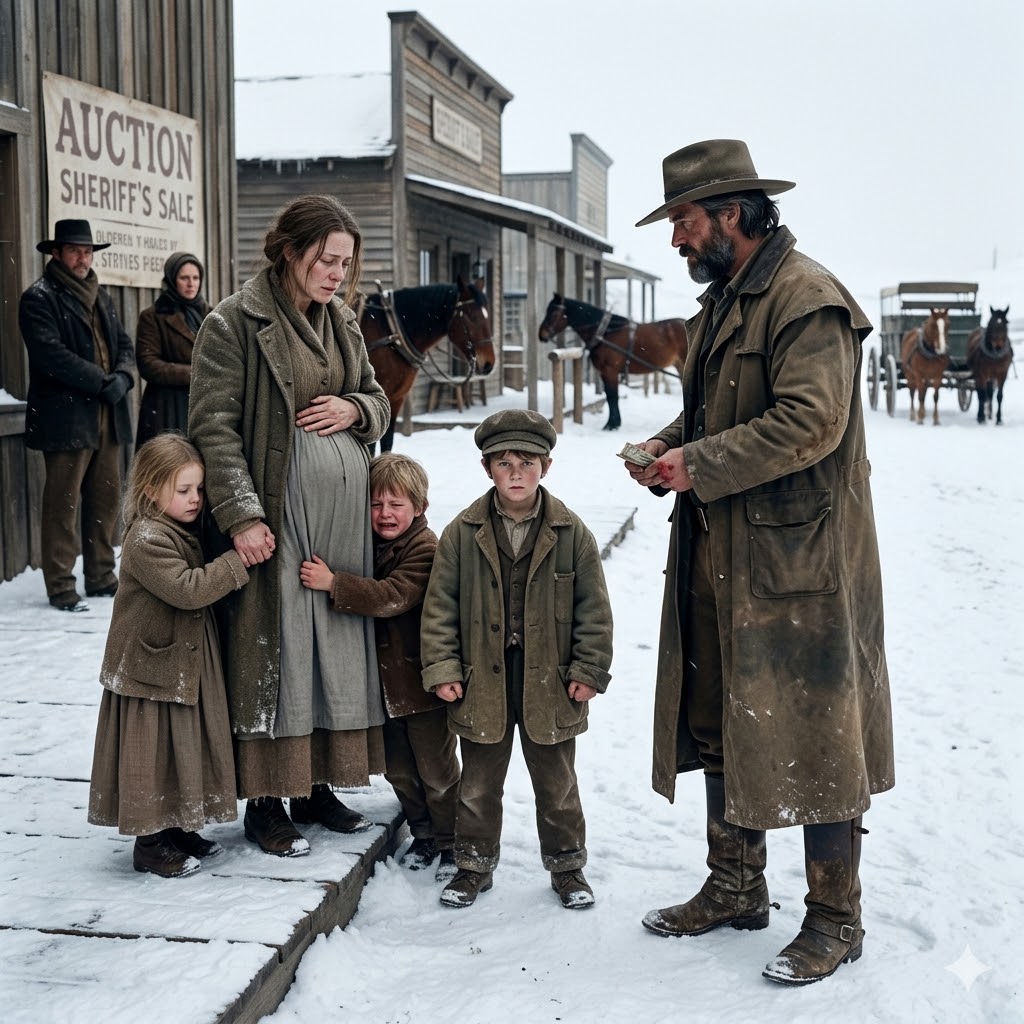
The auctioneer’s hammer cracked down like a gunshot, and the crowd began to break apart as if they had just finished bidding on worn tack or winter cattle, not a pregnant widow and the children clinging to her skirts. Snow moved through the street in thin, bitter sheets. Men turned their collars up and tucked their gloved hands beneath their arms. Women looked away. Nobody wanted to linger too long near the place where mercy had failed in public.
Martha felt the sound of that hammer in her bones.
Her 5-year-old daughter, Grace, had not spoken in 6 weeks. Her 7-year-old son, Tommy, was crying so hard he could barely pull breath into his lungs. Her oldest, 10-year-old Samuel, stood in front of her with his small fists raised, ready to fight grown men twice his size because he had already decided that if the world was going to take his family, it would have to step over him first.
And the stranger who had just bought them was walking toward them through the snow.
He was tall, broad-shouldered, with dark hair going gray at the temples and a beard that looked as if it had not seen a razor in weeks. Blood marked the knuckles of one hand. His coat was weathered, his boots mud-stained, his face hard from a life spent too often in the company of danger. But it was his eyes that stopped Martha cold.
They were empty.
Not cruel in the ordinary way. Not excited by power, not hungry with lust, not bright with triumph. Just flat and dead, the eyes of a man who had seen too much and decided long ago that the world could no longer surprise him.
Tommy pressed closer to her side.
“Mama,” he whispered. “I’m scared.”
“Hush, baby.”
“But Mama—”
“I said hush.”
The stranger finished counting out the bills. He handed them to the auctioneer without looking at him. Twelve dollars. Twelve dollars for 4 people and the unborn child Martha carried beneath her coat. Twelve dollars for hunger, grief, fear, and whatever remained of dignity after being forced onto a platform while strangers calculated the value of your labor and your womb.
Samuel stepped closer to her.
“I won’t let him take us,” he said, his voice shaking with fury. “I’ll fight him, Mama. I’ll kill him if I have to.”
Martha grabbed his arm hard enough that he winced.
“You’ll do no such thing. You’ll stay quiet, and you’ll stay alive. That is all that matters now. Do you hear me?”
Samuel’s jaw clenched, but he nodded.
The stranger stopped in front of them.
“You Martha Wheeler?”
His voice was low and rough.
“Yes.”
“These your children?”
“Yes.”
His gaze moved over Samuel, then Tommy, then Grace’s blank face pressed against Martha’s shoulder. At last, his eyes dropped to her swollen belly.
“That one too?”
Martha’s hand moved protectively over her stomach.
“Yes.”
The stranger nodded once.
“My wagon’s at the end of the street. We leave in 10 minutes. You got belongings?”
“Nothing.”
The word tasted like ash.
“They took everything.”
“Then we leave now.”
He turned and started walking.
Martha did not move.
The stranger stopped and looked back. Something flickered in those dead eyes. Not anger. Not impatience. Something more weary than either.
“You coming or not?”
“Where are you taking us?”
“My ranch. Twenty miles north.”
“Why?”
The question hung in the frozen air. Behind Martha, she could feel the remaining crowd watching, hungry for the last scraps of spectacle.
The stranger looked at her for a long moment.
“Because I got $12 worth of reasons to keep you alive,” he said. “And because where I’m taking you, nobody’s going to sell you again.”
Then he turned and kept walking.
Martha looked down at her children. Samuel’s fury. Tommy’s terror. Grace’s terrible silence. The child inside her shifted, a small, urgent pressure beneath her ribs, as if the baby too was asking what came next.
Martha did not know.
She only knew that there were worse things than following a stranger, and she had already met most of them.
So she followed him into the snow.
The wagon was old but solid, pulled by 2 horses stamping impatiently in the cold. The stranger helped Martha onto the bench seat with a grip that was firm but not rough, mindful of her belly. He lifted Tommy and Grace into the back, where blankets had been spread over hay. Samuel refused his help and climbed up on his own, glaring the whole time.
“Stubborn,” the stranger said.
It was not a question.
“He’s protective. He’s 10. He has been the man of our family for 4 months.”
Martha’s voice hardened without her meaning it to.
“Since his father died in a mine collapse and left us with nothing but debts and a brother-in-law who thinks he owns us…. See full in cmt 
The wooden wheels of the wagon groaned against the hard-packed snow, leaving deep, jagged ruts in the frozen road that led out of Oakhaven. The wind whistled through the pine trees, carrying the bitter cold deep into Martha’s bones. Beside her, the stranger kept his eyes firmly on the road ahead, his large, calloused hands loosely holding the reins. He hadn’t spoken since they crossed the town line, and his silence was as heavy as the winter sky.
In the back of the wagon, Tommy and Grace had stopped crying, lulled into a fragile sleep by the steady, rhythmic swaying of the carriage and the heavy wool blankets tucked tightly around them. Samuel, however, remained wide awake. He sat rigid on the wooden planks, his small jaw tightly set, staring fixedly at the back of the cowboy’s weathered coat as if he could bore a hole through it with his eyes.
“The name’s Silas,” the stranger said suddenly, his rough voice cutting through the whistling wind. He didn’t turn his head. “Silas Vance. I don’t expect you to trust me, Mrs. Wheeler. But I expect you to eat and stay warm. There’s a crate under the canvas behind you. Dried beef, hardtack, and an old canteen of sweet water. Give some to the little ones when they wake.”
Martha didn’t move at first, her protective hand still resting firmly on her protruding belly. “Why did you do it, Mr. Vance? Twelve dollars isn’t an investment. It’s an insult. And men in Oakhaven don’t throw away perfectly good money on a broken family out of Christian charity.”
Silas’s jaw tightened beneath his thick beard. He let out a long, slow breath that bloomed like thick smoke in the freezing air. “Charity’s got nothing to do with it. Your late husband, John Wheeler. He was a miner down at the Blackwood Ridge vein, wasn’t he?”
Martha went entirely stiff. The mention of John’s name always felt like a physical blow to her chest. “He was. He died there four months ago. The timber supports collapsed in the lower shaft. That’s what the company told us. That’s why they said we owed them for his funeral, for the company housing, for the tools he ruined when the mountain fell on him.”
Silas let out a dry, humorless chuckle that sounded like grinding stones. “John didn’t die because the timbers were weak, Mrs. Wheeler. He died because he found something he wasn’t supposed to see, and he wouldn’t keep his mouth shut about it.”
Martha turned her head sharply, staring at Silas’s hard profile. “What are you talking about?”
“We’re not safe talking here,” Silas muttered, cracking the reins to urge the horses faster through the gathering dusk. “The walls have ears in this territory, and the men who run the Oakhaven Mining Syndicate have very long arms. Just know this: John was a good man. He tried to do right by the folks in that valley, and it cost him everything. I owed him a debt. Twelve dollars was just the price of getting you away from his brother-in-law, Silas’s old partner. Now keep your head down and stay warm. We’ve got a long way to go.”
II. The Cabin at Blackwood Ridge
They reached Silas’s ranch long after darkness had completely swallowed the landscape. It wasn’t much of a ranch—just a sturdy, single-story cabin built of thick pine logs, a small barn, and a corral holding two extra horses. But inside, it was surprisingly warm. Silas had left a fire banked in the large stone hearth before heading into town, and within minutes of their arrival, he had stoked it into a roaring, crackling blaze.
For the first few days, a quiet, tense routine settled over the cabin. Silas proved to be a man of few words but deliberate, practical actions. He slept on a pile of buffalo hides by the front door, leaving the main bedroom to Martha and the children. Every morning, he cooked a simple but hearty breakfast of cornmeal mush and salt pork, leaving the food on the table before heading out to chop wood or tend to the livestock.
Slowly, the frozen terror that had gripped the children began to thaw. Tommy discovered a pair of carved wooden horses on a shelf and spent hours playing quietly by the hearth. Even little Grace, who hadn’t uttered a sound since the day her father’s body was brought up from the earth, began to follow Silas around with wide, curious eyes. One afternoon, as Silas was cleaning his rifle at the table, Grace walked up and silently handed him a smooth river stone she had found in the woodbox. Silas looked down at the stone, then at the little girl, and his dead eyes softened just a fraction. He tucked the stone into his vest pocket and gave her a small, solemn nod.
Samuel, however, remained a stubborn island of defiance. He refused to speak to Silas, refused to eat until his mother forced him to, and spent his days sitting by the window, watching the snow-covered perimeter like a tiny sentinel.
“He’s going to break himself trying to be a man before his time,” Silas remarked one evening, watching Samuel aggressively chop kindling outside through the window glass.
“He thinks he has to,” Martha said softly, her hands resting on her apron. “When John died, his brother, Edgar, came to our house. He told Samuel that since his father was a debtor and a coward, Samuel belonged to the mining company now. He said they’d put him to work sorting shale in the breakers the day he turned eleven.”
Silas’s face darkened, the scar across his cheek flushing crimson. “Edgar Wheeler is a snake who sells his own blood for a percentage of the company’s profits. He’s the one who authorized the auction, you know. He claimed you were a public charge and that he couldn’t afford to feed four extra mouths on his foreman’s wages.”
“I know,” Martha said, her voice dropping to a whisper. “But you mentioned a secret, Mr. Vance. You said John found something. What did he find in that mine?”
Silas stood up, walked to the heavy wooden door, and threw the iron bolt into place. He walked back to the hearth, reached up into the chimney, and pulled loose a blackened brick. From the hidden cavity, he extracted a thick, leather-bound ledger and a small canvas pouch. He walked over to the table and emptied the pouch.
Three chunks of heavy, dull-yellow rock tumbled onto the wood.
“Gold,” Martha breathed. “But the Oakhaven mine is a silver and lead operation.”
“That’s what they want the territory to think,” Silas explained, his voice low and dangerous. “The silver vein ran dry nearly a year ago. The owners, the Blackwood brothers, discovered a massive gold deposit deeper down, beneath the old shale shelf. But if the federal government or the independent prospectors found out, the land values would skyrocket, claims would be contested, and they’d have to pay astronomical taxes to the territory. So they kept mining it in secret, smuggling the gold out through freight wagons at night, while telling the miners that profits were low so they could cut wages and keep everyone in deep debt.”
He opened the ledger, pointing to columns of carefully recorded weights and dates. “John was a timber man. He was working a deep shaft when he broke through a false wall the company had built to hide the gold vein. He found the ledger where Edgar and the Blackwoods were tracking the stolen gold. John took the ledger, planning to deliver it to the federal marshal in Denver. But Edgar caught him.”
Martha felt the air leave her lungs, a cold sweat breaking out across her forehead. “Edgar killed his own brother?”
“He sabotaged the timber supports in John’s tunnel section,” Silas said flatly. “Caused a localized collapse to bury the evidence. I was working the night shift on the hoists. I heard them arguing before the crash. I managed to pull John out before the rocks completely covered him, but he was already fading. He gave me this ledger with his last breath and told me to hide his family. But before I could get back to town, Edgar had me arrested on a false charge of stealing company livestock. They kept me in a county cage for three months until the circuit judge finally threw the case out for lack of evidence.”
Silas looked down at his scarred knuckles. “The day I got out was the day they put you up on that auction block. I only had twelve dollars left to my name, Mrs. Wheeler. I figured it was the best twelve dollars I’d ever spend.”
Before Martha could respond, the sound of a horse whinnying sharply outside shattered the nighttime stillness.
III. The Siege
Through the window, Samuel yelled, “Mama! There are men coming up the trail! Lots of them!”
Silas was on his feet in an instant, his empty eyes suddenly blazing with a fierce, lethal focus. He threw the leather ledger into Martha’s arms. “Get the children into the root cellar under the floorboards. Now, Martha!”
Martha didn’t argue. She grabbed Tommy and Grace, lifting the heavy oak trapdoor built into the cabin’s kitchen floor. She hurried them down into the dark, cool earth below, but when she turned to grab Samuel, the boy refused to budge. He had picked up Silas’s old iron blacksmithing hammer, holding it with both hands, his knuckles white.
“Samuel, get down here!” Martha hissed.
“No, Mama. I’m staying with him,” Samuel said, his voice no longer shaking.
Silas looked down at the boy, then at the hammer in his hands. He didn’t waste time arguing. He unholstered a heavy Colt revolver from his belt and checked the cylinder. “Stay low, kid. Don’t look out the windows unless I tell you to.”
A loud, aggressive knock rattled the heavy front door, followed by a voice that Martha recognized instantly. It was Edgar Wheeler—her late husband’s brother.
“Silas Vance!” Edgar shouted from the porch, his voice muffled by the thick logs. “We know you’re in there! And we know you’ve got the widow and the brats. You bought ’em fair and square under town law, but you’re harboring stolen company property—that ledger John took! The Blackwood brothers don’t take kindly to thieves. Bring out the ledger and the woman, and maybe we’ll let you ride out of this territory alive!”
Silas walked up to the heavy door, his voice calm and steady. “The ledger belongs to the federal courts now, Edgar. And Martha and the kids don’t belong to anybody. You want them, you’re going to have to come through this door and take them.”
“Have it your way, jailbird!” Edgar roared.
A volley of gunfire erupted outside, the sharp cracks of Winchester rifles echoing off the surrounding hills. Bullets punched through the glass windows, showering the cabin floor with sharp shards. Silas instantly dropped to one knee, firing through a narrow gunport he had carved into the logs beside the door. A scream of agony echoed from the porch as one of Edgar’s hired men fell into the snow.
“Samuel! Keep your head down!” Silas yelled as a bullet splintered the wooden table just inches from the boy’s head.
The attackers were numerous—at least seven or eight men—and they began circling the cabin, firing systematically into the windows to keep Silas pinned down. The air inside the cabin grew thick and acrid with the smell of black powder smoke.
From the root cellar below, Martha could hear the terrifying chaos of the battle. She held Tommy and Grace close to her chest, praying silently as plaster and dust rained down on them from the floorboards above. The child inside her kicked violently, as if sharing the terror of the world outside.
Suddenly, a heavy thud shook the back of the cabin. Someone was trying to break through the rear shuttered window. Silas fired two shots toward the front door, then spun around to face the back, but his revolver clicked empty. He dropped the gun, reaching for his rifle, but he was a second too late. The heavy wooden shutter splintered inward, and a large, bearded mercenary lunged through the opening, a long hunting knife flashing in the firelight.
The man tackled Silas to the ground, the two men tumbling into the hearth ashes in a desperate, suffocating struggle. The mercenary managed to pin Silas’s arms, raising the knife high for a fatal plunge.
“No!” Samuel screamed.
With all the strength in his ten-year-old body, Samuel lunged forward, swinging the heavy blacksmithing hammer through the air. The iron head struck the mercenary squarely in the shoulder with a sickening crunch. The man roared in pain, dropping the knife as he rolled off Silas.
Silas didn’t hesitate. He grabbed the dropped knife and plunged it into the attacker’s chest. The man went completely limp.
Silas stood up, coughing through the thick smoke, and looked down at Samuel, who was breathing heavily, his chest heaving with adrenaline. Silas placed a heavy hand on the boy’s shoulder. “Good strike, son. Your father would have been proud.”
Before Samuel could reply, a sudden, eerie silence fell over the perimeter outside. The gunfire stopped completely.
“Vance!” Edgar’s voice called out again, but this time it was closer, right outside the shattered front window. “You’re a tough nut to crack. But we don’t need to shoot you out. Look out the window.”
Silas cautiously peered over the sill. In the yard, two men were holding blazing torches made of pine pitch and rags wrapped around long poles.
“This cabin is seasoned pine, Silas!” Edgar shouted, his face twisted into a malicious, desperate grin in the orange firelight. “It’ll burn like dry kindling in five minutes. You come out now with your hands up, or we burn the whole lot of you alive. I’ll give you sixty seconds to decide.”
IV. Justice in the Snow
Inside the smoke-filled room, Silas looked at Samuel, then down at the trapdoor where Martha and the younger children were hidden. His empty eyes were gone, replaced by a fierce, protective fire. He reached down, lifted the trapdoor, and helped Martha up into the room.
“They’re going to burn the house,” Silas said gently, his voice remarkably calm. “There’s a hidden escape tunnel John and I dug from the root cellar that leads into the old root house by the corral. It’s tight, but you and the kids can make it through. Samuel, you take the ledger. You lead your mother and siblings through that tunnel. Once you’re out, get to the horses in the barn and ride south toward the marshal’s office.”
“What about you?” Martha asked, tears cutting tracks through the soot on her pale cheeks.
Silas smiled—a real, genuine smile that transformed his rugged face. “I’m going to go out the front door and give them sixty seconds of hell. They won’t be looking at the barn.”
“No, Silas!” Samuel cried, using the cowboy’s name for the very first time. “We can fight them together!”
“You already did your fighting, son,” Silas said, kneeling down to look the boy in the eye. “Now your job is to keep your family safe. That’s what a real man does.”
Silas stood up, picked up his Winchester rifle, and loaded the final cartridges into the magazine. He looked at Martha one last time. “Go. Now.”
Martha grabbed Samuel’s hand, forcing him down into the cellar. They crawled into the narrow, earth-walled tunnel just as the sound of splintering wood echoed from above. Silas had thrown open the front door.
As they crawled through the darkness, the muffled sound of gunfire erupted once more—furious, rapid, and desperate. Silas Vance was making his final stand.
The tunnel emptied into the floor of the old, collapsed root house near the corral, just as Silas had promised. Martha pushed the wooden hatch open and helped the children out into the freezing night air. A massive orange glow illuminated the valley—the main cabin was completely engulfed in roaring flames, sparks flying high into the dark winter sky.
In the courtyard before the burning house, Silas was on his knee, his rifle empty, surrounded by three fallen attackers. Edgar Wheeler stood over him, a smoking pistol raised, his face twisted in triumph.
“You lost, Silas,” Edgar sneered, aiming the gun at Silas’s head.
“Am I?” Silas coughed, spitting blood into the snow. He looked past Edgar, toward the dark ridge line behind the corral.
Suddenly, a loud, thunderous shout echoed from the darkness.
“Drop your weapons! Federal Marshals! Stand down!”
Out of the snowy pine trees, a dozen mounted men tore into the courtyard, their rifles raised and ready. At the front of the line was the Territorial Marshal, his silver star gleaming in the firelight from the burning cabin. Behind them rode several older citizens from Oakhaven—men who had discovered Edgar’s treachery after Silas had secretly slipped a letter detailing the gold fraud to a trusted courier before the auction.
Edgar froze, his pistol trembling in his hand. He looked at the marshals, then back at Silas, realizing too late that his desperate attack on the ranch had provided all the proof the authorities needed. He dropped his gun into the snow and raised his hands in defeat.
V. A New Dawn
The spring sun shone bright and warm over the valley, melting the last remnants of the stubborn winter snow and revealing the fresh, green grass beneath. The ruins of the old cabin had been cleared away, and in its place, a sturdy new house was nearing completion, its fresh pine logs smelling sweet in the mountain air.
Martha sat on a wooden rocking chair on the newly finished porch, gently cradling her newborn daughter, a healthy, blue-eyed baby girl she had named Silana.
From the corral, the sound of joyous laughter echoed across the yard. Tommy and Grace were running through the tall grass, chasing a young hound pup Silas had brought home from his last trip to town. Grace was shouting and laughing loudly, her voice clear and bright, the terrible silence completely broken.
Near the barn, Samuel was working alongside Silas, helping him frame the door of the new stable. Samuel was taller now, his shoulders broader, moving with the confidence of a boy who knew he belonged. Silas paused in his work, wiping the sweat from his brow, and reached out to hand Samuel a heavy iron hammer. Samuel took it with a proud nod, and the two men went back to work in perfect, synchronous rhythm.
The twelve dollars Silas Vance had paid on that bitter winter day hadn’t just bought a family’s freedom from a corrupt town; it had bought them all a second chance at life, a home built on the unshakable foundation of justice, and a bond that no winter storm could ever break.