A DISTURBING MYSTERY: The professional-grade swimming skills of Lynette Hooker make her disappearance in the Bahamas even more chilling. Did she truly perish by accident, or did her husband watch her vanish on purpose? The world demands to know what happened in the dark waters
THE IMPOSSIBLE DROWNING: Why a Seasoned Sailor and Master Swimmer Vanished in Seconds While Her Husband Watched
ABACO, THE BAHAMAS – The Sea of Abaco is known for its clarity, its vibrant reefs, and its relatively predictable tides. For a woman like 55-year-old Lynette Hooker—a woman with over a decade of blue-water sailing experience and a reputation as a powerhouse swimmer—these waters should have been a playground, not a tomb. Yet, as the investigation into her disappearance enters its most critical phase, the maritime community and her own family are grappling with a haunting question: How does a professional-grade swimmer vanish in seconds, just arm’s length away from her husband and a stable boat?
The official narrative provided by 58-year-old Brian Hooker suggests a tragic “freak accident.” But as seasoned sailors and U.S. investigators dissect the details, the “accident” is beginning to look like a mathematical and physical impossibility.
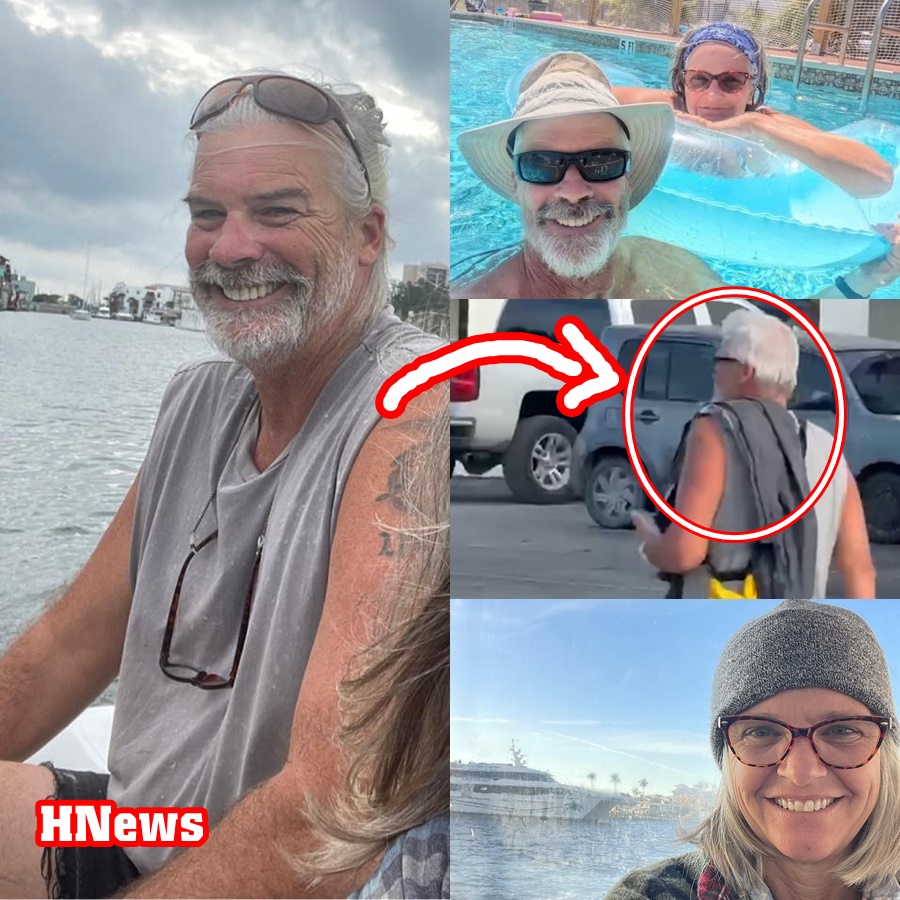
The Victim: A “Master of the Water”
To understand the skepticism surrounding this case, one must look at the credentials of Lynette Hooker. According to her daughter, Karli Aylesworth, Lynette was not a casual tourist. She was a veteran of the sea who had spent more than 10 years navigating complex coastal waters.
“My mother was an experienced swimmer,” Aylesworth told CBS News. “She knew the water better than most people know their own backyards.”
In maritime survival theory, a person with Lynette’s physical conditioning and experience possesses “water competency.” Even when thrown unexpectedly into the water, such individuals instinctively “self-rescue”—they tread water, control their breathing, and look for the nearest flotation point. Given that the dinghy was only 8 feet long, Lynette would have been, at most, three to five feet away from the hull the moment she hit the water. For a swimmer of her caliber, that distance is a single stroke.
The “Keys” to the Mystery
The most glaring inconsistency in Brian Hooker’s testimony involves the boat’s ignition keys. Brian claimed that when Lynette “bounced” out of the dinghy, she was holding the keys (the kill-switch lanyard). This, he says, caused the engine to die instantly, leaving him unable to maneuver the boat back to her.
This detail has ignited a firestorm of doubt among Caribbean sailors. “In 99% of boating operations, the operator wears the kill-switch lanyard,” says James Thorne, a retired Coast Guard officer based in Florida. “Why would a passenger, who isn’t driving, be holding the only mechanism that keeps the boat running? If she wasn’t driving, there is no logical reason for that lanyard to be in her hand. And if she was driving, why did Brian report that he was the one in control?”
Furthermore, the “drift” theory—that she was carried away by strong currents before he could reach her—defies the physics of the Abaco Sound at 7:30 p.m. that night. While there are “rip currents” in the cuts, a person floating in the water and an 8-foot dinghy would drift at roughly the same rate in the wind. Brian was not in a sinking ship; he was in a stable, buoyant vessel.
The Question of “Apathy”: Why No Rescue Attempt?
Perhaps the most “terrifying” question being asked by the public is: Why didn’t Brian jump in?
If a wife of decades falls into the water just a few feet away, the human instinct is an immediate “reach, throw, or go” response. Brian claims he threw a flotation device, but he has not explained why he didn’t immediately dive into the water to hold onto her, especially knowing the engine was dead.
“He was within arm’s reach,” Karli Aylesworth noted, questioning why her father remained in the boat for eight hours while her mother was allegedly drifting nearby. Witnesses who encountered Brian at 4:00 a.m. at the Marsh Harbour Boat Yard described a man who seemed more concerned with the “logistics” of his engine failure than the life of his wife.
The “Eight-Hour Gap” and the Silence of the Husband
Brian Hooker’s decision to paddle for eight hours toward land, rather than seeking help from the numerous yachts anchored nearby or using the emergency equipment on their primary vessel, the Soulmate, remains the central pivot of the investigation.
When approached by American media outlets, including CBS News, Brian has consistently declined to speak. This silence, while legally protected, stands in stark contrast to the desperate pleas of his daughter. It suggests a man who is not looking for a lost partner, but one who is waiting for the clock to run out.
Surfacing Past: Was the Reunion a Trap?
The investigation has taken a dark turn as details of the couple’s past emerge. It has been revealed that Brian and Lynette had previously divorced. Their “reconciliation” and subsequent trip to the Bahamas were seen by friends as a second chance at happiness.
However, Karli Aylesworth’s demand for a thorough investigation suggests that this second chance may have been a “calculated scheme.” “I don’t believe the sequence of events,” Karli said firmly. The “calculated” nature of the trip—taking an experienced sailor to a remote area, engaging in a nighttime transit in “rough” water without life jackets, and the convenient loss of the ignition keys—has led many to believe that Lynette was lured into a situation where her swimming skills would be neutralized by the darkness and a lack of support.
The Search for Truth in the Abyss
As the Royal Bahamas Police Force continues to treat this as a “Missing Persons” case, the pressure for a criminal homicide investigation is mounting from the U.S. side. Forensic experts are calling for a “re-enactment” of the fall to see if it is physically possible for a woman of Lynette’s size to be swept away so quickly that a man standing three feet away could not grab her.
The ocean may be vast, but it leaves clues. If Lynette was a master swimmer, her absence suggests she was either incapacitated before she hit the water or prevented from re-entering the boat.
For Karli Aylesworth, the mission is no longer about finding her mother alive; it is about finding the truth behind her father’s “ice-cold” demeanor and the impossible story of a life lost in a “freak accident” that defies every law of the sea.