The Final Moments of Madness: Surveillance Video Exposes the Chilling Footage of Ryan McFarland Screaming in the Street Before the Iowa Massacre Leaving 6 Dead
MUSCATINE, IOWA – A week has passed since June 1, 2026, the day the most horrific family tragedy in the modern history of Muscatine, Iowa, unfolded. The family massacre orchestrated by 52-year-old Ryan Willis McFarland claimed the lives of his devoted wife, Lesa McFarland (51), and five of their biological children: Ryle (20), Dakota Whitlow (32), Austin Harris (29), Mark (16), and Ryan Jr. (13).
As state authorities and investigators from the Iowa Division of Criminal Investigation (DCI) work tirelessly to piece together the shattered remnants of the motive behind this ruthless act, a deeply unsettling piece of evidence has officially come to light. A security camera (CCTV) from a residence directly across from the home at 210 Park Avenue captured the final moments of Ryan McFarland’s psychological collapse right in the middle of the street—just minutes before he stepped inside, drew his weapon, and slaughtered his family.
For the neighbors who witnessed the scene firsthand or later watched the footage, it remains a terrifying experience—a haunting documentary of a complete human breakdown just before zero hour, punctuated by his cold, final declaration about life, death, and financial desperation.
1. 20 Minutes Before the Tragedy: A Frantic Monologue on Park Avenue
According to the timestamps on the extracted surveillance footage, the video begins at 11:55 AM on Monday, June 1, 2026. The weather in Muscatine was sultry, and Park Avenue was relatively quiet.
In the frame, Ryan McFarland’s pickup truck pulls hastily to the curb and brakes hard. He steps out of the vehicle in a highly agitated state. Instead of walking straight to the front door, he paces frantically back and forth along the sidewalk and the street. The camera documents a middle-aged man with salt-and-pepper hair, his body visibly trembling, gripping his head tightly before flailing his arms into the air in desperation.
Equipped with a wide-range digital audio microphone, the system captured McFarland’s manic shouting with chilling clarity. He repeatedly roared toward the house, where his wife and younger children were inside. His voice in the recording possesses none of the rationality of a stable mind; it is a sequence of agonizing shrieks mixed with heavy, resentful breathing. He can be heard screaming about his financial ruin, past legal battles (specifically his 2016 felony fraud conviction carrying a restitution order of over $58,000), and a total sense of feeling utterly trapped.
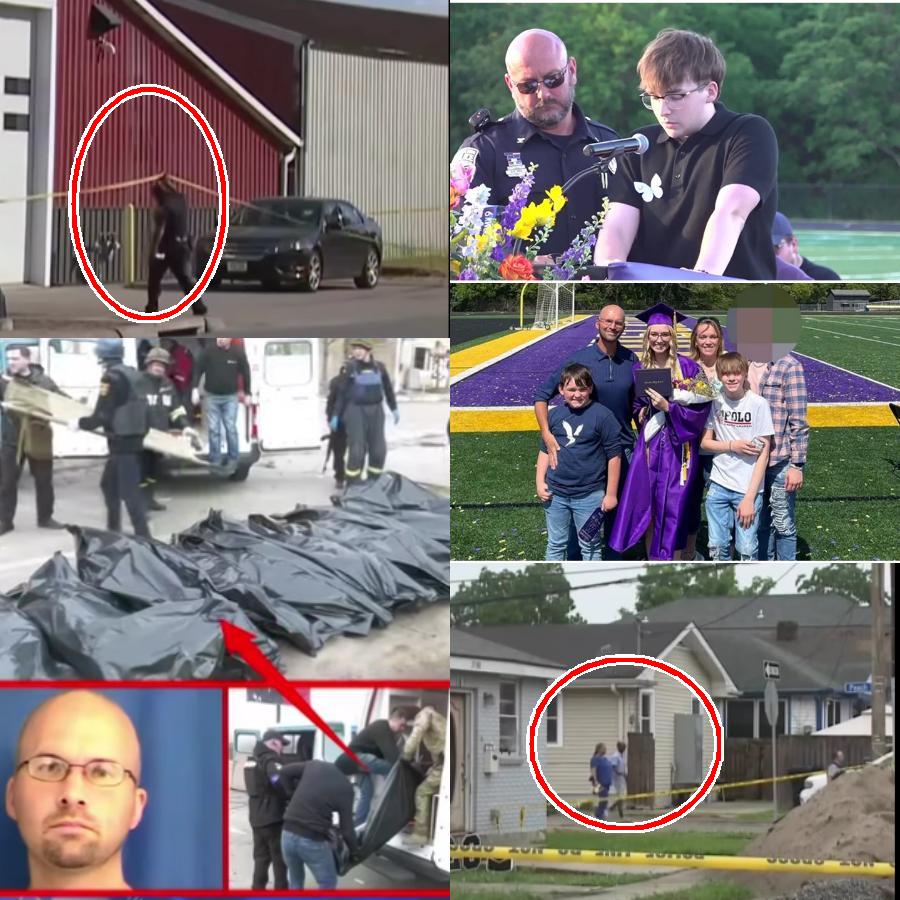
His madness reached its absolute peak when he stood directly in the center of the intersection, looked up at the sky, and screamed a final, haunting philosophy about money before turning toward the house:
“Don’t worry about money. Everything goes away when you die!”
2. Witness Accounts: “A Daylight Nightmare” for Local Neighbors
The CCTV footage captures not only the actions of the killer, but also the stunned, terrified reactions of those nearby. The sheer volume of McFarland’s shouting shattered the quiet midday air, prompting several residents to peek out of their doors and windows in fear.
Melissa Weggen, who lived directly next door to 210 Park Avenue, was one of the first witnesses to confront the unfolding nightmare. Emerging in a tearful interview with a local news station, Weggen recalled the moment with a visible shiver:
“I was preparing lunch in the kitchen when I heard a massive commotion out in the street. At first, I thought it was just a typical road rage incident. But when I looked out the window, I saw Ryan standing there. His face was bright red, his eyes wide and fierce. He was violently kicking the tires of his own truck and pacing the pavement. His final shout—’Don’t worry about money. Everything goes away when you die!’—echoed through the entire neighborhood. It wasn’t just an angry scream; it was a cold, chilling declaration. I have never seen anyone with eyes that terrifying—they were completely hollow, yet filled with deadly intent.”
Weggen added that the most haunting part of the footage was catching a glimpse of the late Lesa McFarland opening the front door to step onto the porch, hoping to quiet her husband after hearing his yells. In the video, Lesa’s slender frame can be seen making gentle gestures, urging her husband to come inside to avoid disturbing the neighborhood. However, her immense patience was met only with a threatening, pointed finger and Ryan’s unhinged hostility.
Another witness, living three doors down, stated that he drew his blinds immediately because he felt something was deeply wrong with McFarland’s mental state: “He looked like a ticking time bomb whose fuse had just run out. The sheer malice radiating from him made anyone who saw him instantly pull back, realizing something awful was about to happen.”
3. Crossing the Threshold: The Gunman Draws His Weapon
At exactly 12:12 PM, the narrative in the surveillance video takes a darker turn. Following his ominous cry regarding death and money, and after nearly 20 minutes of erratic behavior on the street, Ryan McFarland abruptly stops. He stands perfectly still, staring fixedly at his home for roughly 30 seconds. This terrifying silence, according to criminal psychologists, represents the exact moment he made his final choice—the decision to “erase” his entire family due to his own selfish despair.
The security camera records McFarland walking around to the bed of his pickup truck, opening a plastic storage bin, and pulling out a handgun. Concealing the firearm behind his back, he walks with deliberate, cold strides past the threshold and enters the house.
Barely three minutes later, at 12:15 PM, the first sharp echoes of gunfire ring out from inside 210 Park Avenue. That was the exact moment a panicked Melissa Weggen dialed 911 to report the shooting. But it was already too late. Inside that home, Ryan McFarland had coldbloodedly opened fire, taking the lives of his wife and three younger children who stood no chance of defending themselves.
4. A Heavy Shadow Settles Over Park Avenue
For the residents of Muscatine, this surveillance video is far more than a piece of forensic evidence; it is a profound psychological scar weighing on their daily lives. Several neighbors shared that they have been unable to sleep since the tragedy occurred. Every time they close their eyes, McFarland’s frantic words about everything disappearing in death echo in their minds.
“We feel a terrible sense of guilt,” one neighbor shared anonymously through tears. “If we had only realized the gravity of what he was screaming, if we had called the police ten minutes earlier, would Lesa and those sweet kids still be alive today? The image of him walking into that house with the gun loops in my head like a horror film.”
The Park Avenue neighborhood was always known as a peaceful area—a place where children regularly rode their bikes and where the McFarland family was often seen walking their pugs in the evening. Now, it is blanketed by a suffocating silence. Residents have placed fresh bouquets, small teddy bears, and candles along the sidewalk where McFarland once stood, attempting to bring peace to the block and honor the innocent souls that were lost.
5. Expert Analysis: The Distorted Logic of a “Family Annihilator”
The released video has become a vital piece of study for criminal psychologists reviewing the case. His behavior in the street just prior to the killings mirrors the classic psychological framework of a “family annihilator” pushed into a corner by financial ruin.
Experts analyze that his final statement—“Don’t worry about money. Everything goes away when you die!”—proves that McFarland had constructed a deeply warped rationale to justify his impending crimes. To his distorted mind, death was no longer a brutal end, but rather a “solution” to erase all debt, pressure, and personal failure. He viewed the act of killing his loved ones as a twisted form of release, taking the entire family with him to the other side to escape the judgment of law and society.
Furthermore, his subsequent cold actions—driving to two separate locations on Mill Street and Grandview Avenue to track down and kill his two older sons (Dakota and Austin)—demonstrate that his street-side outburst was not a fleeting moment of impulse, but rather the opening salvo of a systematic, pre-planned execution driven by absolute selfishness and a destructive ego.
6. Conclusion
The neighborhood surveillance video capturing Ryan McFarland screaming on the streets of Muscatine will forever stand as one of the most heartbreaking and chilling pieces of documentation from the 2026 Iowa family massacre. It exposes the agonizingly thin line between an ordinary life and an unspeakable tragedy born from the hidden pressures of life.
While Ryan McFarland ultimately turned the gun on himself along the Riverfront Trail to evade justice, the legacy he left on Park Avenue that Monday afternoon—his maniacal screams regarding death and his cold-blooded weapon—will haunt the community for generations to come. Beneath the smoke of the investigation, the portrait of a family that once laughed together now remains a painful memory etched deeply into the heart of the sole survivor, Jonathan McFarland, and the entire city of Muscatine.